
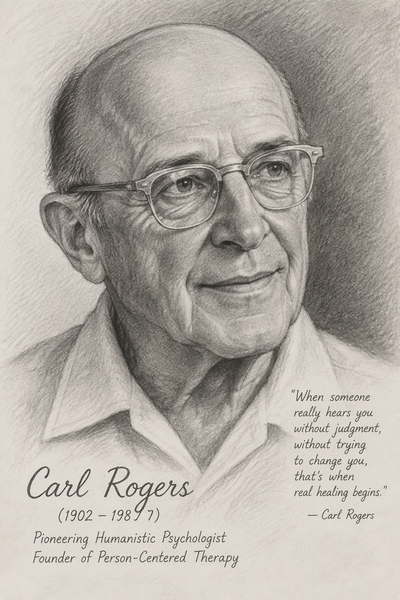


If I could switch lives with one famous person for a week, I would choose Carl Rogers, the pioneering humanistic psychologist and founder of person-centered therapy. Not because I want to see his fame, but because I want to understand how his personal struggles, relationships, doubts, and self-reflection shaped one of psychology’s most hopeful views of human nature. Rogers believed that people grow when they experience empathy, authenticity, and unconditional positive regard.
According to Psychology’s Grand Theorists: How Personal Experiences Shaped Professional Ideas by Amy P. Demorest, the major theories of psychologists such as Rogers were deeply influenced by their personal life experiences. The book argues that understanding the person behind the theory helps us understand the theory itself. (One of my favorite book)
For one week, I would want to step into Rogers’ life and witness the moments that transformed him from a young man raised in a strict religious environment into a psychologist who placed profound trust in human potential. I would be curious to observe how his encounters with clients challenged his assumptions and gradually convinced him that people possess an innate tendency toward growth and self-actualization when provided with the right conditions.
More than attending his lectures or reading his books, I would want to experience his inner journey. How did he learn to listen so deeply? How did his own experiences of acceptance, conflict, and self-discovery lead him to value empathy above expertise? Understanding those personal transformations might reveal that great psychological theories are not merely intellectual achievements; they are often the distilled wisdom of a life carefully examined.
A week in Rogers’ shoes would not just teach me about psychology. It would teach me how a person’s wounds, questions, and experiences can become the source of ideas that help millions of others heal. That, to me, would be an unforgettable journey.