
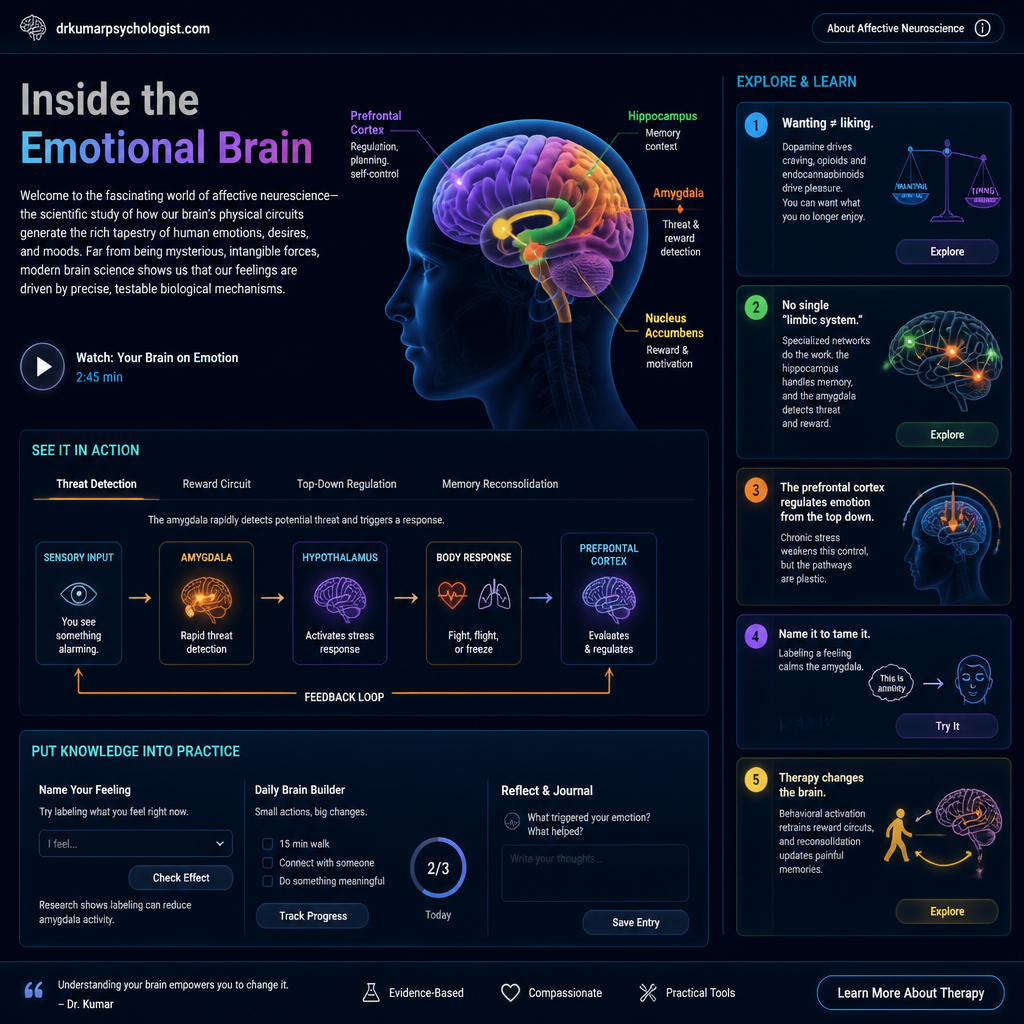
Affective Neuroscience: How Your Brain Creates Emotions and Shapes Your Everyday Life
Understanding the science of emotions, relationships, mental health, and psychological change.
Have you ever wondered why a simple conversation with a supportive friend can make you feel better, while a small disagreement can disturb your entire day?
Why do some people struggle to enjoy things they once loved? Why do certain memories continue to trigger fear even years after an unpleasant experience? And how can talking to a therapist gradually change the way we think, feel, and behave?
The answers lie partly in a fascinating field of science called affective neuroscience.
Affective neuroscience explores how the brain creates, experiences, and regulates emotions. It helps us understand the relationship between our brain, feelings, thoughts, behaviour, and relationships.
More importantly, it shows us that emotions are not simply feelings to control or suppress. They are essential parts of how we understand the world, make decisions, connect with others, and respond to challenges.
Let’s explore how this science connects with everyday life.
1. Your Brain Has an Emotional Team
We often talk about the brain as if it has separate departments for thinking and feeling. In reality, these systems work together.
Several brain regions play important roles in emotional experiences:
- Amygdala: Helps detect emotionally important information, particularly potential threats.
- Prefrontal cortex: Supports planning, decision-making, impulse control, and emotional regulation.
- Hippocampus: Helps connect memories with their emotional and situational context.
- Nucleus accumbens: Plays an important role in motivation, reward, and learning.
- Anterior cingulate cortex: Contributes to attention, emotional processing, and monitoring conflicts.
Think of these regions as members of an orchestra. No single instrument creates the entire performance. Similarly, no single brain region produces the full experience of an emotion.
Our emotions emerge from the interaction of several interconnected brain networks.
The Brain’s Emotional Orchestra
Amygdala
Helps detect emotionally important information, particularly potential threats. It acts like an early-warning radar, alerting the rest of the brain when something requires immediate attention.
Orchestra connection: Communicates rapidly with the hippocampus (memory context) and prefrontal cortex (evaluation & regulation).
Scenario: Someone criticises you during a meeting
Stage 1 — Social Threat Detected: Your amygdala and anterior cingulate cortex register the comment as a sudden social threat. Your heart rate rises, and you feel an immediate surge of embarrassment or anger.
2. Why We Sometimes Want Something but Don’t Enjoy It
Have you ever continued scrolling through social media even when you weren’t enjoying it? Or repeatedly checked your phone, hoping for a notification?
This illustrates an interesting distinction in neuroscience: wanting and liking are not the same thing.
Wanting (Motivation & Pursuit)
The motivation or desire to pursue something. Dopamine plays an important role in this process.
Liking (Actual Pleasure)
The actual pleasure experienced when something enjoyable happens. Opioid-related systems contribute to this experience.
For example, you may strongly want to check your phone because you anticipate an interesting message. But when you finally check it, you may feel little satisfaction.
The anticipation was stronger than the actual pleasure. This distinction helps explain why certain behaviours become repetitive even when they no longer provide much enjoyment.
Wanting (Dopamine) vs. Liking (Opioid) Simulator
The Anticipation Trap: Each swipe triggers a burst of dopamine-driven anticipation (“maybe the next post will be great”), keeping you hooked even though actual enjoyment remains low.
“Am I genuinely enjoying this, or am I simply chasing the expectation of enjoyment?”
3. How Other People Influence Our Emotional State
Human beings are social creatures. Our emotional experiences are strongly influenced by the people around us.
Think about the difference between speaking to someone who listens patiently and someone who constantly interrupts or dismisses you. The words may be similar, but the emotional experience is completely different.
Why? Our brains continuously interpret social signals, including:
A warm voice, an attentive expression, and a non-threatening posture can communicate safety. These signals help reduce perceived social threat and make it easier to relax, communicate, and express vulnerable feelings.
This is particularly important in counselling and psychotherapy. A therapist who listens without judgment, maintains appropriate eye contact, and communicates genuine acceptance is doing more than being polite. These behaviours help create the psychological safety needed for meaningful conversations and emotional exploration.
How Social Cues Shape Perceived Safety
Practical Application: 5 Ways to Help Someone Feel Comfortable
Tap items you want to practise in your next conversation:
Sometimes, the way we communicate matters as much as what we communicate.
4. Why Depression Can Make Even Simple Activities Difficult
One of the important contributions of affective neuroscience is helping us understand depression beyond sadness.
Depression can affect the brain’s reward and motivation systems. A person may lose interest in activities they previously enjoyed. This experience is called anhedonia.
For example, someone who previously enjoyed meeting friends, exercising, or listening to music may gradually lose interest in these activities. This is not necessarily laziness or a lack of willpower. Changes in reward processing and motivation can make ordinary activities feel unusually difficult.
How behavioural activation can help
Behavioural Activation is a psychological approach that encourages people to gradually re-engage in meaningful activities. Instead of waiting until motivation returns, individuals begin with manageable actions.
Action Before Motivation: Rebuilding Reward Pathways
Select manageable actions below to see how small steps gradually challenge negative brain expectations and rebuild reward sensitivity:
Why can this help? Positive experiences can challenge the brain’s negative expectations. Gradually, activities may become more rewarding, helping rebuild motivation and engagement.
5. Emotional Regulation: Learning to Pause Before Reacting
Have you ever said something in anger and regretted it later?
This happens because intense emotions can temporarily make reflective thinking more difficult. When emotional arousal becomes overwhelming, it can interfere with our ability to evaluate situations, consider consequences, and make thoughtful decisions.
This is why emotional regulation is such an important psychological skill. One useful approach is mindfulness. Mindfulness means paying attention to present experiences without immediately judging or reacting to them.
Scenario: Receiving an Upsetting Message
1. Notice: Recognise the emotion arising within you
You read the upsetting message and feel a sudden jolt of frustration or hurt. Simply name it silently: “Anger is here” or “I feel stung right now.” Naming an emotion engages prefrontal circuits.
Slowly
Mindfulness-based skills are incorporated into approaches such as Dialectical Behaviour Therapy (DBT). The objective is not to eliminate emotions. It is to develop the ability to experience them without allowing them to control every action.
6. Why Painful Memories Can Continue to Affect Us
Some experiences remain emotionally powerful long after the original event has passed. A particular smell, sound, place, or conversation may unexpectedly bring back feelings associated with a painful memory.
This happens partly because emotional memories involve interconnected brain systems, including the amygdala and hippocampus.
An important concept in memory research is memory reconsolidation. When we retrieve an established memory, it can sometimes become temporarily open to modification before being stored again. This suggests that memories are not always fixed recordings of the past. New experiences and information can influence how we remember and emotionally respond to previous events.
How Memory Reconsolidation & Psychotherapy Update Expectations
1. Old Memory + Protective Expectation: Consider someone who experienced betrayal in an earlier relationship. The hippocampus and amygdala link relational closeness with danger, creating the expectation that “people cannot be trusted.”
7. Understanding Mental Health Through Brain Mechanisms
Affective neuroscience also helps us understand why different psychological difficulties can produce different patterns of thinking and behaviour.
Depression
Reduced reward responsiveness can contribute to loss of pleasure, reduced motivation, and difficulty engaging in everyday activities.
8. Can We Directly Influence Brain Activity?
Modern neuroscience has opened new possibilities for mental health treatment. One example is Transcranial Magnetic Stimulation (TMS).
TMS uses magnetic pulses to influence activity in specific brain regions. Certain protocols target the prefrontal cortex, particularly in the treatment of depression. The prefrontal cortex is involved in several important functions, including emotional regulation, attention, and decision-making.
TMS demonstrates how understanding brain networks can help develop treatments that directly influence their activity. However, neuroscience is not replacing psychotherapy. Psychological interventions, medication, brain stimulation, and social support can all have important roles depending on an individual’s needs.
9. Why Mental Health and Physical Health Are Connected
Mental health does not exist separately from physical health. Depression, chronic stress, and emotional difficulties can influence how people eat, sleep, exercise, and manage medical conditions.
Consider someone living with depression and diabetes
They may understand the importance of exercise and healthy eating but struggle to follow these routines. Why?
- Low motivation can make exercise difficult.
- Fatigue can reduce everyday activity.
- Poor concentration can interfere with planning.
- Reduced interest can make healthy activities feel unrewarding.
- Stress can encourage short-term comfort-seeking behaviours.
This is not simply a problem of willpower. Mental health difficulties can affect the psychological processes needed to maintain healthy behaviours. Therefore, managing physical illness also requires attention to emotional well-being, motivation, and psychological support.
10. The Most Important Lesson: The Brain Is Not the Whole Story
Neuroscience gives us remarkable insights into human emotions, but we should avoid one common mistake: explaining every human experience through a single brain chemical or brain region.
To understand a person’s emotional life, we need to consider several interconnected dimensions:
Four Interconnected Dimensions of Emotional Life
Biological Dimension
Includes: Brain activity, genetics, hormones, and nervous system functioning.
How it connects: Sleep, stress hormones, and neural circuits shape our baseline energy and emotional reactivity—yet they are continuously shaped in return by our thoughts, habits, and relationships.
These dimensions continuously influence one another. A person’s emotional difficulties cannot always be understood by examining their brain alone. We must also understand their experiences, relationships, personal meanings, and life circumstances. This integrated perspective is essential for psychology and mental health practice.
Putting the Science into Everyday Practice
Understanding the brain becomes meaningful when we translate scientific knowledge into everyday actions. Here are five simple practices inspired by affective neuroscience:
5 Daily Brain-Wise Habits
Final Thoughts: Understanding the Brain Helps Us Understand Being Human
Affective neuroscience reminds us that emotions are not obstacles to rational thinking. They are essential partners in human decision-making, relationships, learning, and survival.
Sometimes emotions overwhelm us and interfere with clear thinking. At other times, our feelings and deeply held values help us make meaningful and rational decisions. The ability to understand, regulate, and respond to emotions is therefore central to psychological well-being.
“We are not permanently defined by our emotional reactions, painful memories, or past experiences. Through learning, supportive relationships, meaningful actions, and appropriate psychological interventions, we can develop new ways of thinking, feeling, and responding.”
Understanding the brain is not just about understanding neurons and neurotransmitters. It is ultimately about understanding ourselves and becoming more compassionate towards others.
Social Signals Received: Steady eye contact, unhurried tone, open posture, and patient silence. Your brain’s threat radar quiets down, making it safe to reflect and speak openly.