
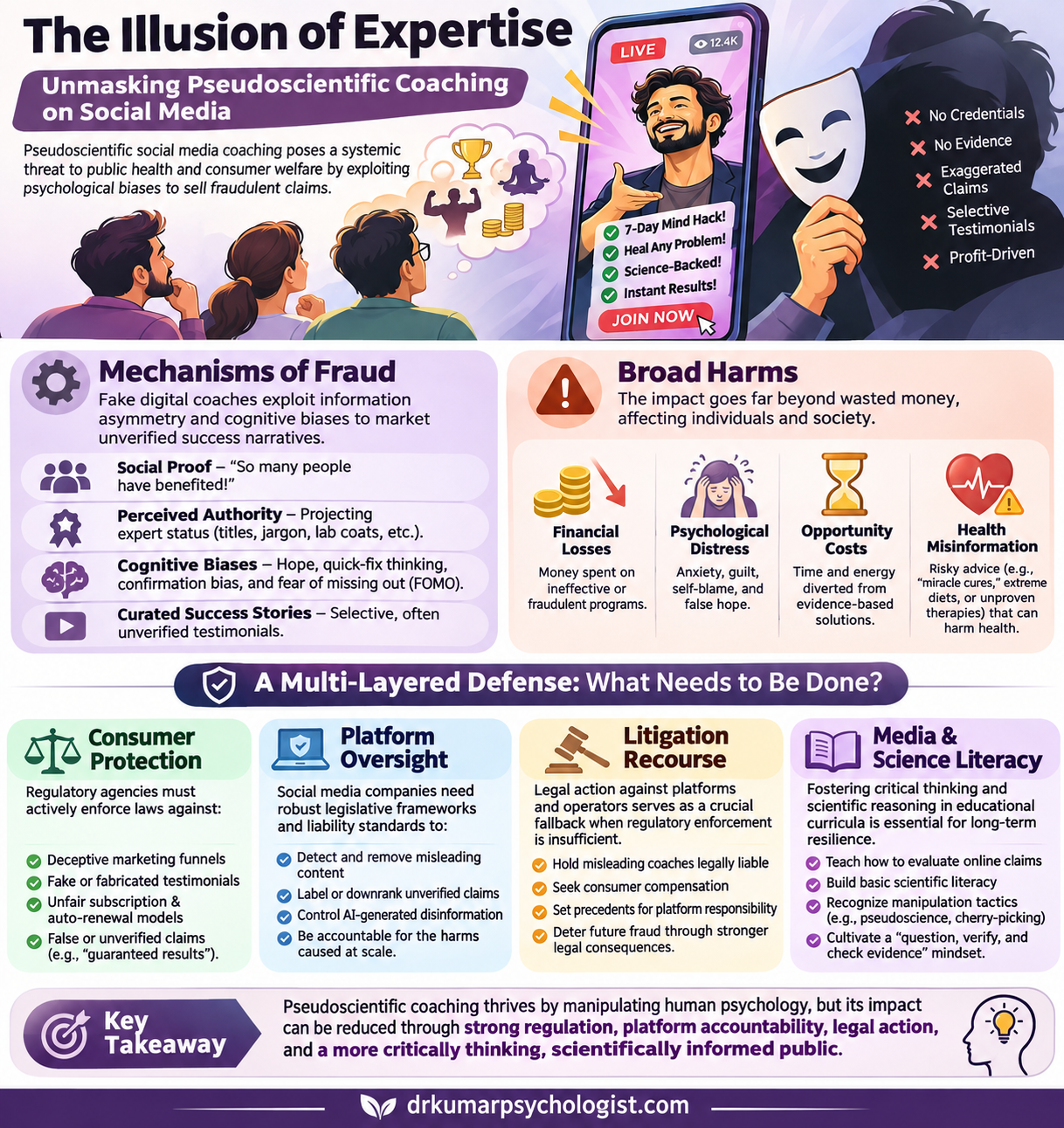
How fake gurus exploit cognitive biases—and what regulators, platforms, and consumers must do to stop them.
Scroll through almost any social media feed today, and you’ll encounter them: charismatic “coaches” promising overnight financial freedom, miraculous health transformations, or instant emotional mastery. Wrapped in sleek visual aesthetics and high-production videos, these operations often present a veneer of authority.
Underneath the surface, however, many of these digital coaching businesses operate as sophisticated intellectual frauds. The rapid proliferation of pseudoscientific claims across social platforms represents a growing threat to public health, consumer welfare, and the integrity of our digital information ecosystem.
What is Pseudoscientific Coaching?
Pseudoscience occurs when products, practices, or ideas lacking scientific rationality are rhetorically packaged and presented to society as legitimate science. In the realm of digital coaching, “fake” businesses take advantage of information asymmetry—where the seller knows far more about the true value of a product than the buyer.
By leveraging deep-seated psychological mechanisms like social proof (e.g., follower counts, curated testimonials) and perceived authority (e.g., inflated titles, self-issued certifications), these operators sell unverifiable success narratives to vulnerable individuals seeking rapid life improvements.
Operational Contrast: Pseudoscientific vs. Authentic Practice
Claims lack testable hypotheses, falsifiability, or transparent methods. Relies heavily on anecdotal breakthroughs and proprietary “secret systems.”
Based on peer-reviewed research, empirical validation, standard clinical protocols, and falsifiable, transparent mechanisms.
High-pressure sales funnels, urgent “free webinars”, manufactured artificial scarcity, countdown timers, and hidden upsell tiers.
Transparent pricing, clear scope of work, informed consent, and zero psychological coercion or deceptive urgency.
Inflated titles, unaccredited certificates from proprietary online registries, or self-assigned “guru” and “mentor” statuses.
Verified degrees, state or national professional licenses, accredited board memberships, and verifiable registers.
Opaque refund policies, non-disparagement agreements, and legal disclaimers hiding behind “entertainment or educational purposes only.”
Standard dispute mechanisms, formal ethical codes of conduct, board oversight, clear consumer recourse, and malpractice protections.
The Real-World Impact: Financial, Psychological, and Health Harms
The damage inflicted by predatory coaching extends far beyond a drained bank account:
Psychological Distress
Victims often suffer severe guilt, self-doubt, and anxiety when guaranteed results fail to materialize. When clients express doubt, coaches frequently blame the victim’s “mindset blocks” or lack of devotion, compounding psychological vulnerability.
Opportunity Costs
Time, energy, and capital spent on ineffective coaching programs distract individuals from seeking evidence-based healthcare or legitimate professional guidance, allowing manageable challenges to escalate into crises.
Health Disinformation & Infodemics
In the healthcare space, pseudoscience has become a massive revenue driver for unscrupulous businesses. Misleading health claims spread rapidly through digital networks, creating “infodemics” that distort public trust and lead to dangerous self-treatment or medical overuse.
Emerging research using artificial intelligence tools to evaluate digital content reveals significant levels of false health claims—even among practitioners registered with voluntary regulatory bodies. Furthermore, data indicates that individuals who fall victim to social media misinforming content are disproportionately vulnerable to financial scams, highlighting a shared overlap in digital victimhood.
Online Coach Risk Assessment
Evaluate any social media coach, program, or digital guru using this 5-point critical checklist.
The Government’s Role: A Multi-Layered Defense
Tackling a systemic market failure of this scale requires more than just telling users to “buyer beware.” It demands a coordinated approach involving law enforcement, regulatory bodies, tech platforms, and educational institutions.
Robust Consumer Protection Enforcement
Existing legal frameworks against unfair or deceptive practices are essential tools. Regulatory agencies are increasingly deploying enforcement measures against deceptive marketing funnels, fake testimonials, undisclosed material connections, and non-refundable trap subscriptions. While enforcement mechanisms in some jurisdictions still face challenges regarding consumer compensation, updating legal reporting frameworks remains a critical priority.
Platform Oversight & AI Regulation
With over 5 billion active users, social media platforms serve as the primary infrastructure for misinforming content. Governments are actively evaluating platform liability and exploring legislative frameworks to address online misinformation, disinformation, and mal-information—particularly as generative AI tools enable the automated generation of fake medical advice or synthetic endorsements at scale. Regulatory bodies like the US Federal Trade Commission (FTC) maintain clear authority to penalize deceptive AI-generated medical content regardless of whether it impersonates real institutions.
Litigation as a Fallback
When legislative frameworks lag behind fast-evolving digital tactics, litigation serves as a vital recourse. Lawsuits against social media platforms for hosting and amplifying hazardous practices are increasingly drawing parallels to historical litigation against tobacco and pharmaceutical manufacturers.
Investing in Media Literacy and Science Education
Public education remains the most effective long-term defense. Studies demonstrate that a strong belief in scientific reasoning directly correlates with lower susceptibility to pseudoscientific claims. Expanding public relations strategies to counteract hoaxes in real time—and fostering critical thinking skills in academic curricula—helps build societal immunity against digital manipulation.
Looking Ahead: Protecting Digital Integrity
Pseudoscientific social media coaching shouldn’t be dismissed as a minor nuisance or a personal lapse in judgment. It represents a systemic failure in the digital marketplace that exploits human psychology for profit.
Protecting consumers requires treating digital deception as both a public health risk and a regulatory priority. By combining stringent consumer protection laws, active platform accountability, and proactive science education, we can rebuild trust in digital information and safeguard online communities from predatory exploitation.
Executive Summary
- • Mechanisms of Fraud: Fake digital coaches exploit information asymmetry and cognitive biases—such as social proof and perceived authority—to market unverified success narratives.
- • Broad Harms: Victims suffer significant financial losses, psychological distress, opportunity costs, and exposure to dangerous health misinforming content.
- • Consumer Protection: Regulatory agencies must actively enforce laws against deceptive marketing funnels, fake testimonials, and unfair subscription models.
- • Platform Oversight: Social media companies need robust legislative frameworks and liability standards to address online misinformation and AI-generated disinformation at scale.
- • Litigation Recourse: Legal action against platforms and operators serves as a crucial fallback mechanism when traditional regulatory enforcement is insufficient.
- • Media & Science Literacy: Fostering critical thinking and scientific reasoning in educational curricula is essential for building long-term societal resilience against digital manipulation.
Scientific & Legal Citations (22)
Peer-reviewed literature, public inquiries, and regulatory frameworks cited.