
A Complete Guide for Parents, Educators, and Mental Health Professionals
In modern environments marked by digital distraction, hyper-scheduled extracurriculars, and performance anxiety, authoritative and democratic guidance acts as a vital protective buffer. It moves caregivers away from the rigid “carpenter” model of sculpting a child toward a responsive “gardener” model that provides warmth, firm structure, and emotional attunement. Rather than asking “How do we control children?”, Adlerian guidance asks the question that matters most: “How do we help children feel connected, capable, and contributing members of their community?”.
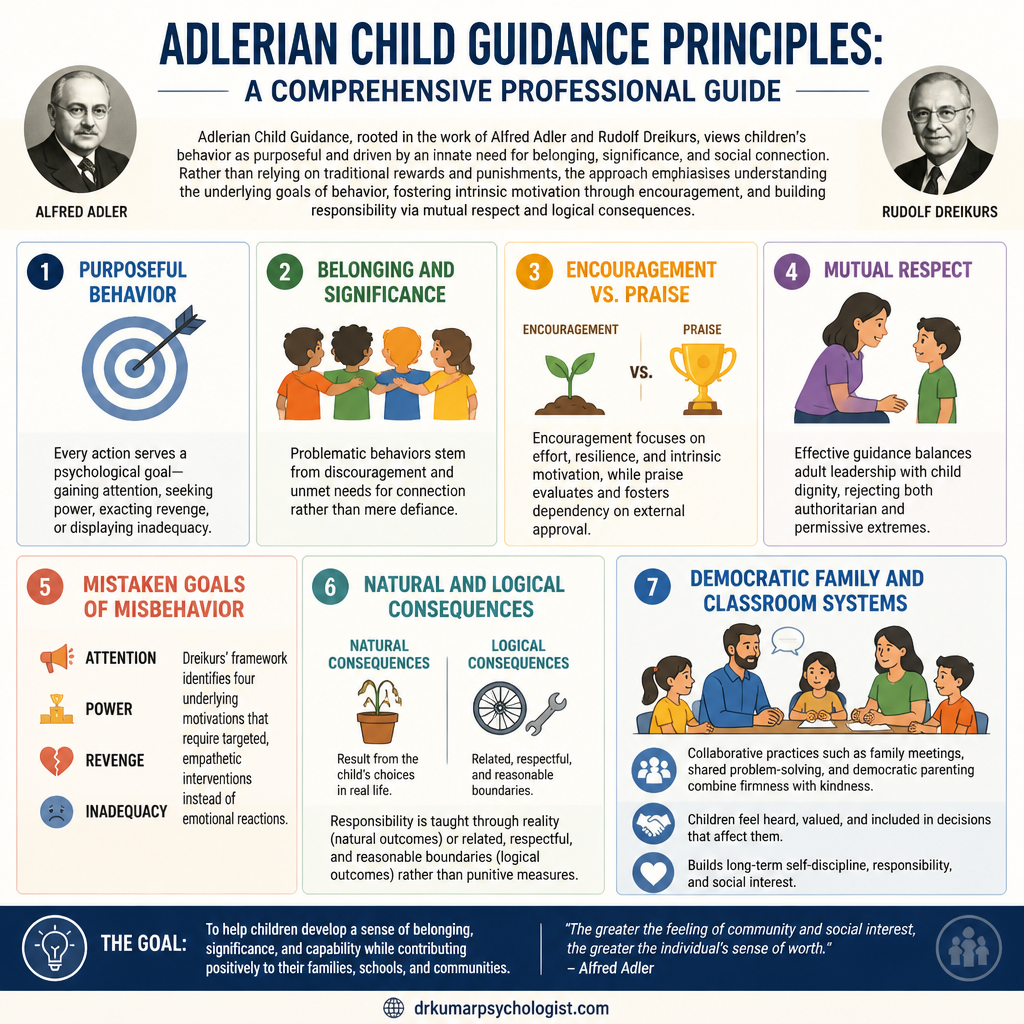
Adlerian Child Guidance
Understand the purpose behind children’s behaviour. Build belonging, confidence and cooperation through encouragement, mutual respect and responsibility—not fear or humiliation.
From “How do I stop this?” to “What is this child trying to achieve?”
Adlerian Child Guidance views behaviour as meaningful and goal-directed. A child is not a problem to be fixed, but a developing person seeking a place in family, classroom and community life.
Developed from Alfred Adler’s Individual Psychology and later expanded in child guidance by Rudolf Dreikurs, this approach places belonging, significance, encouragement and social connection at the centre of discipline.
1. Alfred Adler and Individual Psychology
Adler (1870–1937), an Austrian physician and psychotherapist, established Individual Psychology after departing from Freud’s psychoanalytic tradition. His approach highlighted human strengths, social relationships, personal responsibility, goal-directed behaviour and community participation.
Strengths
Notice capabilities and resources, not only deficits.
Relationships
Understand behaviour within a social context.
Purpose
Explore the goals and meanings guiding actions.
2. The need for belonging and significance
Children seek answers to four powerful questions:
Do I belong here?
Am I included and connected?
Am I valued?
Are my feelings and efforts taken seriously?
Do I matter?
Can others see and appreciate me?
Can I contribute?
Do I have a meaningful role?
When children feel accepted and respected, cooperation and responsibility can become easier. When they feel excluded, powerless or discouraged, behaviour may become an attempt to regain significance.
Guidance direction: Increase connection and meaningful participation while keeping clear boundaries.
3. Understand behaviour as purposeful
Adlerian guidance encourages adults to investigate the possible purpose of behaviour rather than react automatically. A behaviour may be an attempt to gain attention, avoid failure, acquire power, seek revenge or find belonging.
Describe what happened, when it happened and who was present. Separate the observable action from your interpretation of it.
Remember: a mistaken goal is a working hypothesis—not a diagnosis. Consider developmental stage, stress, communication needs, learning difficulties and safety before deciding how to respond.
4. Encouragement versus praise
Evaluates the child
“You’re brilliant.”
“You’re the smartest student.”
“You’re amazing.”
Repeated evaluation can make external approval feel especially important.
Notices effort and growth
“You kept going despite frustration.”
“You tried a different strategy.”
“I noticed how carefully you worked.”
Supports courage, persistence and confidence in learning.
5. Dreikurs’ four mistaken goals of misbehaviour
Rudolf Dreikurs described four common mistaken goals that may help adults understand discouraging behaviour. Select each card to reveal a practical response.
Attention
Possible behaviours: interrupting, showing off, constant demands, excessive dependence.
Explore the adult response
- Avoid repeated scolding that keeps the attention cycle going.
- Offer positive involvement and scheduled one-to-one time.
- Invite useful contribution.
Power
Possible behaviours: refusal, arguing, defiance, negotiating every request.
Explore the adult response
- Avoid escalating into a power struggle.
- Offer bounded choices while maintaining the limit.
- Example: “Would you like sneakers or sandals?”
Revenge
Possible behaviours: aggression, cruel comments, property destruction, withdrawal.
Explore the adult response
- Prioritise safety and stop harm clearly.
- Explore hurt feelings when everyone is calm.
- Work to repair the relationship and teach conflict resolution.
Display of inadequacy
Possible behaviours: giving up, avoidance, helplessness, low motivation.
Explore the adult response
- Break tasks into manageable steps.
- Create achievable opportunities for success.
- Recognise progress rather than perfection.
Try it: choose a helpful first response
Scenario: A child refuses to put on shoes and argues about every suggestion. Which response is most consistent with the guidance above?
6. Natural and logical consequences
Follows without adult arrangement
Forgetting a coat may mean feeling cold; neglecting to water a plant may cause it to wilt.
Arranged by an adult
If toys are repeatedly left scattered, they may be temporarily put away until the child is ready to help care for them.
Logical consequences should be
Directly connected to the behaviour.
Protect the child’s dignity.
Proportionate to the situation.
Predictable, not a surprise punishment.
7. Family meetings and democratic parenting
Family meetings create opportunities for shared responsibility, communication, collaborative problem-solving and connection.
Appreciation
Each person shares something they value.
Problem discussion
Raise one issue respectfully.
Brainstorm
Generate solutions without criticism.
Agreement
Choose a workable shared plan.
Follow-up
Review what worked next time.
Children are guided, not dominated. Adults retain responsibility for safety and appropriate boundaries while listening to children’s perspectives.
8. Classroom applications and child counselling
In the classroom
- Student voice and inclusion
- Cooperation and peer mentoring
- Collaborative rule creation
- Class meetings
- Restorative conversations
- Encouragement-focused feedback
In counselling
- Family constellation
- Early recollections
- Lifestyle assessment
- Strength identification
- Encouragement and insight
- Social connectedness
Adlerian counselling seeks to understand the child’s unique worldview, relationships and beliefs about self and others. Assessment should be developmentally appropriate and sensitive to the child’s context.
9. Practical case studies
Case 1: Homework refusal in a 12-year-old
Initial label: “Lazy.”
Possible Adlerian interpretation: Fear of failure or discouragement.
Guidance: Break assignments into steps, encourage effort and recognise persistence. Check whether the work is appropriately challenging and whether additional learning support is needed.
Case 2: Aggressive sibling behaviour
Possible interpretation in the source framework: Revenge or hurt.
Guidance: First protect the sibling and stop aggression. Later, explore feelings, strengthen connection and teach collaborative conflict resolution. Repair does not replace accountability.
Case 3: Repeated interruptions at home
Possible interpretation: Seeking attention or inclusion.
Guidance: Create predictable opportunities for one-to-one connection and invite the child into family conversation. Teach a respectful way to enter a conversation.
10. Connections with contemporary psychology
The source guide relates Adlerian ideas to several contemporary areas. These are conceptual connections, not proof that the theories are identical or that every Adlerian claim has been empirically established.
Self-Determination Theory
Autonomy, competence and relatedness connect with the emphasis on agency, capability and belonging.
Growth mindset
Learning, effort and improvement align with encouragement over fixed labels.
Positive psychology
Strengths and flourishing complement a focus on capabilities.
Social-emotional learning
Empathy, self-awareness and responsible decision-making support social contribution.
11. Turn insight into a small action
Tick the prompts you have considered, then write one practical step. Your entries remain in this page only and are not sent anywhere.
0 of 6 reflection prompts considered
12. Test your understanding
Choose one answer for each question and check your score.
Key takeaways
Connect before correcting
Belonging and significance are central to the Adlerian perspective.
Be curious about behaviour
Explore possible goals rather than relying on labels.
Encourage, don’t over-evaluate
Notice effort, courage, learning and contribution.
Teach responsibility respectfully
Use clear limits and proportionate consequences.
Educational note: This resource summarises an Adlerian child-guidance framework. The four mistaken goals are interpretive guides, not a diagnostic checklist. Children’s behaviour can have multiple causes. Persistent, severe or unsafe behaviour warrants individual assessment by an appropriately qualified professional.
Selected references
- Adler, A. (1927). Understanding Human Nature.
- Adler, A. (1930). The Education of Children.
- Dreikurs, R., & Soltz, V. (1964). Children: The Challenge.
- Carlson, J., Watts, R., & Maniacci, M. (2006). Adlerian Therapy: Theory and Practice.
- Sweeney, T. J. (2009). Adlerian Counseling and Psychotherapy.
- Nelsen, J. (2021). Positive Discipline.
For professional use, consult the original texts and current child-development literature when making clinical, educational or safeguarding decisions.