Latest post

Podcast Episode: Living Well In Relationships

Pip: What if the secret to a long, healthy life isn't your salary or your productivity stack โ€” it's whether anyone actually likes you?

Mara: That's the territory Dr. K. Kumar covers in this week's posts: what decades of research say about the relationships that keep us well, and what young couples actually face when they try to build those relationships in the first place.

Pip: Let's start with what an 85-year study found out about how to live well.

The Harvard Study and the Relationships That Keep Us Alive

Mara: The Harvard Study of Adult Development is the longest-running research project on human life in history โ€” over 85 years, tracking hundreds of participants across very different socioeconomic backgrounds to answer one question: what actually makes a good life?

Pip: And the answer wasn't a corner office. The post quotes Dr. Robert Waldinger directly: "Good relationships keep us happier and healthier. Period."

Mara: That's the headline finding, and the implications are significant. Warmth in your relationships is a stronger predictor of long-term health and happiness than fame, social class, or cholesterol levels.

Pip: Which means we've been treating the foundation like a reward. Social time as something you earn after the real work โ€” when it is the real work.

Mara: The post also makes clear that loneliness isn't just psychological discomfort. The WHO now classifies chronic disconnection as a serious public health concern, equivalent in harm to smoking 15 cigarettes a day.

Pip: So disconnection gets under the skin โ€” literally. It triggers chronic stress responses that compromise immunity and accelerate physical aging.

Mara: Right. And the post moves from the Harvard data into the Gottman Institute's research on how to protect those relationships once you have them. The 5:1 magic ratio โ€” five positive interactions for every one negative โ€” is the maintenance schedule for what the post calls your emotional bank account.

Pip: And contempt is what drains the account fastest. The post calls it the sulfuric acid of connection โ€” not just a predictor of divorce, but a direct immune hazard.

Mara: The practical tools the post offers include the Gentle Start-Up formula โ€” replacing character attacks with "I feel, about, I need" โ€” and a 20-minute physiological timeout when conflict escalates past the point where rational thought is possible.

Pip: The lives of two Harvard participants close it out โ€” one who had every advantage and collapsed, one who started with nothing and thrived โ€” making the case that early circumstances don't determine the arc.

Mara: What determines it, the post argues, is the quality of your connections and the small, consistent choices to maintain them. That brings us to what building those connections actually looks like for couples early in the process.

What Young Couples Are Really Navigating

Mara: The post on relationship adjustment for young couples reframes the difficulty of early partnership โ€” not as a red flag, but as what it calls a lifelong practice of psychological retooling.

Pip: The first surprise: merging into a unified "we" is actually the problem, not the goal. The post puts it plainly โ€” "Healthy adjustment means holding both โ€” the 'I' and the 'we' โ€” with equal reverence."

Mara: That tension is especially sharp for people in their twenties and thirties, who are still consolidating their own identities while simultaneously building a shared life.

Pip: And then there's the 69 percent rule โ€” which is either liberating or alarming depending on your disposition.

Mara: Gottman's research shows 69 percent of relationship problems are perpetual, meaning they're rooted in fundamental differences in personality or values, not fixable logistics. The post reframes success as the quality of the ongoing conversation, not the elimination of conflict.

Pip: Conflict literacy over conflict resolution. That's a shift worth sitting with.

Mara: The post also covers stress spillover โ€” external pressure leaking into the relationship's emotional atmosphere โ€” and attachment styles, particularly the anxious-avoidant feedback loop where each partner's self-protective response triggers the other's deepest fear.

Pip: The good news is those patterns aren't permanent. The relationship itself can become what the post calls a corrective emotional experience.


Mara: Across all of it, the throughline is the same: connection is the infrastructure, not the decoration.

Pip: Small deposits, consistent choices, and knowing the difference between a perpetual problem and a solvable one. More on how that plays out โ€” next time.

Podcast Episode: Building Skills For Modern Life

Pip: If you've ever wondered what it would take to actually understand yourself, manage anxiety, figure out who you are online, and make better decisions โ€” Dr. K. Kumar has apparently been very busy.

Mara: This episode covers ground from a multi-part life skills course to the real cost of ignoring mental health, identity in the digital age, and the frameworks behind proactive decision-making. Let's start with the course itself โ€” self-awareness, empathy, communication, and relationships.

Building the Social and Emotional Skill Set

Pip: The course positions these four skills โ€” self-awareness, empathy, communication, and interpersonal relationships โ€” as a sequence, not a menu. The argument is that you can't really develop any of the later ones without the first.

Mara: The Self-Awareness post puts it directly: "Self-awareness is the foundation for emotional intelligence and the starting point for personal growth. By cultivating self-awareness, you gain the ability to regulate your emotions, make intentional decisions, and build meaningful relationships."

Pip: So it's not introspection as a hobby. It's the prerequisite infrastructure. Skip it and the rest of the stack runs on guesswork.

Mara: The Empathy post sharpens that point. Without it, communication stays, in the post's phrase, "one-way traffic focused only on self-interest." And the Effective Communication post extends this further โ€” it frames communication as the mechanism that translates internal values into actual navigable behavior in the world.

Pip: Which is a more useful framing than "speak clearly and make eye contact."

Mara: The Interpersonal Relationship Skills post ties it together by combining social skills with emotional management โ€” the argument being that the combination is what builds a support network that actually buffers stress rather than just filling a contact list.

Mara: All four lessons use the same "Now What?" Reflection Framework โ€” three structured questions: What happened, what did I learn, and how do I apply it โ€” as the bridge from self-knowledge to real-world action.

Pip: A consistent scaffold across the whole course. That's worth noting โ€” the structure itself is part of the pedagogy.

Mara: From skills to the broader system that either supports or undermines them โ€” mental health is next.

The Real Cost of Ignoring Mental Health

Pip: The question here isn't whether mental health matters. It's what it actually costs when a society treats it as optional.

Mara: The Cost of Neglecting Mental Health in Society opens with the WHO's framing: "There is no health without mental health." The post argues the traditional mind-body divide isn't just philosophically wrong โ€” it's physiologically dangerous, triggering sustained cortisol elevation and downstream cardiovascular and immune consequences.

Pip: So the body ends up paying the bill the mind ran up. The economic case is just as blunt โ€” the Lancet Commission projects mental health conditions will cost the global economy sixteen trillion dollars in lost output between 2010 and 2030.

Mara: And the WHO research cited suggests a four-dollar return for every one dollar invested in treatment. The post frames mental health access as a human rights issue, not a wellness preference โ€” gating care behind high costs creates what it calls a tiered system of citizenship.

Pip: The piece on studying abroad lands in the same territory from a different angle โ€” international students navigating what the post calls a "liminal space," caught between cultures with their usual support systems gone.

Mara: And the chronic anxiety post grounds all of this neurologically โ€” explaining how an overactive amygdala and a weakened prefrontal cortex create a state where you genuinely cannot simply decide to relax. The system is too loud for logic to land.

Pip: Which connects directly to who we think we are โ€” and who we're performing online.

Who You Are, Online and Off

Pip: Digital Identity: The Performance of Self Explained uses Erving Goffman's stagecraft framework to argue that managing different selves across different contexts isn't dishonesty โ€” it's how social life works.

Mara: The post quotes Goffman directly: "The self is a dramatic effect that emerges from the immediate scene being presented โ€” it is shaped by the audience, the setting, and the expectations at play in any given encounter."

Pip: The practical problem it identifies is the collapse of backstage space. Remote work and social media push private life permanently into the front stage, and staying in character that long is genuinely exhausting.

Mara: Navigating Identity Crisis in the Digital Age approaches this from the developmental side โ€” citing longitudinal research showing that identity commitment functions as a psychological immune system, reducing distress symptoms measurably. And The Reality Behind Our Perception of Social Responsibility extends the self outward, asking how wide our circle of concern actually is and why prosocial behavior so often stops at the in-group boundary.

Pip: The stakes of self-knowledge run straight into how we decide โ€” which is where this lands next.

Decision-Making as a Practiced Skill

Pip: Mastering Life Skills for Success makes the case that high IQ and strong credentials don't automatically produce good judgment โ€” the WHO's ten life skills are what actually determine whether someone can navigate complexity.

Mara: The post defines the foundation plainly: "Self-Awareness: Recognition of 'self' โ€” your character, strengths, weaknesses, desires, and dislikes." Everything else โ€” critical thinking, creativity, emotional regulation โ€” runs on top of that base.

Pip: Transform Decision-Making: From Reactivity to Proactivity takes the same argument into information overload specifically โ€” the problem isn't too little data, it's too much, and the premium skill is now filtering rather than gathering.

Mara: It introduces the "reflective pause" as the practical mechanism โ€” a deliberate gap between stimulus and response that shifts decision-making from reactive to intentional. Viktor Frankl's line anchors it: "Between stimulus and response there is a space. In that space is our power to choose."

Pip: The whole arc of the course points here โ€” self-awareness, empathy, communication, relationships, and then the judgment to act on all of it deliberately.


Mara: The through-line across everything here is that psychological skills aren't soft extras โ€” they're the operating infrastructure for a functional life.

Pip: And apparently the first step is knowing yourself well enough to notice you've been running without one. More from this site next time.

Online course Part- 6 โ€“ Problem-solving

Subscribe to continue reading

Subscribe to get access to the rest of this post and other subscriber-only content.

How to Stop Overthinking: Tips for Mental Clarity

Do you often replay a conversation in your mind, going over every word? Maybe you spend your evenings worrying about all the negative possibilities of a meeting that hasn’t taken place yet. This feelingโ€”a mind that keeps spinning without getting anywhereโ€”is called “maladaptive rumination.”

Unlike productive problem-solving, overthinking is an unproductive loop fueled by cognitive biases like catastrophizing (assuming the worst) and mind-reading (assuming negative judgments from others). It is a trap of analysis, worry, and self-doubt that hinders decision-making and drains mental well-being.

1. Itโ€™s a Cause, Not Just a Symptom

According to the “Response Styles Theory,” overthinking is a causal driver of distress, not just a side effect of being in a bad mood. While it feels like you are thinking because you are sad, the science suggests the opposite: the act of thinking is what keeps you stuck.

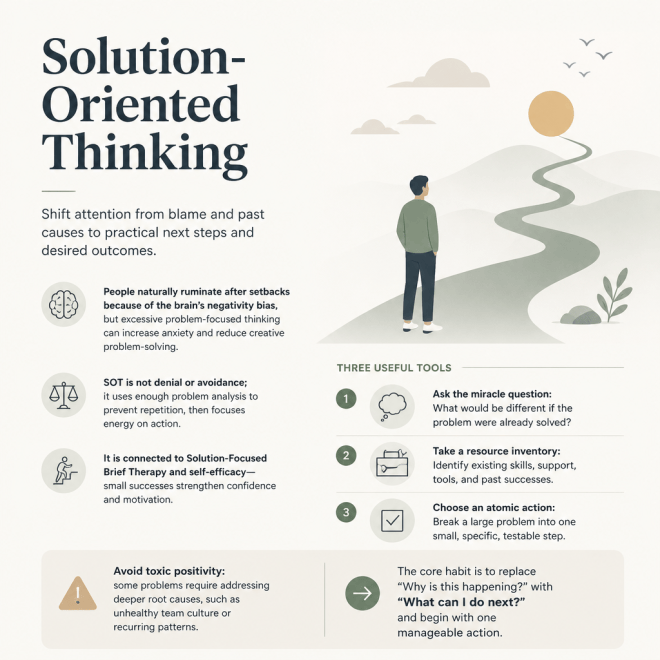
When you ruminate, you focus on the symptoms of your distress and the implications of those feelings. You ask “Why do I feel this way?” instead of “What can I do?” This focus on the feeling kills your ability to act. It traps you in a cycle where the investigation of the problem becomes the very thing preventing the solution.

“Overthinking… is about getting stuck in a loop of analysis, worry, and self-doubt that hinders decision-making, creativity, and overall well-being.”

The revelation for the reader is a shift in perspective. Move from “I am sad, so I am overthinking” to “I am overthinking, so I am staying sad.” This realization is the first step toward reclaiming agency.

2. The Biological Glitch of the “Default Mode”

Overthinking is rooted in a biological “glitch” within the brainโ€™s architecture. Specifically, it involves the Default Mode Network (DMN), comprising the medial prefrontal cortex and the posterior cingulate cortex. This network is usually active when the brain is at rest, but in overthinkers, it fails to switch off during tasks.

This leads to a struggle between two key players:

  • The Amygdala (The Internal Smoke Alarm): This area detects threats. In an overthinker, it is hyper-sensitive, sounding the alarm at the slightest social or personal risk.
  • The Prefrontal Cortex (The On-Site Investigator): This area handles executive control. When the “smoke alarm” goes off, the investigator rushes in to find the fire.

In a biological loop, the investigator (PFC) tries to resolve the threat through cyclical analysis. When it canโ€™t find a “perfect” solution to an imagined problem, it actually creates more stress, which re-triggers the smoke alarm (amygdala). The brain becomes an investigator looking for a fire that isn’t there, fueled by its own frantic searching.

3. The Trap of “Meta-Worry”

A major driver of this cycle is the Metacognitive Model, which explores how we think about our thinking. We often stay trapped because of “positive metacognitive beliefs“โ€”the hidden idea that overthinking is actually a safety tool.

If you struggle with perfectionism or a fear of making mistakes, you likely believe that “Worrying makes me prepared” or “Scrutiny prevents failure.” These are positive beliefs about a negative habit. When you combine these with “negative metacognitive beliefs” (the fear that your thoughts are uncontrollable or dangerous), you develop “meta-worry”โ€”worrying about the fact that you are worrying.

Believing that overthinking is a necessary shield is the very thing that keeps the cycle alive. It is an illusion of safety that keeps you from the actual work of living.

4. The Physical Exhaustion of Mental Loops

Overthinking is not “doing nothing”; it is a high-intensity physiological event with a profound Psychosomatic Impact. Your brain is a prediction engine that, when stuck in a loop, consumes massive amounts of glucose and oxygen to sustain repetitive thought patterns. This results in Cognitive Fatigue.

This mental exertion manifests physically through:

  • Elevated Cortisol: Chronic rumination keeps the body’s stress hormone levels high.
  • Sleep Disruption: An inability to “switch off” the DMN disrupts sleep architecture.
  • Immune Suppression: Sustained stress signals can weaken the bodyโ€™s natural defenses.

This is why you feel physically shattered after a day spent entirely in your head. Your body is reacting to a mental marathon it never signed up to run.

5. Content vs. Processโ€”The Key to Breaking Free

To break the cycle, we must change our relationship with our thoughts through a concept called “decentering.” This involves viewing thoughts as ephemeral mental eventsโ€”like clouds passingโ€”rather than absolute truths.

Clinical interventions offer two distinct paths:

  • CBT: Focuses on the content (Is this worry true?).
  • Metacognitive Therapy (MCT): Focuses on the process.

MCT is particularly powerful for overthinkers because it doesn’t ask you to argue with the “truth” of your thoughts. Instead, it targets the belief that you must engage with them at all. By changing the process of thinkingโ€”treating thoughts as noise that doesn’t require immediate analysisโ€”you can step off the hamster wheel.

“Progress, however small, is more valuable than stagnant analysis.”

Conclusion: From Paralysis to Presence

Overthinking is a complex intersection of survival mechanisms and learned habits, but because it is a learned pattern, it can be unlearned. By identifying the triggers of the “thought loop,” you can move from a state of analysis paralysis to a state of agency.

Reclaiming the mental energy you’ve lost in the “hamster wheel” can truly give you back precious time and focus that you deserve.

If you stopped using your cognitive fuel to power a loop that leads nowhere, what could you achieve with that reclaimed power today?

Online course Part- 5 โ€“Decision-making

Subscribe to continue reading

Subscribe to get access to the rest of this post and other subscriber-only content.