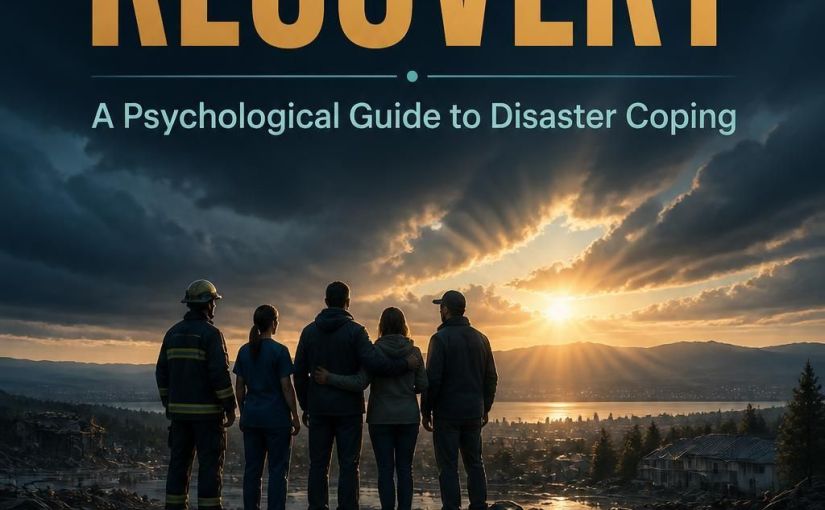
The Core Paradigm: When sudden disasters strike, they trigger acute stress reactions—including confusion, emotional overwhelm, and hyperarousal—which represent normal, adaptive human responses to abnormal events rather than psychiatric illness. Research consistently demonstrates that most individuals possess inherent resilience and experience a natural recovery trajectory when supported through structured, active interventions.
Not every recovery starts in a therapist’s office.
Sometimes people going through anxiety, burnout, or low mood get better on their own — no therapy, no medication, no hospital stay. Researchers call this spontaneous remission, and it’s more common (and less mysterious) than most people think.
It isn’t magic. It’s your brain and body doing what they’re built to do: adapt, regulate, and recover — when the conditions allow it.
Why Distress Happens in the First Place
Mental strain usually shows up when something tips out of balance:
Life feels overwhelming
Support feels thin
Old coping habits stop working
Stress hormones stay switched on
Beliefs about yourself or the situation turn unhelpful
Recovery, then, isn’t really about “fixing” symptoms. It’s about helping these systems find their balance again.
Five Things That Help the Mind Recover Naturally
1. Lower the Load
Less stress means more room to heal. Small, doable changes matter:
Step back from draining relationships
Trim your commitments
Cut down on scrolling and news overload
Protect a few quiet minutes each day
2. Reconnect With People
Isolation feeds distress; connection eases it. Regular contact with friends and family — even a few honest conversations — has one of the strongest links to natural recovery.
3. Shift How You Think About It
Struggles often deepen when reality clashes with expectations. Journaling, reframing setbacks, and setting small realistic goals help the mind find new footing.
4. Build Resilience
Confidence grows from small wins. A daily walk, a new skill, a mindfulness habit — each one builds the sense that you can handle what’s ahead.
5. Support the Body
The mind runs on biology. Sleep, movement, real food, hydration, and time outdoors all feed the same systems that regulate mood and stress.
The Natural Recovery Path
Recovery tends to move through stages, not in a straight line:
Natural recovery works best for mild-to-moderate struggles. It is not a substitute for professional help if someone is dealing with suicidal thoughts, self-harm, psychosis, bipolar disorder, severe depression, or symptoms that have lasted months without easing. In those cases, please reach out to a mental health professional.
Remission does not necessarily indicate complete recovery. Symptom reduction may occur while residual psychological difficulties remain, increasing vulnerability to future relapse.
Awareness of spontaneous remission has important implications for mental health care. Knowledge that some individuals recover naturally can help clinicians avoid unnecessary overtreatment in mild cases.
Current research suggests that spontaneous remission arises from a complex interaction of psychological adaptation, social resources, environmental changes, resilience, and biological processes. Future studies should continue investigating these mechanisms to improve both preventive mental health strategies and personalized treatment planning.
The Takeaway
Healing isn’t always something that happens to you in treatment. Often, it’s something your mind and body already know how to do — they just need the right conditions: less overload, more connection, adaptive thinking, resilience, and a healthy body to run on.
The right conditions not only support recovery, but also foster prevention and promote mental health.
Create the conditions, and recovery has room to happen.
Whiteford, H. A., Harris, M. G., McKeon, G., Baxter, A., Pennell, C., Barendregt, J. J., & Wang, J. (2013). Estimating remission from untreated major depression: A systematic review and meta-analysis. Psychological Medicine.
Fuhr, D. C., et al. (2023). Predictors of spontaneous remission and recovery among women with untreated perinatal depression in India and Pakistan. Global Mental Health.
Solmi, M., et al. (2023). An umbrella review of candidate predictors of response, remission, recovery, and relapse across mental disorders. Molecular Psychiatry
Lee, S., et al. (2025). Molecular Characteristics of Spontaneous Remission in Major Depressive Disorder. Clinical Psychopharmacology and Neuroscience
Lamb, S., & Peele, S. (1999). “The concept of spontaneous remission.” Journal of Substance Abuse.
Life throws a lot at you between the ages of 18 and 25 — exams, first jobs, breakups, money stress, and a phone that never stops buzzing. How you handle that stress matters just as much as the stress itself.
That’s what “coping” really means: the habits, thoughts, and actions you reach for when things get hard. Some of these habits help you grow. Others just help you hide. This guide breaks down the difference — and shows you how to build a coping toolkit that actually works.
Why Your Coping Skills Matter So Much Right Now
Your brain is still under construction. The prefrontal cortex — the part responsible for planning, focus, and emotional control — doesn’t fully mature until your mid-20s. At the same time, you’re being handed more independence and more pressure than ever before.
That gap between “adult responsibilities” and “still-developing brain” is exactly why this stage of life can feel so intense. The good news? Coping is a skill, not a fixed personality trait. It can be learned, practiced, and improved.
The key idea: Healthy coping helps you face a problem and manage your emotions, even when you can’t remove the problem itself. Unhealthy coping offers quick relief — but quietly makes things worse over time.
The Three Types of Coping
Psychologists generally group coping strategies into three buckets:
1. Problem-focused coping You tackle the source of the stress directly — through planning, time management, or gathering information. Great for things you can actually control, like an upcoming exam.
2. Emotion-focused coping You manage the feeling the stressor creates — through mindfulness, journaling, talking to someone, or simply accepting reality as it is. Best for things you can’t control, like a global crisis or a situation you can’t fix right now.
3. Avoidant coping You try to escape or ignore the discomfort altogether — denial, procrastination, doomscrolling, or numbing out. This feels good for about five minutes and costs you a lot more later.
The real skill isn’t picking one style forever — it’s knowing which one fits the situation. Psychologists call this contextual agility: using problem-solving when you can change something, and using acceptance or emotional support when you can’t.
Healthy vs. Unhealthy Coping: The Short-Term Trap
Here’s the pattern that makes unhealthy coping so tempting — and so dangerous:
Strategy
Feels Like (Short-Term)
Costs You (Long-Term)
Positive reappraisal (reframing a setback as a growth opportunity)
Dependence, health problems, harder time processing emotions
Notice the pattern: the “easy” option always borrows relief from your future self — with interest.
Warning Signs Your Coping Has Become Unhealthy
Do a regular check-in with yourself. Watch for:
Persistent distress — you still feel anxious or low long after the stressful event has passed
Declining performance — grades, work, or relationships start to slip
Compulsive reliance — you increasingly need substances, gaming, or spending just to feel normal
Avoidance building up — your go-to strategy keeps you from dealing with real responsibilities
If two or more of these sound familiar, it’s worth pausing and asking: is this habit actually helping me, or just helping me hide?
Defense Mechanisms: The Ones You Don’t Even Notice
Beyond conscious coping choices, your mind also runs automatic, unconscious “shields” against anxiety. Some keep you grounded in reality. Others quietly distort it.
Mature defenses (healthy):
Sublimation — turning anger into a workout, or sadness into art
Humor — laughing at a hard situation to gain perspective, without ignoring it
Altruism — relieving your own stress by helping someone else
Suppression — consciously choosing to deal with something later, at a better time
Immature defenses (unhealthy):
Denial — refusing to admit a problem exists
Projection — pinning your own feelings onto someone else
Passive aggression — venting frustration sideways instead of speaking up
Regression — reverting to childish behavior to dodge adult responsibility
You can’t always control which defense kicks in automatically — but noticing the pattern is the first step to choosing better ones.
The Doomscrolling Trap: Coping in the Digital Age
Your generation faces a stressor no previous one had to deal with at this scale: constant connectivity. Social media can be genuinely useful — it offers real support through friends and communities. But it also makes avoidance dangerously easy.
Studies show that passively scrolling to numb out doesn’t actually calm you down. It increases hypervigilance and lowers your self-efficacy — your belief that you can actually handle your problems. That drop in confidence makes you want to avoid even more. It’s a loop.
A simple digital hygiene checklist:
Unfollow accounts that trigger comparison or constant negativity
Set a 10-minute timer for news instead of endless scrolling
Use your phone for real connection (calls, messages to actual friends) instead of passive scrolling
Stick to a couple of trustworthy sources instead of chasing every update
Putting It Into Practice: Real Scenarios
Stressor
The Adaptive Path
The Maladaptive Path
Exam stress
Structured study schedule, practice questions
Binge-watching, procrastinating
Relationship conflict
Open communication, active listening
Silent treatment, passive-aggressive posts
Job loss
Updating your resume, networking, talking to friends
Avoiding the job search, isolating
Money problems
Budgeting, seeking advice, small manageable steps
Impulse spending, ignoring your bank statements
Same stressor, two very different paths. The one that feels easier in the moment is almost never the one that actually helps.
Building Your Coping Toolkit: 3 Things to Remember
Practice reframing. When something goes wrong, ask: “What can this teach me, or what can I do with it?” This single skill — cognitive reappraisal — is one of the strongest predictors of long-term wellbeing.
Match the strategy to the stressor. Problem-solve what you can change. Accept and process what you can’t. Trying to “fix” an uncontrollable situation just leads to burnout.
Stay connected, don’t withdraw. Reaching out to a trusted friend or mentor when things get hard is one of the most protective habits you can build.
A Simple Weekly Check-In
Resilience isn’t something you either have or don’t — it’s a skill you build one choice at a time. Try this once a week:
“Is the way I’m handling stress right now actually helping me grow — or is it just helping me hide?”
That one question, asked honestly, is often the first step toward swapping a habit that’s holding you back for one that moves you forward.
Coping well doesn’t mean never struggling. It means having a toolkit flexible enough to meet whatever life throws at you — and the self-awareness to notice when it’s time to switch tools.
In the wake of what neuroscientists Huda Akil and Eric Nestler call the “Second Pandemic,” the global community is grappling with a staggering 25% rise in major depressive and anxiety disorders. Triggered by the cumulative allostatic load of Covid-19, climate change, and systemic instability, this wave of distress has exposed the fragility of our collective mental health. Yet, even within this crisis, a biological paradox remains.
Why did the “Wild Boar” football team, trapped for 18 days in the Tham Luang cave, emerge with such visible psychological stability? Why do the majority of Hurricane Katrina survivors demonstrate “impressively high” levels of recovery despite total displacement?
As a cognitive strategist, I view these cases not as miracles, but as the result of precision resilience. This isn’t a passive trait; it is a sophisticated neurobiological infrastructure. By analyzing the science of “Meaning Making,” we can uncover the biological mechanisms that allow the human mind to convert extreme stress into adaptive growth, moving from a state of allostatic cost to one of cognitive dividend.
——————————————————————————–
TAKEAWAY 1: Resilience is the Rule, Not the Exception
Popular culture often treats trauma as a guaranteed path to disorder. However, the data reveals a different truth: the human brain is evolutionarily wired for allostasis—the process of achieving stability through change. Resilience is not merely the absence of a diagnosis; it is an active, counter-regulatory mechanism that monitors and adjusts our internal state to meet external demands.
Synthesized data from major disasters shows that recovery is the statistical norm:
Hurricane Ike: Only 8.3% of the exposed population met the criteria for PTSD.
Hurricane Katrina: Despite near-total infrastructure collapse, 78% of survivors did not develop PTSD.
While we must respect the “biological cost” of chronic stress—the allostatic load—we must also recognize that the mind possesses a natural infrastructure designed to absorb and process shock.
“Understandably, levels of recovery and resilience after disasters are impressively high… This human capacity to recover and even thrive postdisaster warrants attention.” — Crystal L. Park
——————————————————————————–
TAKEAWAY 2: The “Meaning-Making” Engine: When Global and Situational Beliefs Clash
Psychological resilience is powered by a two-level cognitive engine. To navigate a crisis, we must move from Meaning Making (the process of reconciliation) to Meaning Made (the outcome of a reconstructed identity).
Global Meaning: Our foundational beliefs that the world is fair, predictable, or controllable.
Situational Meaning: Our immediate appraisal of a disaster (e.g., “This occurred due to human negligence”).
When a catastrophe “shatters” your global meaning, the engine engages to reconcile the discrepancy. This is where strategic choices determine your trajectory. For many, religious attributions serve as a “double-edged sword.” Positive religious coping—viewing the event as part of a larger plan or seeking closeness to a higher power—acts as a stabilizer. Conversely, negative religious coping—viewing the event as “payback” or questioning a higher power’s strength—often leads to chronic distress.
Success in this engine is measured by “Meaning Made.” This isn’t about returning to your old self; it’s about building a reconstructed identity where your new global beliefs can finally accommodate the reality of the trauma.
——————————————————————————–
TAKEAWAY 3: Reappraisal vs. Suppression: Leveraging “Market Data for the Mind”
In a crisis, most individuals default to emotional suppression, trying to “not rise to the bait.” From a strategic perspective, this is a high-cost failure. Emotions are not just “feelings”; they are unique pieces of information—essentially market data for the mind—that allow us to adjust our proposal-strategies and value creation in a changing environment.
Strategy
Action
Information Value
Resulting Impact
Emotional Suppression
Controlling expression; “bottling it up.”
Hidden: Data is ignored, but the biological alarm continues to ring.
High Cognitive Cost: Drains the “battery” needed for allostasis; reduces social liking and future value creation.
Cognitive Reappraisal
Re-framing the threat as a source of data or a challenge.
Leveraged: Uses emotion to identify issues and adjust strategies.
Suppression drains the very mental resources needed for the brain to physically reshape itself. Reappraisal, however, allows you to use the information provided by stress to build a more flexible, resilient circuit.
——————————————————————————–
TAKEAWAY 4: Group Cohesion is a Biological Buffer
The Tham Luang cave rescue provides a masterclass in social-biological buffering. The team’s survival wasn’t just a feat of endurance; it was a result of shared identity. Their “Wild Boar” squad identity provided a social structure that reduced the “perceived threat” at a neurological level.
Autonomic Regulation: The coach, drawing on Buddhist meditation, taught the boys to down-regulate their autonomic arousal (tachycardia and hyperventilation). This kept their stress cascade from reaching a point of permanent allostatic load.
The minority risk: While the boys were “in high spirits” upon rescue, we must apply a precise scientific lens. Data suggests a minority—up to 20 percent—may still develop long-term mental health issues like PTSD or depression. Resilience is a high-probability outcome, but not a universal guarantee.
Social Connectivity: As seen in studies from North India, perceived social support acts as a buffer that physically limits the release of cortisol and adrenaline, protecting the hippocampus from stress-induced damage.
——————————————————————————–
TAKEAWAY 5: The “Natural World” as a Structural Support
In resource-poor settings, such as those studied in North India (Burans), the natural world emerges as a critical, low-cost structural intervention. For the “intersectionally disadvantaged,” engagement with fields, forests, or even “pollution-free blue skies” was not just a pleasant distraction—it was a cognitive strategy.
Participants described this as making the “mind lighter” (mann halke ho jate hai). Biologically, this engagement resets the internal monitoring process of the stress system. By shifting focus away from the self, it breaks the cycle of rumination and catastrophic thinking. In a world of increasing “digital noise,” the natural world serves as a primary tool for resetting our neurobiological preparedness.
——————————————————————————–
CONCLUSION: Building Your Resilience Infrastructure
The “chemical imbalance” myth is dead. We now know that the monoamine model (serotonin/noradrenaline) is insufficient to explain the complexities of mood disorders. The proof is in the data: while SSRIs increase serotonin levels in days, they take weeks to show clinical efficacy. This delay suggests that recovery isn’t about “balancing a chemical“; it’s about neural remodeling.
Resilience is not a fixed trait; it is a biological infrastructure you build through active meaning-making, cognitive reappraisal, and social connection.
The Power Takeaway: Resilience is something you do. It is the result of using adaptive neuroplasticity to turn allostatic load into a more flexible, sophisticated mind.
When the world next violates your “global meaning,” will you pay the cognitive cost of suppression, or will you use that distress as data to re-frame your place in a changing world?
Resilience isn’t about being immune to pain or hardship. It’s not about pretending everything is fine when it’s not. Instead, resilience is the psychological capacity to adapt well in the face of adversity, trauma, tragedy, threats, or significant sources of stress. It’s the ability to “bounce back” from difficult experiences, not by erasing them, but by integrating them and continuing to move forward with strength and purpose.
Post-Traumatic Growth (PTG) is a real phenomenon: some people report positive psychological change — deeper relationships, new possibilities, greater personal strength — as a direct result of struggling with highly challenging life crises.
The Pillars of Resilience: What Makes Us Bounce Back?
Psychologists have identified several key components that contribute to resilience:
Positive Self-Belief and Self-Efficacy: This is the fundamental belief in your own ability to cope and succeed. It’s about trusting your judgment, knowing you have the skills and resources to handle challenges, and understanding that you have some control over your life.
Optimism and Hope: While realism is important, a hopeful outlook fuels resilience. It involves believing that things can improve, that future outcomes can be positive, and that your actions can make a difference. This doesn’t mean ignoring problems, but rather focusing on possibilities.
Strong Social Connections: Humans are social beings. Having a robust support network – friends, family, mentors, or community groups – provides a buffer against stress. These connections offer emotional support, practical assistance, and a sense of belonging, reminding you that you are not alone.
Problem-Solving Skills and Adaptability: Resilience involves actively engaging with challenges rather than avoiding them. This means being able to identify problems, brainstorm solutions, make decisions, and adapt your approach when things don’t go as planned. Flexibility is key.
Emotional Regulation: The ability to manage and express your emotions in healthy ways is crucial. This involves recognizing your feelings, understanding their triggers, and developing strategies to cope with intense emotions without being overwhelmed or resorting to destructive behaviors.
Sense of Purpose and Meaning: Having a clear understanding of your values, goals, and what gives your life meaning provides a powerful anchor during difficult times. This purpose can be found in work, relationships, spiritual beliefs, or contributions to others.
Self-Care Practices: Physical and mental well-being are inextricably linked to resilience. Prioritizing sleep, nutrition, exercise, and activities that bring you joy and relaxation are not luxuries; they are fundamental to building your capacity to cope.
Building Your Resilience Muscle: Practical Strategies
Understanding the pillars is one thing; actively cultivating them is another. Here are actionable strategies to build your resilience:
Foster Positive Relationships:
Invest in your connections: Make time for loved ones. Be present and supportive in return.
Seek out positive influences: Surround yourself with people who uplift and encourage you.
Join groups or participate in activities: This can build new connections and a sense of community.
Cultivate a Positive Mindset:
Practice gratitude: Regularly acknowledge the good things in your life, no matter how small. This shifts your focus from what’s wrong to what’s right.
Challenge negative thoughts: When you catch yourself thinking pessimistically, ask yourself if there’s another way to view the situation. Is it a fact or an assumption?
Focus on what you can control: Acknowledge what’s outside your influence and direct your energy towards what you can change.
Develop Problem-Solving Skills:
Break down large problems: Overwhelming issues can be tackled by dividing them into smaller, manageable steps.
Brainstorm solutions: Don’t be afraid to think outside the box. Consider all possibilities before settling on a course of action.
Learn from mistakes: View setbacks as learning opportunities. What can you do differently next time?
Practice Self-Compassion and Emotional Regulation:
Be kind to yourself: Treat yourself with the same understanding and compassion you would offer a friend in distress.
Identify and name your emotions: Simply acknowledging how you feel can reduce their intensity.
Develop coping mechanisms: Experiment with techniques like deep breathing, mindfulness, journaling, or engaging in creative activities.
Find Meaning and Purpose:
Reflect on your values: What is most important to you in life?
Set meaningful goals: Pursue aspirations that align with your values and bring you a sense of accomplishment.
Contribute to something larger than yourself: Volunteering or helping others can provide a profound sense of purpose.
Prioritize Self-Care:
Establish healthy routines: Consistent sleep, nutritious food, and regular exercise are foundational.
Make time for enjoyable activities: Engage in hobbies and interests that recharge your batteries.
Learn to say no: Protect your energy and avoid overcommitment.
Resilience strategies are powerful — but they are not a substitute for professional mental health care. If you find yourself experiencing persistent sadness, inability to function, thoughts of self-harm, or prolonged difficulty coping, please reach out to a licensed therapist or counselor.
Resilience is a Journey, Not a Destination
Building resilience is an ongoing process. There will be times when you feel strong and capable, and other times when you feel vulnerable. The key is to approach these challenges with self-awareness, a willingness to learn, and a commitment to nurturing your inner strength.
By understanding the psychological foundations of resilience and actively incorporating these strategies into your life, you can equip yourself to not only endure life’s inevitable storms but to emerge from them stronger, wiser, and more capable of embracing all that life has to offer. Embrace the challenge, trust your capacity to adapt, and remember: you have the power to bounce back.
“You are not defined by what has broken you. You are defined by what you choose to do with the pieces.”