


Subscribe to continue reading
Subscribe to get access to the rest of this post and other subscriber-only content.
Subscribe to get access to the rest of this post and other subscriber-only content.
Understanding the Cognitive and Emotional Functions of Goal Pursuit
Goals are not merely items on a to-do list. Psychologically, they represent mental images of a desired future, shaping how we act, direct our attention, manage emotions, and sustain motivation. Psychological research demonstrates that optimal human functioning requires both short-term and long-term goals, with each serving distinct cognitive and emotional purposes.

Short-term goals are objectives achievable in the near future—ranging from days or weeks to a few months. Examples include completing an assignment, exercising three times a week, or learning a specific new skill.
1. Motivation Through Immediate Rewards: Cognitive theories show people respond strongly to immediate feedback. Every completed short-term target triggers reward pathways, reinforcing engagement and momentum.
2. Building Self-Efficacy: As Albert Bandura highlighted, mastery experiences reinforce the belief in one’s capability to succeed (“I can do this”), providing resilience when facing harder challenges.
3. Managing Cognitive Load: Proximal goals provide clear standards for progress tracking, preventing brain freeze and keeping daily stress low.
4. Emotional Regulation: Tracking small accomplishments provides a continuous sense of competence, helping maintain optimism and emotional stability.
Long-term goals represent broader ambitions that take years to achieve, such as earning a degree, establishing a career, reaching financial independence, or fostering personal growth.
1. Providing Purpose and Meaning: Long-term goals address fundamental questions regarding who you want to become and the life you wish to build, linking day-to-day work to core values.
2. Identity Formation: Over time, major ambitions become internalized into one’s self-concept (e.g., “I am becoming a psychologist”). Alignment between identity and goals deepens personal commitment.
3. Sustaining Long-Term Persistence: Challenging visions foster delayed gratification, helping individuals endure periods of slow progress or temporary failure.
4. Guiding Choices as a Compass: A clear long-term aspiration serves as a filter for decision-making (“Does this bring me closer to my desired future?”), strengthening self-regulation.
Optimal performance occurs when long-term and short-term goals are connected hierarchically. The long-term goal supplies meaning, direction, and identity, while short-term goals supply structure, feedback, and action steps.
Example Hierarchy:
Without long-term goals, action lacks direction. Without short-term goals, vision lacks execution.
Excessive Short-Term Focus: Can lead to chasing quick wins without aligning with core values—resulting in achievement without fulfillment (e.g., focusing solely on exam scores while losing interest in learning).
Excessive Long-Term Focus: Can lead to overwhelm, anxiety, and procrastination because the distant target feels daunting without concrete near-term milestones.
Based on Locke and Latham’s Goal-Setting Theory, effective goal pursuit relies on five core principles:
1. Specificity: Clear targets like “Exercise 30 minutes daily” significantly outperform vague aims like “get healthier.”
2. Difficulty: Goals should be challenging yet realistic—stretching your capabilities without overwhelming you.
3. Personal Meaning: Targets must align with core values to build deep, sustained commitment.
4. Feedback: Regular check-ins keep motivation alive and allow for necessary strategic adjustments.
5. Subgoals: Breaking distant objectives into smaller, actionable milestones builds momentum and confidence.
Key takeaway
Long-term goals give life meaning, direction, identity, and purpose, while short-term goals deliver focus, feedback, confidence, and daily momentum. Neither type of goal functions effectively in isolation. The key to sustainable accomplishment and personal growth lies in weaving both into a single, cohesive framework where daily actions directly support ultimate long-term ambitions.
Continuous self-improvement through daily learning, reflection, and reading. These practices enhance adaptability, prevent stagnation, and promote personal growth while fostering…

The chakra system, historically revered in Eastern traditions but often dismissed by Western science, is gaining recognition through modern research….
The content discusses effective recovery strategies from stress, highlighting the mismatch between common relaxation methods and actual needs. It emphasizes…
The concept of karma is viewed through a psychological lens as personal accountability, emphasizing that actions have consequences affecting one’s…
The post challenges conventional self-development notions by emphasizing quality over quantity in personal growth. It highlights the importance of being…
Imagery Rehearsal Therapy (IRT) is an innovative, non-pharmacological approach that helps individuals address chronic nightmares, traditionally seen as untreatable. The…
We make decisions constantly, never fully sure how they’ll play out. Holding out for absolute certainty is a dead end—it breeds missed chances, endless second-guessing, and needless anxiety.
The aim isn’t flawless foresight. It’s placing sound bets, sidestepping mental pitfalls, and adapting on the fly.

When we face uncertainty, our brains use shortcuts that often lead us astray. Here is how to spot and fix them:
| If your situation looks like this… | What you should do: |
| The decision is easy to reverse.Understanding Signal Detection Theory | Act now. You’ll learn more from doing than from overthinking.Decision-Making Under Uncertainty |
| Delaying will close your window of opportunity.Decision-Making Under Uncertainty | Act now. The cost of waiting is higher than the cost of a small mistake.Decision-Making Under Uncertainty |
| Vital, game-changing information is arriving tomorrow.Decision-Making Under Uncertainty | Wait. Let that key data arrive before committing.Decision-Making Under Uncertainty |
| The mistake could be financially or physically catastrophic.Decision-Making Under Uncertainty | Pause. Get a second opinion and double-check your downside.Understanding Signal Detection Theory+ 1 |
Waiting to have all the facts usually means you act too late. Once you have about 70% of the key information, make your move and adjust as you go.
A smart call can sometimes backfire simply because of bad luck, while a reckless bet might pay off. When you look back at how things turned out, ask yourself: “Did I make a sound, sensible choice based on what I knew at the time?” Don’t beat yourself up just because fortune didn’t cooperate.
Daily decisions often come with uncertainty, leading to common mental traps like overconfidence and confirmation bias. To navigate these, one should use strategies like Rules for Practical Action and Acting decisively with around 70% information and focusing on the decision-making process can enhance outcomes.
Continuous self-improvement through daily learning, reflection, and reading. These practices enhance adaptability, prevent stagnation, and promote personal growth while fostering…
The chakra system, historically revered in Eastern traditions but often dismissed by Western science, is gaining recognition through modern research….
The content discusses effective recovery strategies from stress, highlighting the mismatch between common relaxation methods and actual needs. It emphasizes…
The concept of karma is viewed through a psychological lens as personal accountability, emphasizing that actions have consequences affecting one’s…
The post challenges conventional self-development notions by emphasizing quality over quantity in personal growth. It highlights the importance of being…
Imagery Rehearsal Therapy (IRT) is an innovative, non-pharmacological approach that helps individuals address chronic nightmares, traditionally seen as untreatable. The…
solution-oriented thinking – Explained
Ever notice how some people, faced with a setback, immediately start asking “whose fault is this?” — while others jump straight to “okay, what do we do now?”
Both instincts are natural. But only one of them tends to move things forward. Psychologists call it solution-oriented thinking (SOT) — and understanding how it works can change the way you handle everything from a stalled project at work to a rough patch in a relationship.
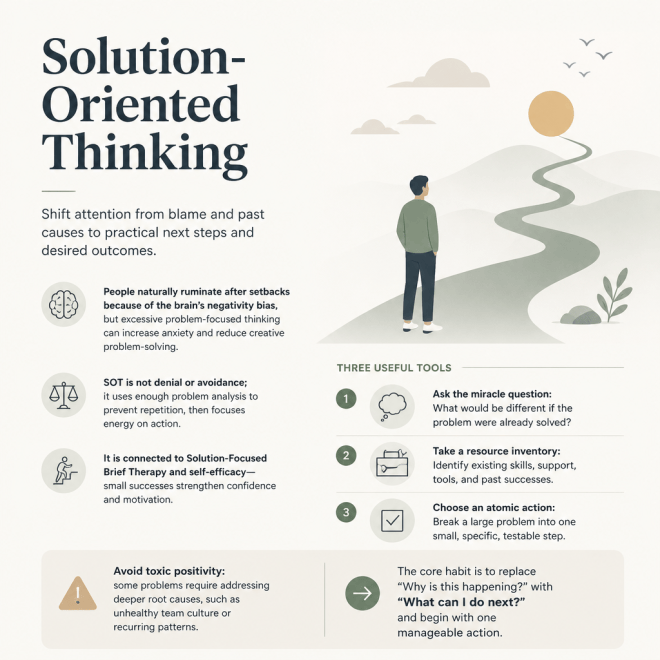
Humans are wired with a negativity bias — an old survival mechanism that makes us hyper-alert to threats and causes of failure. Thousands of years ago, obsessively analyzing “why did that predator get my friend?” kept you alive.
Today, that same wiring shows up as rumination: replaying what went wrong, hunting for blame, circling the same thoughts without landing anywhere. It feels productive because it feels like thinking hard. But it often isn’t going anywhere.
SOT isn’t about ignoring problems or pretending everything’s fine. It’s a deliberate mental shift — from analyzing the past to designing the future.
| Problem-Focused Thinking | Solution-Oriented Thinking |
| “Why did this happen?” | “What can we do about it?” |
| Looks backward, at causes | Looks forward, at outcomes |
| Often triggers anxiety or defensiveness | Builds a sense of agency and momentum |
| Ends in diagnosis | Ends in action |
This idea has real roots in clinical psychology — it draws on Solution-Focused Brief Therapy, developed by de Shazer and Berg, which found that people can often move toward change without first excavating the full history of a problem. It also connects to Bandura’s concept of self-efficacy: the more we experience ourselves successfully solving small pieces of a problem, the more we believe we’re capable of solving the next one.
1. Ask the “miracle question.” Instead of “what’s wrong here,” ask: if this problem were already solved, what would be different? Picturing the resolved state — vividly — helps your brain reverse-engineer the steps to get there. Try it the next time you’re stuck: describe the finish line before you plan the route.
2. Do a resource inventory, not a deficiency audit. When something’s not working, our default is to list everything that’s missing or broken. Try flipping it: what do I already have — skills, people, past wins, tools — that I could put to use right now? You’ll usually find more than you expect.
3. Break it into “atomic” actions. Big problems are paralyzing because they’re abstract. Instead of “fix the team’s communication,” try “send one clarifying message today.” Small, testable actions lower the psychological barrier to starting — and each small win builds confidence for the next step.
SOT has a real limitation worth naming: if you only ever ask “how do we move forward” and never ask “why does this keep happening,” you risk papering over a genuine root cause. A team with a toxic culture doesn’t need a better to-do list — it needs the culture addressed.
The healthiest approach uses problem analysis to inform the plan, without letting it anchor the whole process. Understand the “why” enough to avoid repeating it — then spend most of your energy on the “how.”
Your brain’s default setting after a setback is to look backward. Solution-oriented thinking is the practiced skill of catching that impulse and redirecting it — toward what’s next, not just what went wrong. It won’t replace honest diagnosis when a real root cause needs fixing, but for most everyday obstacles, it’s the faster, more empowering path from stuck to moving again.
Next time you catch yourself asking “why is this happening,” try pausing and asking “what’s one small thing I can do about it right now?” That single shift in framing is where solution-oriented thinking begins.
Continuous self-improvement through daily learning, reflection, and reading. These practices enhance adaptability, prevent stagnation, and promote personal growth while fostering…
The chakra system, historically revered in Eastern traditions but often dismissed by Western science, is gaining recognition through modern research….
The content discusses effective recovery strategies from stress, highlighting the mismatch between common relaxation methods and actual needs. It emphasizes…
The concept of karma is viewed through a psychological lens as personal accountability, emphasizing that actions have consequences affecting one’s…
The post challenges conventional self-development notions by emphasizing quality over quantity in personal growth. It highlights the importance of being…
Imagery Rehearsal Therapy (IRT) is an innovative, non-pharmacological approach that helps individuals address chronic nightmares, traditionally seen as untreatable. The…
Pip: What if the problem with your mind isn’t what’s in it — but that you’ve been misidentifying who’s doing the looking? Dr. K. Kumar has some thoughts, and they go back a few thousand years.
Mara: Today we’re covering two territories: the ancient architecture of a calm mind, and the question of whether modern psychology is even asking the right questions about consciousness.
Pip: Let’s start with what serenity actually costs you — and what it asks you to give up first.
Pip: The frame here isn’t “try harder to relax.” It’s a diagnostic: your mind has specific structural obstacles, and peace is what’s left when you clear them.
Mara: The post sets this up directly — “Achieving peace of mind is not about acquiring external knowledge — it is a diagnostic process of removing structural mental obstacles. By clearing away these psychological veils, you shift from being reactively fragmented to occupying a place of calm self-mastery.”
Pip: So serenity isn’t added on top — it’s already there underneath. The work is subtraction.
Mara: Right. The post maps six internal obstacles — desire, anger, greed, delusion, pride, jealousy — and shows how they cascade. Desire blocked becomes anger; anger clouds judgment; clouded judgment erases past wisdom; and without wisdom, reasoning collapses entirely.
Pip: That’s not a bad mood. That’s a full system failure triggered by wanting something you didn’t get.
Mara: And beneath those six sits a deeper layer: five root afflictions, starting with ignorance — specifically, confusing your temporary thoughts and body with your actual self.
Pip: The antidotes aren’t imposed virtues, though. The post is clear that peace, compassion, contentment, equanimity, and clarity are natural qualities that surface once the obstacles are removed — not disciplines you bolt on.
Mara: The practical side includes what the post calls a Social Blueprint: meet happiness with friendliness, suffering with compassion, virtue with joy, and harmful behavior with neutrality. And the Ocean Mindset — remain steady while desires and events flow in continuously.
Pip: The post also connects all of this to modern neuroscience — practicing compassion calms the stress response and rewires neural pathways — and to CBT’s core move of observing thoughts rather than fusing with them.
Mara: Which is exactly where the next territory picks up — because one framework asks what to do with your thoughts, and the other asks who’s watching them.
Mara: Modern psychology maps behavior, cognition, and trauma with real precision. The question this post raises is whether it’s looking in the right place for the observer doing the experiencing.
Pip: The post puts it plainly: “Modern science focuses heavily on the contents of the mind while neglecting the nature of the observer.”
Mara: That gap is where Advaita Vedanta steps in. The concept of Sakshi — Witness Consciousness — holds that you are not your memories, traits, or mental processes. You are the unchanging awareness that observes all of them.
Pip: Which is a bigger claim than CBT’s self-distancing, where you step back from a thought. This says the thing doing the stepping back is your actual identity.
Mara: The post extends this through four states of experience from the Mandukya Upanishad — waking, dreaming, deep sleep, and Turiya, described as the foundational background awareness behind all three. The analogy the post uses: Turiya is the movie screen, untouched while scenes continuously change.
Pip: And suffering, in this framework, isn’t a cognitive distortion to be corrected. It’s a case of mistaken identity.
Mara: Specifically, Avidya — ignorance of your true nature. The post argues that misidentifying the temporary mind-body complex as your core self is the root, and that recognizing you are the observer of the ego, not the ego itself, is where real relief lives.
Pip: Modern therapy targets emotional regulation and resilience. This framework targets something it calls Moksha — liberation from ego identification altogether — where compassion stops being a moral effort and becomes, as the post puts it, a natural reflex.
Mara: The post’s conclusion is integrative: Western clinical tools handle behavioral change and symptom management; Vedantic insight supplies the framework for self-realization. Neither alone is the complete picture.
Pip: Two frameworks, one underlying move — stop treating the noise as the signal.
Mara: Whether it’s clearing mental obstacles or recognizing the witness behind them, the direction is the same: inward, and then stable.
Pip: More to explore next time.


