
Move like
water.
Meet life
with wisdom.
What if a calmer mind did not come from controlling everything—but from learning what to hold, what to soften, and what to let flow?
This playful learning journey explores the Tao Te Ching through a psychologist’s lens: emotional flexibility, attention, relationships, self-awareness and everyday choices.
Nine ideas. One inner compass.
Choose a doorway. Each Taoist principle points towards a practical psychological skill—not a rule to obey, but an invitation to experiment.
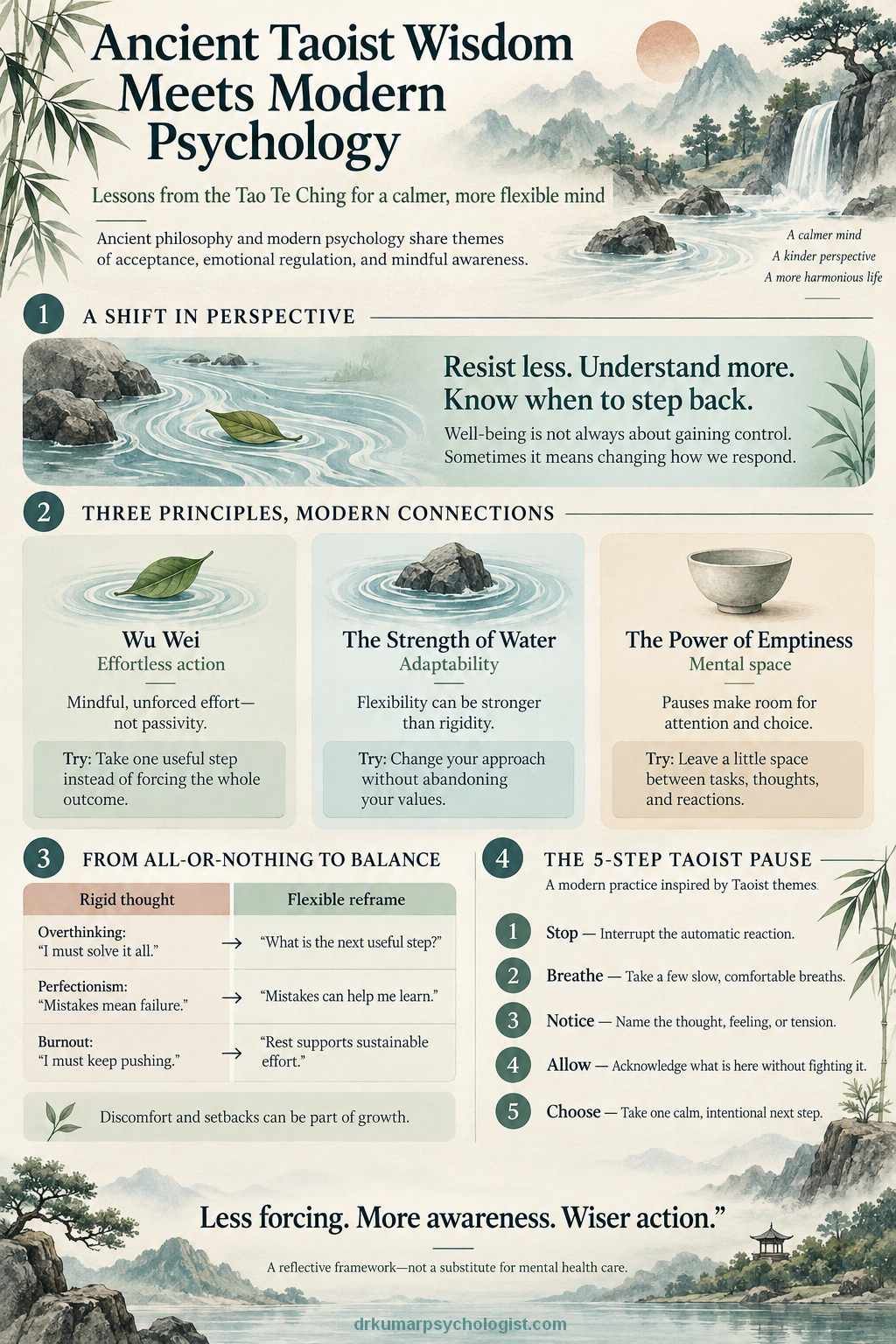
Accept the ungraspable
Make room for uncertainty instead of fighting reality.
Act without forcing
Trade frantic effort for purposeful, well-timed action.
Become like water
Stay flexible in strategy and steady in values.
Make space
Protect quiet attention and the pause before reaction.
Hold two truths
Step beyond black-and-white thinking.
Loosen the ego
Listen without turning every difference into a contest.
Choose enough
Notice when comparison turns desire into dissatisfaction.
Practise the three treasures
Bring kindness, moderation and humility into daily life.
Guide, don’t grip
Support autonomy instead of controlling every outcome.
Don’t just read the wisdom.
Try it on.
Choose how you might respond in a familiar situation. There is no perfect human response. Explore which choice creates more room for clarity, flexibility and values-led action.
Someone criticises your work.
A colleague points out a mistake in a project you worked hard on. You feel your chest tighten and immediately want to defend yourself.
What could you do next?
Wisdom, translated into practice.
Tap each card to reveal a psychologist’s interpretation and a small experiment you can try this week.
Effort without strain
Not passivity. It is responding effectively without adding unnecessary struggle.
Try this experiment
Before a task, ask: “What is the next useful step?” Do that one step before planning ten more.
Softness with strength
Adapt your approach when reality changes; keep your deeper values intact.
Try this experiment
When a plan fails, write down two alternative routes to the same meaningful goal.
The useful pause
Attention needs breathing room. A pause can interrupt an automatic reaction.
Try this experiment
Take a two-minute screen-free pause between activities. Notice your body and attention without trying to fix them.
Think in both/and
Two apparently opposite experiences can both contain truth.
Try this experiment
Complete the sentence: “This is difficult, and one thing I can learn or do is…”
Quiet confidence
Self-worth does not need to be defended in every conversation.
Try this experiment
In one conversation, ask a curious question before explaining your own position.
Return to what matters
Less comparison can create more room for intrinsic meaning and gratitude.
Try this experiment
At the end of the day, name one thing that was enough: a moment, a relationship, an effort or a small pleasure.
Meet your own patterns.
Use the prompts as a tiny workbook. Your writing stays in this page while it is open; it is not sent anywhere.
Where am I using force when flexibility might help?
What is within my influence—and what is not?
What would “being like water” look like this week?
Can you spot the Taoist move?
A quick, low-pressure knowledge check. Learn from the explanation after each answer.
Your one-minute Taoist practice
Pause. Notice what is happening. Soften the unnecessary struggle. Choose one useful action. Release the demand to control everything that follows.
Disclaimer: This is a creative, exploratory interpretation inspired by ideas from the *Tao Te Ching* and perspectives from psychology. It does not represent Taoist philosophy in its entirety, nor does it comprehensively reflect established psychological theories, research or clinical practice. The ideas, activities and connections presented here are intended to spark curiosity, encourage critical thinking, invite self-reflection and inspire readers to explore different ways of understanding themselves and everyday life. Rather than offering definitive conclusions, this is an invitation to think, question, reflect and develop your own perspective.