
Learn • Grow • Thrive
Behavioral Activation for Depression
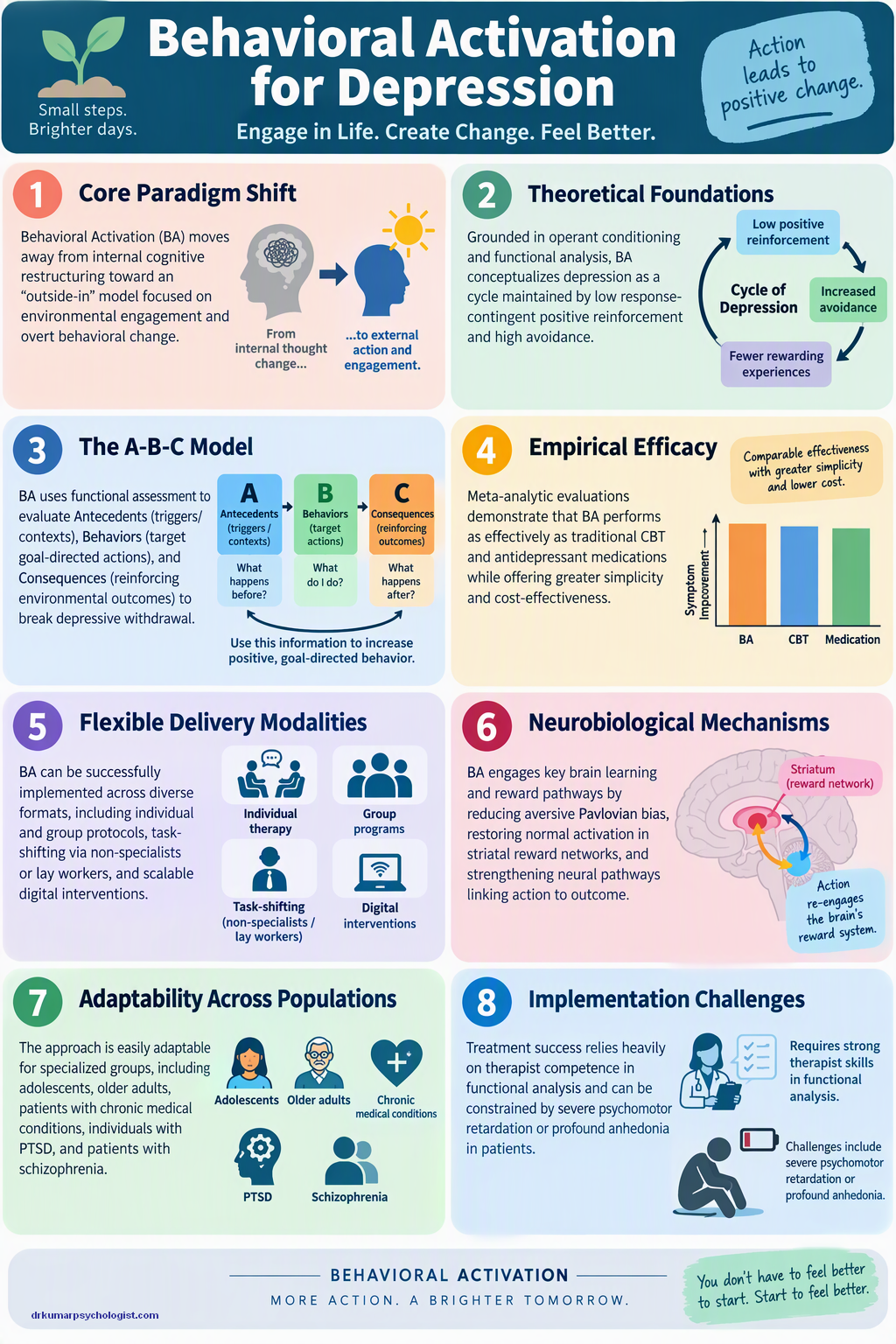
A scientific overview of the theoretical foundations, efficacy, clinical applications, and practical use of Behavioral Activation (BA): an “outside-in” approach that uses meaningful action to help disrupt depressive withdrawal.
Executive Summary
Behavioral Activation (BA) is a structured, evidence-based psychological treatment for depression. Rather than waiting for motivation or mood to improve before taking action, BA helps people gradually re-engage with valued, meaningful, and rewarding activities.
Outside-in approach
BA focuses on changing behaviour and environmental engagement to influence mood.
Breaks avoidance
It helps people replace withdrawal and avoidance with valued, goal-directed action.
Restores reinforcement
Meaningful activities can rebuild contact with reward, pleasure, achievement, and connection.
Practical and scalable
BA can be delivered individually, in groups, digitally, and by trained non-specialists.
Theoretical Foundations
BA is rooted in behavioural theory, especially operant conditioning and functional analysis. It focuses on the relationship between what a person does, the context in which they do it, and the consequences that follow.
The “Outside-In” Paradigm
Depression can weaken the link between behaviour and reward. Fatigue, low interest, and anhedonia may lead a person to withdraw from activities. Withdrawal then reduces opportunities for pleasure, achievement, connection, and mastery—further deepening low mood.
BA interrupts this cycle by helping a person take small, planned actions even before motivation feels high. Action becomes a route toward improved mood, rather than something that must wait for mood to change first.
BA uses functional analysis to understand what maintains depression and avoidance.
Antecedents
Triggers or contexts linked with distress, fatigue, or low mood. Example: waking up late, receiving a difficult message, or being alone at home.
Behaviours
Actions taken in response. These may include avoidance, staying in bed, cancelling plans, or withdrawing from others.
Consequences
Short-term relief from avoiding a task, but long-term loss of reward, confidence, connection, and routine.
BA Compared With Cognitive Therapy
Both approaches can be effective for depression, but they begin with different targets.
| Core dimension | Traditional Cognitive Therapy (CBT) | Behavioral Activation (BA) |
|---|---|---|
| Primary target | Negative automatic thoughts and schemas | Environmental interaction and overt actions |
| Mechanism | Cognitive reframing and restructuring | Response-contingent positive reinforcement |
| Therapeutic logic | Inside-out: modify cognition to alter behaviour | Outside-in: alter behaviour to modify mood |
| Primary tools | Thought records and cognitive reframing | Functional analysis and structured activity scheduling |
Efficacy and Delivery
Research suggests that BA can be as effective as traditional CBT and antidepressant medication for many people with depression, while offering advantages in simplicity, accessibility, and cost-effectiveness.
Individual and group
Individual BA can reduce depressive symptoms, while group formats may offer peer support and lower-cost delivery.
Task-sharing
Trained non-specialists, paraprofessionals, and lay workers can deliver BA in some settings, expanding access where mental-health professionals are limited.
Digital delivery
Web-based and mobile BA programmes may increase convenience, reach, and consistency of treatment support.
Possible Mechanisms of Change
BA may work by strengthening reward learning, reducing avoidance, and rebuilding links between action and positive outcomes.
Reinforcement learning
BA may reduce avoidance-based learning patterns and increase sensitivity to reward.
Neural plasticity
Repeated engagement in valued activities may support new learning and more adaptive reward-related brain activation.
Action-outcome links
Structured activities can strengthen the connection between effort, action, and meaningful consequences.
Targeting anhedonia
Gradual exposure to potentially rewarding activities may address loss of interest and motivational difficulties.
Adaptations Across Populations
Because BA focuses on observable behaviour and practical action, it can be adapted across age groups and clinical contexts.
| Clinical context | Adaptation strategy | Potential benefits |
|---|---|---|
| Adolescents | Focus on concrete, observable behaviours rather than abstract reasoning | May support peer engagement and overcome developmental cognitive barriers |
| Older adults | Adapt activities to physical limitations and functional changes | May counter isolation and reduced mobility associated with late-life depression |
| Medical conditions | Use simple, low-effort actions for conditions such as stroke, TBI, or dialysis | May improve engagement without requiring intensive executive functioning |
| PTSD and veterans | Target avoidance behaviours connected with trauma-related distress | May disrupt avoidance and withdrawal patterns that maintain distress |
| Schizophrenia | Use simple goal-directed actions and routine building | May reduce social withdrawal, apathy, and negative symptoms |
Interactive Activity: Build a Behavioral Activation Plan
This activity is for reflection and practice. Choose one small, achievable action that connects with a personal value—not something that depends on feeling motivated first.
Weekly Activity Tracker
Track whether you completed your planned actions. Completion matters more than whether the activity felt enjoyable at first.
0 of 7 activities completed
Implementation Challenges
Severe symptoms
Profound fatigue, psychomotor slowing, or anhedonia can make initial activity scheduling difficult.
Quality of delivery
Benefits depend on careful functional analysis, not simply making a list of activities.
Non-response
Some people may need additional support, such as combined treatment or adaptation of the plan.
Future Directions
Transdiagnostic integration
BA may be combined with approaches such as Acceptance and Commitment Therapy (ACT) and mindfulness to address broader emotional difficulties.
Digital innovation
Smartphone sensing, wearable activity tracking, and real-time prompts may support more personalised activity scheduling.
Conclusion
Behavioral Activation is a scientifically validated, scalable, and adaptable intervention for depression. By disrupting withdrawal and rebuilding positive reinforcement through functional analysis and values-based activity scheduling, BA offers a practical path toward recovery and improved functioning.
Remember: Start small, act according to your values, and let action create new opportunities for reward and change.
This page is for educational purposes and does not replace assessment, psychotherapy, crisis support, or treatment from a qualified mental health professional. If you experience thoughts of self-harm or suicide, contact local emergency services or a crisis support service immediately.
drkumarpsychologist.com
- Beck, A. T., Rush, A. J., Shaw, B. F., & Emery, G. (1979). Cognitive therapy of depression. Guilford Press.
- Dimidjian, S., Hollon, S. D., Dobson, K. S., Schmaling, K. B., Kohlenberg, R. J., Addis, M. E., … & Jacobson, N. S. (2006). Randomized trial of behavioral activation, cognitive therapy, and antidepressant medication in the acute treatment of adults with major depression. Journal of Consulting and Clinical Psychology, 74(4), 658–670.
- Ferster, C. B. (1973). A functional analysis of depression. American Psychologist, 28(10), 857–870.
- Jacobson, N. S., Dobson, K. S., Truax, P. A., Addis, M. E., Koerner, K., Gollan, J. K., … & Prince, S. E. (1996). A component analysis of cognitive-behavioral treatment for depression. Journal of Consulting and Clinical Psychology, 64(2), 295–304.
- Lewinsohn, P. M. (1974). A behavioral approach to depression. In R. J. Friedman & M. M. Katz (Eds.), The psychology of depression: Contemporary theory and research (pp. 157–185). Winston-Wiley.
- Martell, C. R., Dimidjian, S., & Herman-Dunn, R. (2010). Behavioral activation for depression: A clinician’s guide. Guilford Press.