
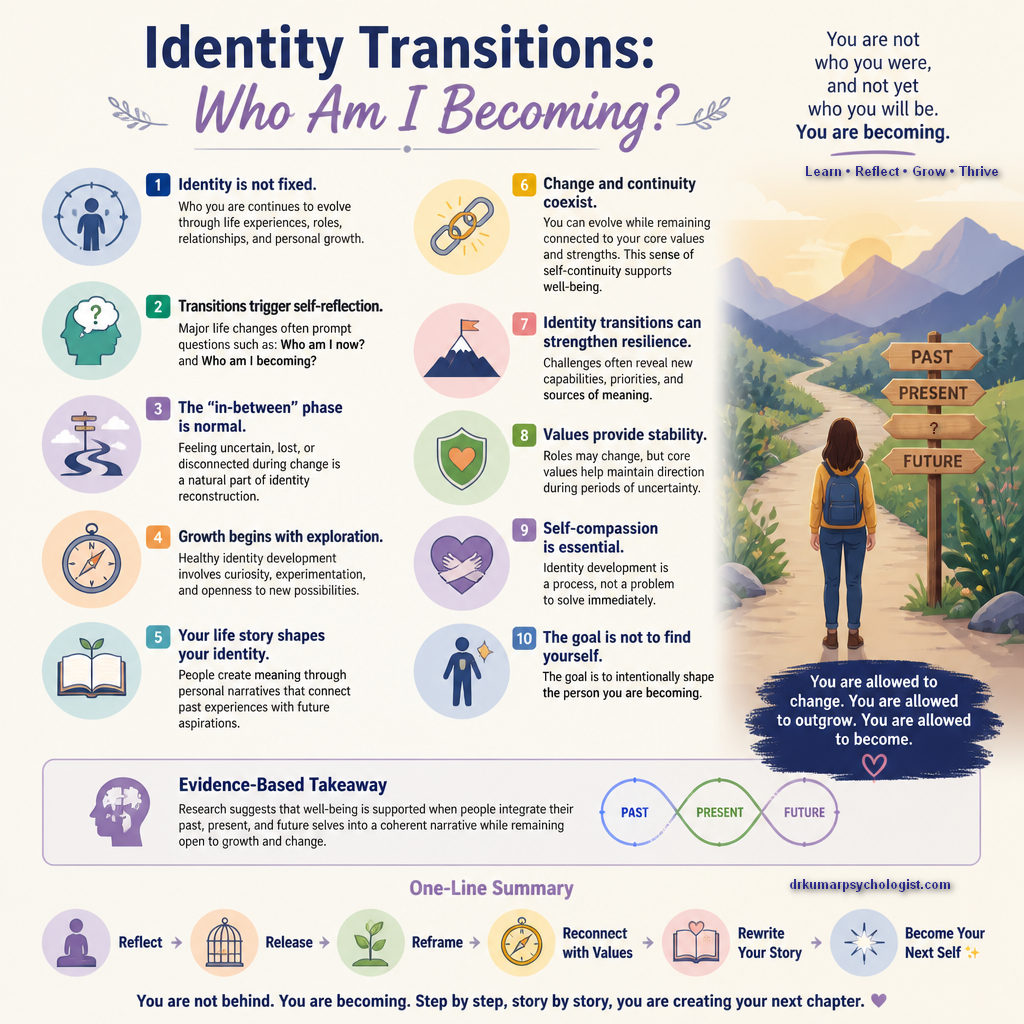
Identity transitions prompt critical reflection on who we are becoming during significant life changes. While discomfort and uncertainty arise, these periods represent growth opportunities rather than instability. Acknowledging that identity is an ongoing journey encourages us to integrate past experiences and actively shape our evolving selves towards authenticity.
There are moments in life when the question is no longer“Who am I?” but“Who am I becoming?” A career change, becoming a parent, moving to a new city, recovering from illness, ending a relationship, retirement, or even personal growth can disrupt familiar ways of seeing ourselves. During these transitions, our old identity may no longer fit, while our new identity is still taking shape.
Although often uncomfortable, identity transitions are a normal part of human development. Rather than a sign of instability, they can be opportunities for growth, meaning-making, and psychological maturity.
Identity is not a destination but an ongoing process. Across the lifespan, each transition invites us to revisit the question:“Who am I becoming?”
The answer is rarely immediate. It emerges through reflection, experimentation, meaningful relationships, and lived experience. In times of change, we do not simply lose an old identity; we actively construct a new one. The challenge is not to become someone entirely different, but to integrate what we have learned into a more authentic and evolving version of ourselves.
Ultimately, identity transitions remind us that growth is not about finding a permanent self. It is about developing the capacity to adapt, reflect, and continue becoming.
Identity Transitions: Who Am I Becoming?
Identity is not fixed. It continues to evolve through life experiences, roles, relationships, and personal growth. This interactive page invites you to reflect, release, reframe, reconnect with your values, and begin shaping your next self.
Understanding Identity Transitions
Major life changes often prompt important questions: Who am I now? and Who am I becoming? Feeling uncertain during these periods is not a sign that something is wrong—it is often part of identity reconstruction.
Identity evolves
You are not fixed; your sense of self can grow through experience.
In-between is normal
Uncertainty, loss, and disconnection can be part of transition.
Values give direction
Roles may change, but values can remain a stable inner compass.
Growth needs openness
Curiosity, experimentation, and self-compassion support healthy change.
Activity 1: My Identity Timeline
Identity develops through the connection between your past, present, and future. Write a few honest notes in each box.
🕰️ Past self
What experiences, roles, challenges, or relationships shaped who you have been?
📍 Present self
Who are you now? What matters to you, and what are you navigating?
✨ Future self
Who would you like to become? What qualities or possibilities appeal to you?
Activity 2: Release, Keep, Explore
Identity transitions involve both change and continuity. Choose what you may be ready to release, what you want to keep, and what you would like to explore.
Select up to three items in each category.
Activity 3: Values Compass
Values can provide stability when roles and circumstances change. Move each slider to show how important each value currently feels to you.
Activity 4: Rewrite One Sentence
Identity stories can be revised. Begin with a self-critical or limiting thought, then practise a more compassionate and growth-oriented reframe.
Activity 5: Letter to My Next Self
Write a short, kind letter to the version of you that is emerging through this transition.
Dear future me,
With hope,
Me
Reflect · Release · Reframe · Reconnect
Identity development is a process, not a problem to solve immediately. You can honour your past, live in the present, and remain open to the person you are becoming.
Evidence-based takeaway: Well-being is supported when people integrate past, present, and future selves into a coherent narrative while remaining open to growth and change.
This page is for reflection and educational purposes. It does not replace counselling, psychotherapy, crisis support, or professional mental health care.
Branje, S., de Moor, E. L., Spitzer, J., & Becht, A. I. (2021). Dynamics of identity development in adolescence: A decade in review. Journal of Research on Adolescence, 31(4), 908-927.
McAdams, D. P., & McLean, K. C. (2013). Narrative Identity. Current Directions in Psychological Science, 22(3), 233-238.
Sedikides, C., Hong, E. K., & Wildschut, T. (2023). Self-Continuity. Annual Review of Psychology, 74, 333-361.
Van Halen, C., Bosma, H. A., & Van der Meulen, M. (2020). Experiencing Self-Definition Problems over the Life Span. Identity, 20(3), 170-187.
Connolly, C., & Gobet, F. (2024). Self Concept: Its Evolution During Career Stage Transitions. In Transition Expertise and Identity. Cambridge University Press.