
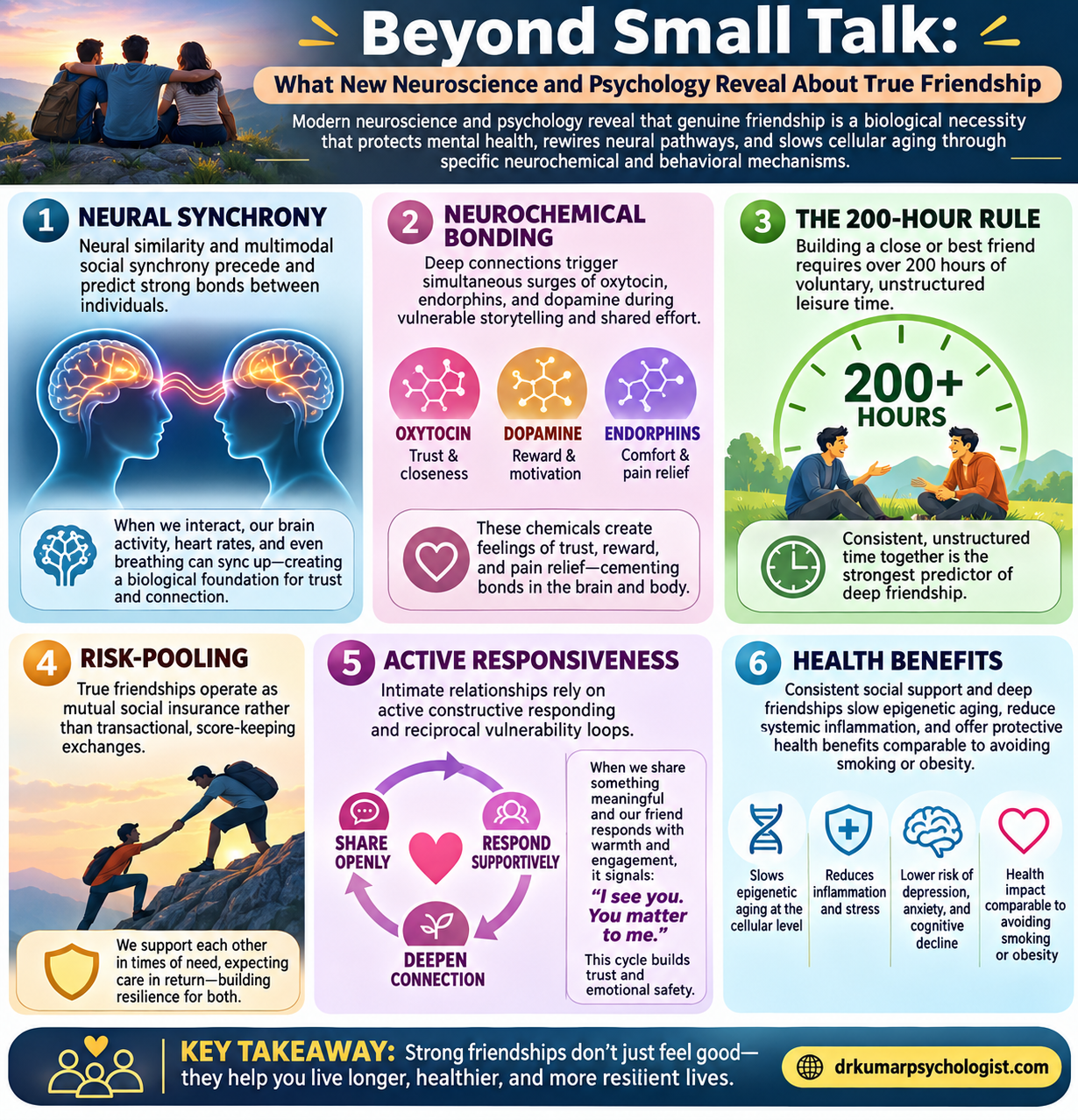
We live in an era of relentless digital connectivity—group chats, status updates, and rushed coffee catch-ups—yet loneliness remains widespread. Breakthrough research from 2024–2026 shows that deep friendship isn’t built on shared hobbies or proximity; it is a biological necessity that aligns brainwaves, slows epigenetic aging, and operates under specific psychological rules.
Neural similarity predicts friendship before words are spoken.
Unstructured leisure required for a close or best friend.
Loyalty in crises beats transactional scorekeeping.
Cumulative support slows epigenetic clocks & IL-6.
The gap between feeling socially busy and feeling genuinely known comes down to the difference between acquaintance and attachment. Contemporary behavioral surveys—including the American Friendship Project—show that adults are spending noticeably less time with friends and more time at home or with family, often citing exhaustion, busyness, and financial barriers (~40% report cost as an obstacle).
Yet modern science reframes friendship from an optional leisure preference into a foundational public health asset—comparable in protective power to quitting smoking or maintaining cardiovascular fitness. Explore the six interactive research modules below to examine how your brain selects, builds, and biologically benefits from deep friendship.
Neural Synchrony & Self-Other Overlap Visualizer
Toggle between a polite small-talk interaction and a close friendship bond to observe real-time EEG phase-locking, physiological synchrony, and neural identity merging.
Neural Identity Mapping: “Self-Other Overlap”
18% OverlapStranger / Small Talk: Your brain encodes the other person as an external social object. Weather or schedule chatter does not reveal enough of their inner world to merge neural representations.
1. Neural Similarity Precedes Bonding
Neuroimaging published in Nature Human Behaviour (2025) revealed that strangers whose brains respond similarly while watching film clips are significantly more likely to become friends months later. The brain actively maps social networks using neural alignment as a compatibility heuristic.
2. Multimodal Social Synchrony
Once bonded, close friends display higher EEG phase-locking values, synchronized galvanic skin responses, and aligned attentional rhythms when sharing aesthetic experiences or collaborating on physical tasks.
3. Anterior Cingulate Cortex (ACC) Empathy
In close friendships, the same neural circuits fire when you think about your friend as when you think about yourself. When they experience pain, your ACC activates in sympathy—explaining why deep conversations feel meaningfully demanding.
The Neurochemical Bonding Cocktail
Deep friendship isn’t powered by a single hormone—it requires three neurochemical systems firing together. Select an interaction style below to see how your brain’s bonding chemistry shifts.
Trust & Threat Reduction
Lowers amygdala threat detection and fosters psychological safety. Triggered not only by touch, but also by synchronized laughter and emotional storytelling.
Shared Resilience & Pain Buffer
The body’s natural painkillers. Rowing studies show friends exercising together exhibit significantly higher physical pain thresholds than strangers doing the exact same workout.
Anticipatory Joy & Reward
The brain encodes a close friend as a primary reward—generating an uplifting surge of dopamine simply from anticipating time together.
The 200-Hour Rule: Friendship Investment Calculator
Research led by friendship scientist Jeffrey Hall reveals that turning an acquaintance into a close confidant follows a predictable time curve—provided the hours are spent in voluntary, unstructured leisure rather than forced workplace proximity.
Light conversation & familiar comfort.
Voluntary plans & personal stories.
Deep trust, laughter & vulnerability.
Risk-Pooling vs. Transactional Scorekeeping
Cross-cultural research from the Human Generosity Project (2025) shows true friendships reject 50/50 debt-tracking in favor of risk-pooling—mutual social insurance during unpredictable crises.
Friends step in during emergencies without tallying favors or expecting immediate repayment (exemplified by Maasai osotua partnerships and resilient modern bonds).
In volatile life seasons (illness, grief, job loss), strict reciprocity collapses when one person cannot temporarily repay—whereas risk-pooling absorbs shocks.
Across U.S. and global samples, people prioritize knowing a friend will show up when it counts over equal coffee-bill splitting.
Interactive Simulator: The Vulnerability Loop & Active Constructive Responding
Longitudinal studies (University of Kansas) show that intimate friendships aren’t “low maintenance”—they thrive on responsiveness. Test how different reactions either build an oxytocin trust bank or trigger amygdala threat.
“Honestly, I’ve been feeling overwhelmed lately and worried I’m falling behind in my career compared to everyone else.”
Awaiting Interaction Choice
Choose either Response Option 1 or Option 2 on the left to see how the brain processes emotional bids and reciprocal risk.
How Friendship Shapes Aging, Mental Health & Society
Explore synthesized evidence from 2024–2026 global cohorts across cellular aging, adolescent longitudinal tracking, digital communication, and cross-cultural social networks.
Slower Epigenetic Aging
Analyzing over 2,100 adults, Ong et al. found that cumulative social advantage—sustained warmth and emotional support from friends, family, and community across decades—slows biological aging on GrimAge and DunedinPACE epigenetic clocks and lowers systemic inflammation (interleukin-6).
Vital Kin Substitutes
Across 87 low-, middle-, and high-income nations, friendships act as an indispensable safety net for unpartnered or childless older adults, buffering against mental health declines associated with daily physical limitations.
Inclusive Community Support
Social isolation carries mortality risks comparable to smoking or obesity. For adults with intellectual disabilities and retirees navigating role transitions, structured peer networks provide essential companionship and resilience.
“Bids for Depth” Conversation Deck
Tap any card to flip from a scripted small-talk habit to a science-backed prompt that triggers neural synchrony, oxytocin, and reciprocal disclosure.
“How have you been? Busy week?”
“What’s been taking up the most headspace for you this week?”
“Got any plans for the weekend?”
“What is something small or big you’re genuinely looking forward to right now?”
“Let’s sit at a loud coffee shop for 30 minutes.”
“Want to take a 45-minute walk outside or cook dinner together?”
Key Scientific References
- 1. Neural Similarity & Friendship Formation (2025). “Neural similarity predicts whether strangers become friends.” Nature Human Behaviour, 9, 2285–2298.
- 2. Multimodal Social Synchrony & Network Cognition. Studies on EEG phase-locking, galvanic skin alignment, aesthetic synchrony, and social network mapping during group coordination (Bohrium Neuroscience Synthesis).
- 3. Pennington, N., Hall, J. A., & Holmstrom, A. J. (2024–2026). The American Friendship Project: A report on the status and health of friendship in America. PLOS ONE & University of Kansas longitudinal reports on time allocation and the 200-hour threshold.
- 4. Ayers, J. D., & Aktipis, A. (2025). Human Generosity Project cross-cultural research on risk-pooling social insurance vs. transactional reciprocity in friendship.
- 5. Ong, A. D., Mann, F. D., & Kubzansky, L. D. (2025). “Cumulative social advantage is associated with slower epigenetic aging and lower systemic inflammation.” Brain, Behavior, and Immunity – Health (Cornell University / MIDUS cohort).
- 6. Global Aging & Public Health Equity Studies. Cross-national investigations across 87 countries on friendship among aging adults without partners/children, adults with intellectual disabilities, and retirement transitions (European Journal of Ageing, 2026; AARP Friendship Study, 2026).
- 7. Adolescent Popularity vs. Friendship Quality (2026). University of Virginia longitudinal study tracking mid-teen popularity vs. close best-friend quality into young adulthood (age 25).
- 8. Digital Communication & Adolescent Well-Being (2026). Online communication with offline vs. online-only friends and mental well-being. Child and Adolescent Mental Health (Swedish HBSC cohort) & integrative reviews on digital relationality and Aristotelian online friendship (2015–2025).
- 9. Cross-Cultural & Workplace Friendship Meta-Analyses (2026). Comparative studies on UK group-oriented vs. Japan dyadic-oriented friendship styles, 12-country closeness preferences, and Chen et al. (2026) in European Journal of Work and Organizational Psychology.
- 10. Social Networks, Intergroup Ties & Civic Cohesion. Natural experiments on university friendship networks narrowing political polarization and structural predictors of intergroup/interminority friendships.