
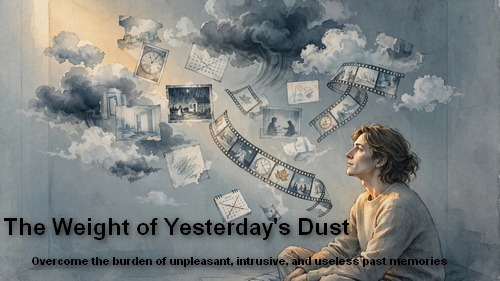
Understanding the Burden of Unpleasant, Intrusive, and Useless Past Memories
“The past is not always behind us. Sometimes it sits quietly in the corners of the mind, gathering dust, waiting for the slightest disturbance to rise again.”
Introduction
Human memory is often celebrated as one of our greatest cognitive gifts. It allows us to learn from experience, preserve identity, and maintain meaningful relationships. Yet memory has a darker side. Many people carry a collection of unpleasant, intrusive, and seemingly useless memories that continue to occupy mental space long after their practical value has expired. An embarrassing comment made years ago, a failed relationship, a humiliating public mistake, or a painful rejection can return unexpectedly, producing emotions as vivid as those originally experienced.
This phenomenon raises an important question: why does the human mind preserve memories that no longer serve a constructive purpose? More importantly, what is the psychological cost of carrying these remnants of the past?
This article explores the burden of intrusive memories, examining their cognitive origins, emotional consequences, and the strategies individuals can employ to reduce their psychological weight.

What Are Intrusive and Unpleasant Memories?
Intrusive memories are involuntary recollections that enter conscious awareness without intention. Unlike deliberate remembering, these memories emerge unexpectedly and often carry strong emotional content. While some intrusive memories are associated with traumatic experiences, many involve ordinary yet painful life events.
Examples include:
- Replaying a social embarrassment from years ago.
- Remembering a hurtful comment from a former friend.
- Reliving a professional failure.
- Dwelling on missed opportunities and life regrets.
- Revisiting moments of rejection or humiliation.
These memories differ from useful recollections because they often provide little new information or guidance. Instead, they repeatedly reactivate negative emotional states.
Psychologists sometimes describe this process as rumination—the repetitive focus on distressing experiences and their meanings. Rather than promoting problem-solving, rumination typically maintains emotional suffering and reinforces negative self-perceptions.
Why Does the Brain Hold Onto Negative Memories?
From an evolutionary perspective, the answer is surprisingly practical.
Human beings evolved in environments where remembering danger increased survival. Negative experiences often contained essential lessons about threats, mistakes, and social risks. Consequently, the brain developed mechanisms that prioritize emotionally significant events.
Researchers have identified the role of the amygdala, a brain region involved in emotional processing, in strengthening memory consolidation for emotionally charged experiences. Negative events frequently receive enhanced neural processing, making them easier to recall than neutral experiences.
This tendency contributes to what psychologists call the negativity bias—the cognitive inclination to pay greater attention to unpleasant experiences than positive ones. A single criticism may remain memorable for years, while numerous compliments fade quickly.
Unfortunately, what once helped ancestors avoid danger does not always serve modern psychological well-being. The brain often treats social mistakes and emotional wounds as if they remain urgent threats, repeatedly bringing them back into awareness.
The Psychological Weight of “Yesterday’s Dust”
The metaphor of “yesterday’s dust” captures an important reality. Dust consists of particles that have settled, remnants of things that once existed. Similarly, many intrusive memories are fragments of events that no longer possess direct relevance to current life.
Yet these fragments can accumulate.
- Emotional Exhaustion
Repeatedly reliving unpleasant memories consumes emotional energy. Each recollection can trigger shame, sadness, anger, or anxiety, even when the original event is long over.
Over time, this cycle creates emotional fatigue, reducing an individual’s capacity to engage fully with present experiences. - Distorted Self-Identity
People often use memories as evidence when evaluating themselves. Unfortunately, intrusive recollections tend to highlight failures rather than successes. - A person may begin to construct an identity around isolated mistakes:
“I am incompetent.”
“I always fail.”
“People don’t like me.”
“I should have done better.”
Such conclusions frequently emerge not from objective reality but from repeated exposure to a narrow subset of memories. - Reduced Psychological Flexibility
When attention remains anchored to past disappointments, individuals become less adaptable in the present. Opportunities for growth, creativity, and connection may be overlooked because mental resources are occupied by unresolved recollections.
The result is a paradox: memories intended to protect us from future mistakes can limit our ability to move forward.
When Memory Stops Being Useful
Memory serves an important function when it contributes to learning.
For example:
Remembering a business failure may improve future decisions.
Recalling a relationship conflict may strengthen communication skills.
Reflecting on a mistake may encourage personal growth.
However, many intrusive memories lose their instructional value.
A useful memory asks:
“What can I learn from this?”
An unhelpful memory repeatedly asks:
“Why did this happen to me?”
The first promotes adaptation. The second often sustains suffering.
The distinction is critical because not every remembered experience deserves continued psychological investment. Some memories become mental clutter—occupying attention without providing benefit.
The Neuroscience of Repetition
Every time a memory is recalled, it undergoes a process known as reconsolidation. Contrary to popular belief, memories are not static recordings. They are reconstructed each time they are accessed.
This means that repeatedly revisiting a negative memory can strengthen its emotional pathways. The mind effectively rehearses distress.
Furthermore, individuals who frequently engage in rumination often develop stronger associations between certain cues and negative recollections. A song, location, smell, or casual conversation can become sufficient to trigger an unwanted memory cascade.
In this way, yesterday’s dust does not merely remain on the shelf—it continues to spread throughout the mental environment.
Strategies for Lightening the Load
- Recognize That Remembering Is Not Reliving
Many individuals unconsciously respond to memories as though the original event is occurring again.
A healthier approach involves reminding oneself:
“This is a memory, not a current reality.”
Creating psychological distance reduces emotional reactivity and helps restore perspective. - Shift From Judgment to Observation
Instead of evaluating memories through self-criticism, individuals can observe them with curiosity.
Replace:
“Why was I so foolish?”
With:
“What was I experiencing at that time?”
This change encourages self-understanding rather than self-punishment. - Practice Selective Attention
Attention functions like a spotlight. Every moment spent rehearsing painful memories is attention unavailable for meaningful present experiences.
Mindfulness practices can strengthen the ability to redirect attention away from repetitive mental loops. - Reconstruct the Narrative
A memory does not change, but its interpretation can.
A failed project may become evidence of resilience.
A rejection may become a turning point.
An embarrassment may become a reminder of personal growth.
Meaning-making allows individuals to integrate experiences rather than remain trapped within them. - Accept the Presence of Unwanted Memories
Ironically, efforts to completely suppress thoughts often make them more persistent.
Acceptance does not mean approval. It means acknowledging that some memories may occasionally appear without allowing them to dictate emotional reality.
Final thought
As we conclude, let’s take a moment to reflect on the journey we’ve embarked upon and recognize the valuable insights we’ve gained along the way. It’s essential to appreciate how far we’ve come and the lessons each experience has taught us. Looking ahead, let’s embrace the opportunities that lie before us with optimism and determination, ready to forge new paths and create lasting impact.
The burden of unpleasant, intrusive, and seemingly useless memories is a universal human experience. These recollections persist because the brain is designed to prioritize emotionally significant events, particularly negative ones. Yet mechanisms that once enhanced survival can become sources of modern psychological distress.
The challenge is not to erase the past but to alter our relationship with it.
Yesterday’s dust will always exist. Fragments of old mistakes, losses, embarrassments, and regrets are inevitable components of a remembered life. However, they need not define the present. When memories cease to serve learning and become instruments of self-punishment, their weight can be consciously reduced.
A healthier mind is not one that remembers less. It is one that knows which memories deserve a seat at the table—and which can finally be allowed to settle quietly into history.
The Weight of Yesterday’s Dust – Key takeaway
Not all memories are useful. Many unpleasant memories persist long after their lessons have been learned.
The brain is biased toward negative experiences. It stores and recalls emotionally painful events more strongly than neutral or positive ones.
Intrusive memories are often automatic. They appear without invitation and can repeatedly trigger old emotions.
Rumination is the real burden. The suffering usually comes not from the past event itself, but from mentally replaying it over and over.
A memory is not a current reality. Remembering an event does not mean it is happening again.
Negative memories can distort identity. Repeated focus on mistakes may falsely convince people that failures define who they are.
Most old regrets have diminishing informational value. Once a lesson is learned, continued replay often adds no new wisdom.
Every recall can reinforce the memory. Frequently revisiting painful experiences can strengthen their emotional impact.
Attention is a limited resource. Time spent carrying yesterday’s emotional dust reduces engagement with today’s opportunities.
Healing comes from changing the relationship with memories, not erasing them.
Self-compassion is more effective than self-punishment. Understanding past actions promotes growth better than repeated self-criticism.
Acceptance weakens the grip of intrusive memories. Fighting them often strengthens them; acknowledging them reduces their power.
Growth begins when the question changes from “Why did this happen?” to “What did this teach me?”
Core Thesis
The psychological weight of the past does not come from what happened yesterday, but from how much mental space yesterday continues to occupy today.
One response to “Burdens of Intrusive Memories Explained”
Good one sir