
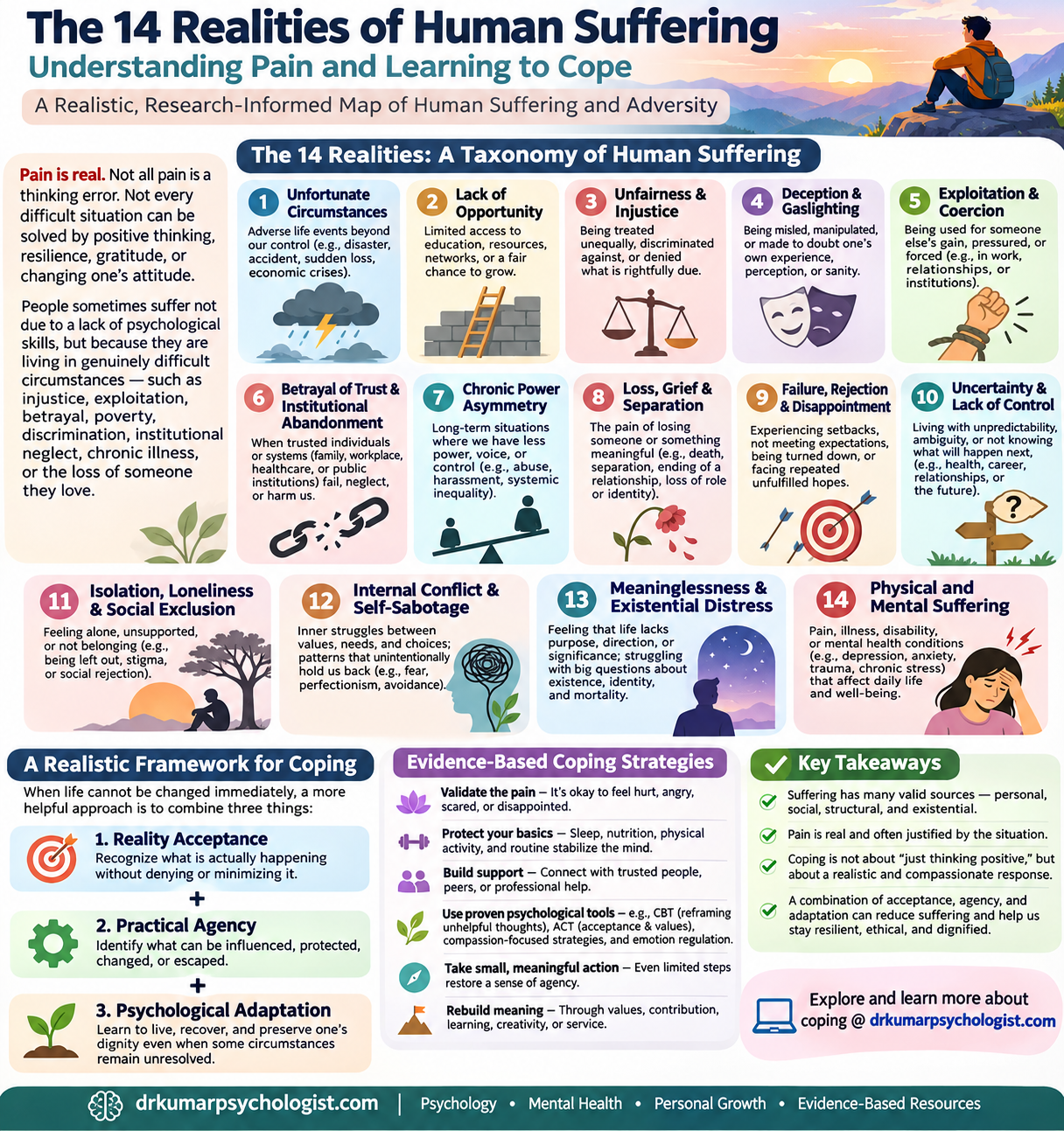
People sometimes suffer not because they lack psychological skills, but because they are living in genuinely difficult circumstances.
Pain is real. Not all pain is a thinking error. Not every difficult situation can be solved by positive thinking, resilience, gratitude, or changing one’s attitude.
Someone may be experiencing injustice, exploitation, betrayal, poverty, discrimination, institutional neglect, chronic illness, or the loss of someone they love. Telling such a person to simply change their mindset can become another form of invalidation.
Coping with the 14 core forms of human suffering
A mindset-focused, practical guide. It does not promise to remove pain. It helps you protect your agency, dignity, safety and long-term well-being by matching the right stance to the hardship you face.
The core mindset
Pain comes from events, losses and barriers outside your immediate control. Suffering grows when we fight reality, internalize systemic failures, abandon our values, or sink into learned helplessness.
1. Acknowledge first, fix second
Name what happened without minimizing it. Denial and forced positivity carry heavy costs over time.
2. Sort by control
Separate what you can change, what you can influence, and what you must accept.
3. Think small and near
Focus on the next 24 hours, not a lifetime of uncertainty. Small actions rebuild agency.
4. Separate event from identity
“This happened to me” is not “This is who I am.”
5. Treat feelings as information
Anger signals violated values, grief signals love, anxiety signals uncertainty about something that matters.
6. Do not carry it alone
Seeking a safe person, community or professional is part of coping, not a sign of failure.
| Dimension | Core question | Focus |
|---|---|---|
| External reality | What happened to me? | Events, barriers, losses, injustice, physical conditions |
| Internal experience | What is happening inside me? | Emotional waves, fear, anger, grief, physical tension |
| Response and adaptation | What can I do right now? | Protection, boundaries, values-based action, support |
Explore the 14 forms of suffering
Choose a domain, then select the hardship closest to yours.
Sort a stressor with the three circles
Type something that is weighing on you, then place it. Energy spent in the circle of control builds resilience. Energy spent in the circle of concern drains it.
Control
Habits, boundaries, effort, preparation, choicesInfluence
Communication, advocacy, negotiation. No guarantees.Concern
Economy, the past, other people’s decisionsA daily 15-minute practice
Resilience needs regular maintenance, not only emergency repair. Tick each block as you finish it.
0 of 6 blocks complete
When self-help is not enough
Mindset tools are not a substitute for specialist support. Select your situation.