
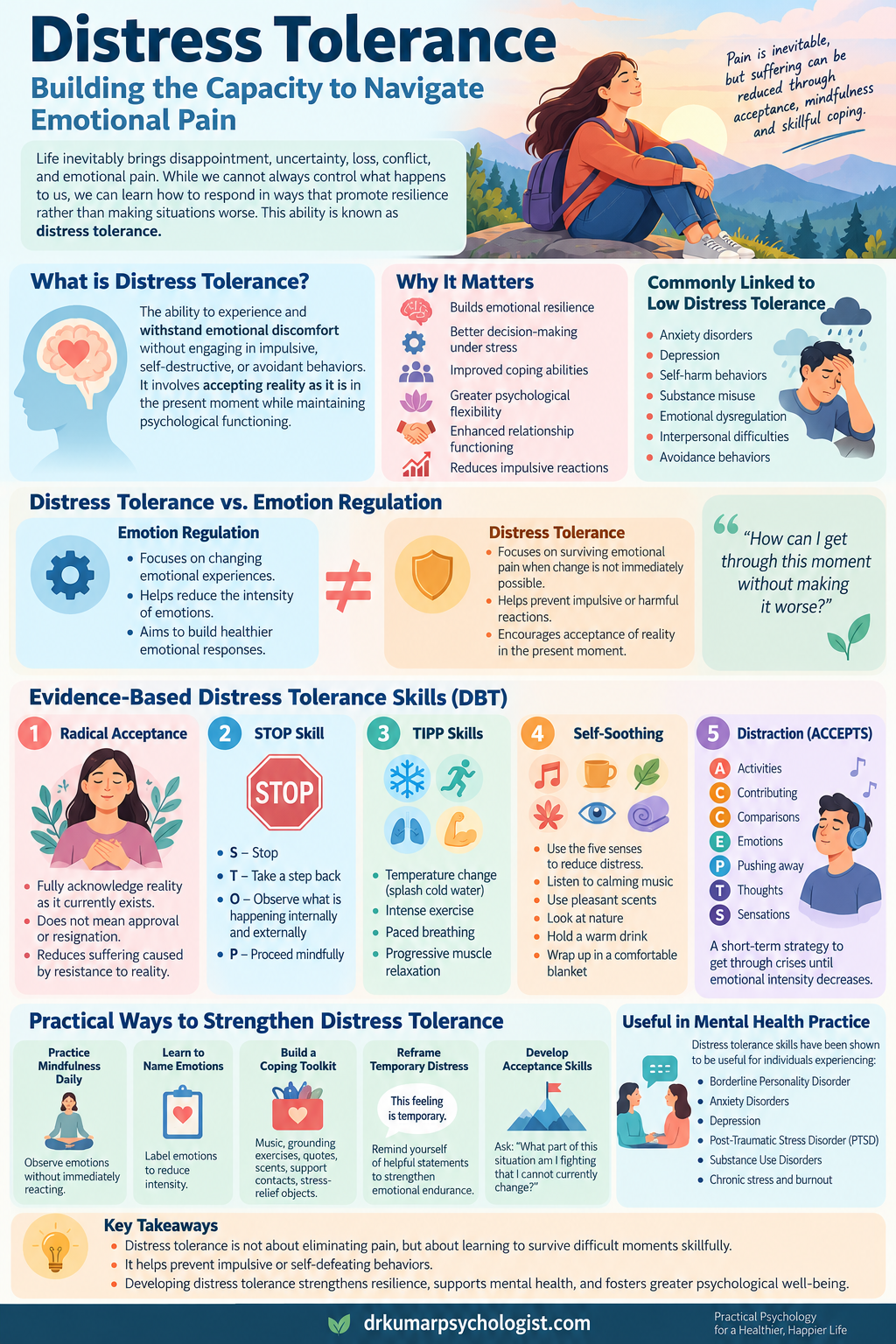
The content discusses distress tolerance, a key concept in Dialectical Behavior Therapy (DBT) developed by Marsha Linehan. It emphasizes the ability to endure emotional pain without resorting to harmful behaviors, focusing on skills such as Radical Acceptance and TIPP. Distress tolerance is vital for improving emotional resilience and coping strategies in challenging situations.
Distress Tolerance: Building the Capacity to Navigate Emotional Pain
We can’t always control what happens to us, but we can learn to respond in ways that build resilience rather than making things worse.
What is Distress Tolerance?
A core concept in Dialectical Behavior Therapy (DBT), developed by Marsha Linehan, distress tolerance is the capacity to experience and withstand emotional discomfort without impulsive, self-destructive, or avoidant behavior. It isn’t about eliminating pain. It’s about getting through hard moments skillfully, accepting reality as it is right now instead of spending energy fighting what can’t immediately be changed.
Problems arise when people try to escape, suppress, or avoid painful emotions through substance use, aggression, withdrawal, rumination, or self-harm.
Distress tolerance vs. emotion regulation
- Focuses on surviving emotional pain when change isn’t immediately possible
- Helps prevent impulsive or harmful reactions
- Encourages acceptance of reality in the present moment
Why It Matters
Tap the switch to see how the picture changes.
Low distress tolerance is associated with:
Anxiety disordersDepressionSelf-harm behaviorsSubstance misuseEmotional dysregulationInterpersonal difficultiesAvoidance behaviorsEvidence-Based Skills
Radical Acceptance
Fully acknowledge reality as it is, even when it’s painful. Acceptance isn’t approval or resignation; it’s recognizing facts without excessive resistance.
Examples: accepting that a relationship has ended, a medical diagnosis, or circumstances beyond your control.
Linehan argues that suffering grows when pain is combined with resistance to reality. Acceptance reduces that secondary suffering.
Practice: Paced Breathing
Part of TIPP. Breathe in for 4 seconds, out for 6. Follow the circle.
Reframe Temporary Distress
Tap the card for the next reminder.
Build Your Coping Toolkit
Tap to add ideas to your personal distress tolerance kit, or write your own.
My kit
Check Your Understanding
Which question best captures distress tolerance?
In Practice
Distress tolerance has shown usefulness across many populations, including Borderline Personality Disorder, anxiety disorders, depression, PTSD, substance use disorders, and chronic stress and burnout. By helping people tolerate discomfort rather than escape it, therapists support long-term resilience and adaptive coping.
Pain is inevitable, but suffering can be reduced through acceptance, mindfulness, and skillful coping. Distress tolerance isn’t suppressing emotions or pretending everything is fine. It’s the ability to stay present and effective during emotional pain.
- Linehan, M. M. (2015). DBT Skills Training Manual (2nd ed.). New York: Guilford Press.
- Linehan, M. M. (2015). DBT Skills Training Handouts and Worksheets (2nd ed.). Guilford Press.
- Chapman, A. L., Gratz, K. L., & Tull, M. T. (2011). The role of emotional responding and distress tolerance in psychopathology and treatment. Clinical Psychology Review, 31(6), 1187-1198. (Referenced in summary source)
- Positive Psychology. What Are Distress Tolerance Skills? Your Ultimate DBT Toolkit.
- Linehan Institute. DBT Skills Training Handouts & Worksheets.
- Dialectical Behavior Therapy Skills Resources. Distress Tolerance modules and skill descriptions.