The Science of Happiness: A Guide to Sustainable Well-Being is not a manual for forcing permanent positivity or cheerful optimism. Instead, it offers a practical, evidence-based blueprint for building a life system that works—even when things get difficult.
Rather than chasing a constant good mood, this book shifts our focus from the impossible standard of “How can I feel happy all the time?” to a more realistic and powerful question: “What conditions help me function, connect, recover, grow, and experience my life as worthwhile?”
By exploring how we allocate our attention, nourish our core psychological needs (autonomy, competence, and relatedness), manage our physical foundations, and navigate hedonic adaptation, it reveals that sustainable well-being is not a prize to win. It is a dynamic, multidimensional system you design, build, and maintain.
For full bookdownload.. Join me on an exciting journey as we uncover psychology not just as a theory confined to textbooks, but as a vibrant tapestry of wisdom interwoven into our everyday moments.
Subscribe, it’s completely free, and be part and learns to live smarter, deeper, and more effectively – one concept at a time.”
Join our vibrant community by entering your email address to embark on an exciting journey with this blog, where you’ll be among the first to receive thrilling notifications of new posts directly to your inbox. Unlock access to all current and future content, completely free forever!
Subscribe to continue reading
Subscribe to get access to the rest of this post and other subscriber-only content.
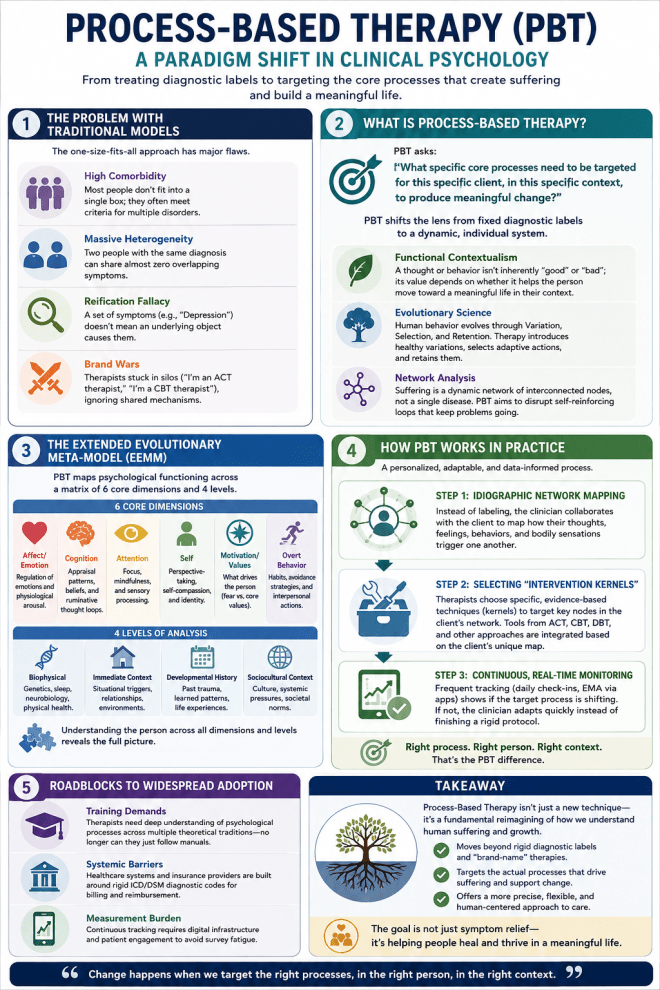
For decades, psychotherapy research and practice have been trapped in rigid boxes. Clinicians were taught to diagnose patients using categorical manuals—like the Diagnostic and Statistical Manual of Mental Disorders (DSM)—and then apply a rigid, standardized “treatment package” (like CBT for Panic Disorder or DBT for Borderline Personality Disorder).
However, psychology is undergoing a massive paradigm shift. Pioneer researchers like Steven C. Hayes and Stefan G. Hofmann are leading the charge toward Process-Based Therapy (PBT). Instead of treating diagnostic labels, PBT focuses on the actual mechanisms of change within a unique individual.
Here is a clear look at what Process-Based Therapy is, why it matters, and how it is changing mental health care.
1. The Problem with Traditional Therapy Models
Historically, clinical psychology relied on a nomothetic approach—applying the same diagnostic label and treatment protocol to everyone presenting similar symptoms. While this brought structure to research, it created major real-world problems:
High Comorbidity: Most people don’t fit into a single box; they often meet the criteria for multiple disorders at once.
Massive Heterogeneity: Two people can carry a diagnosis of “Major Depressive Disorder” while sharing almost zero overlapping symptoms.
The Reification Fallacy: Describing a set of symptoms (e.g., calling low energy and sadness “Depression”) doesn’t mean “Depression” is an underlying biological object causing those symptoms.
Brand Wars: Therapists got stuck in silos (“I am an ACT therapist,” “I am a CBT therapist”), ignoring that different modalities often work through the same underlying psychological mechanisms.
2. What is Process-Based Therapy?
Rather than asking, “What protocol treats this diagnosis?” PBT asks:
“What specific core processes need to be targeted for this specific client, in this specific context, to produce meaningful change?”
PBT shifts the lens from fixed diagnostic labels to a dynamic, individual system. It relies on three core theoretical pillars:
Functional Contextualism: A thought or behavior isn’t inherently “good” or “bad”; its value depends entirely on whether it helps the person move toward a meaningful life in their specific environment.
Evolutionary Science: Human behavior evolves through Variation, Selection, and Retention. Therapy helps introduce healthy behavioral variations, selects adaptive actions, and retains them.
Network Analysis: Psychological suffering is viewed as a dynamic network of interconnected nodes rather than a single disease. For example, poor sleep causes rumination, which leads to social withdrawal, which causes fatigue, which further ruins sleep. PBT aims to disrupt these self-reinforcing loops.
3. The Extended Evolutionary Meta-Model (EEMM)
To organize the complexity of human experience, PBT maps psychological functioning across a matrix called the Extended Evolutionary Meta-Model (EEMM).
Clinicians evaluate an individual across 6 Core Dimensions:
Affect/Emotion: How emotions and physiological arousal are regulated.
Cognition: Appraisal patterns, beliefs, and ruminative thought loops.
Attention: Focus, mindfulness, and sensory processing.
Self: Perspective-taking, self-compassion, and identity.
Motivation/Values: What drives the person (fear vs. core values).
Overt Behavior: Habits, avoidance strategies, and interpersonal actions.
Implementing PBT in a clinical setting follows a personalized, highly adaptable workflow:
Step 1: Idiographic Network Mapping
Instead of giving a standard questionnaire to hand out a label, the clinician works collaboratively with the patient to build an individual map showing how their specific thoughts, feelings, behaviors, and physical sensations trigger one another.
Step 2: Selecting “Intervention Kernels”
Rather than adhering to a 12-week manual, the therapist selects specific, evidence-based procedures (called kernels) to target key nodes in the patient’s network. A clinician might pull a mindfulness kernel from ACT, a cognitive reframing tool from CBT, or an emotional regulation technique from DBT—all tailored to that single patient’s network map.
Step 3: Continuous, Real-Time Monitoring
PBT uses frequent tracking (such as daily check-ins via mobile apps or Ecological Momentary Assessment) to measure if the target process is actually shifting. If a technique isn’t changing the target process, the clinician pivots immediately rather than blindly finishing a rigid protocol.
5. Roadblocks to Widespread Adoption
While PBT represents a major step forward, transitioning to this model comes with real-world hurdles:
Training Demands: Therapists can no longer just follow a step-by-step treatment manual; they need a deep understanding of psychological mechanisms across multiple theoretical traditions.
Systemic Barriers: Healthcare systems and insurance providers are built around rigid ICD/DSM diagnostic codes for billing and reimbursement.
Measurement Burden: Continuous tracking requires digital infrastructure and patient engagement to avoid survey fatigue.
Takeaway
Process-Based Therapy isn’t just a new technique; it’s a fundamental reimagining of how we understand human suffering and growth. By moving past rigid diagnostic labels and “brand-name” therapies, PBT offers a more precise, flexible, and human-centered approach to mental healthcare—targeting the actual processes that allow people to heal and thrive.
Hayes, S. C., & Hofmann, S. G. (2018). Process-Based CBT: The Science and Core Clinical Competencies of Cognitive Behavioral Therapy. New Harbinger Publications.
Hofmann, S. G., & Hayes, S. C. (2019). The future of intervention science: Process-based therapy. Clinical Psychological Science.
Hayes, S. C., & Hofmann, S. G. (2020). Beyond the DSM: A Process-Based Approach to Psychological Treatment. Context Press.
Building a Meaningful Life While Making Space for Pain
Acceptance and Commitment Therapy (ACT) is an evidence-based psychological approach designed to help people live richer, more values-driven lives—even when thoughts and feelings are difficult. Instead of aiming to eliminate distress, ACT teaches a different skill: make room for internal experiences (including anxiety, sadness, anger, or fear) and then act in ways that align with what truly matters to you.
In other words, ACT isn’t “positive thinking.” It’s not about pretending everything is fine. It’s about learning psychological flexibility—your ability to stay present with what’s happening, relate differently to thoughts, and choose actions based on your values rather than your emotions.
The Six Core Principles (The Pillars of ACT)
ACT is built around six interlocking foundations. Together, they help you shift from getting trapped by internal experiences to moving through them with intention.
1. Acceptance
Acceptance in ACT means allowing painful thoughts and feelings to exist without wrestling with them. It’s the opposite of getting pulled into a struggle like: “I shouldn’t feel this,” “Why am I like this?” “I need to get rid of this immediately.”
Acceptance helps you notice a key pattern: avoidance and emotional control efforts often shrink your life over time. When you avoid feelings, you may also avoid the situations that matter.
Importantly, acceptance is not resignation. It doesn’t mean giving up. It means meeting reality as it is—so you can respond wisely rather than react automatically.
2. Cognitive Defusion
Cognitive defusion is learning to create distance from unhelpful thoughts. In ACT, thoughts aren’t treated as instructions or facts. They’re mental events—something your mind produces.
Instead of saying, “I am having the thought that I can’t do this,” many people get stuck in the fusion: “That thought is true, and I must obey it.”
Defusion techniques help you loosen that bond. Common approaches include:
Observing thoughts as they appear
Labeling (“I’m having the thought that…”)
Metaphors (showing how thoughts behave like passengers passing through)
The goal isn’t to stop thoughts from happening—it’s to reduce their control over your choices.
3. Being Present (Mindfulness)
Mindfulness in ACT is flexible, nonjudgmental awareness of the present moment. It’s about noticing what’s happening—internal and external—without immediately evaluating it as “good” or “bad.”
When you practice presence, you’re better able to catch the moment where your mind spirals into the past or future. You also become more skilled at responding rather than automatically reacting.
Anchoring to “what’s happening now” becomes a way to interrupt cycles of rumination, worry, and avoidance.
4. Self as Context
Self as context is one of ACT’s most distinctive ideas. It helps you recognize that there is a part of you that is doing the noticing—the observer of thoughts, emotions, sensations, and memories.
Rather than treating identity as a fixed collection of thoughts (“I’m broken,” “I’m helpless,” “I’m always like this”), ACT invites you to view yourself as the perspective that experiences those thoughts.
This shift can create psychological space. And with space comes choice.
5. Values
Values are the compass of ACT. Values are not rules for how you should live. They’re chosen directions—what matters to you deeply.
Values might include:
Being a loving partner or friend
Growing and learning
Contributing to others
Living with integrity
Building health and resilience
ACT emphasizes distinguishing values from “shoulds.” Shoulds come with pressure and fear. Values come with meaning and purpose.
6. Committed Action
Committed action is where ACT becomes real. It’s taking steps aligned with your values—even when discomfort is present.
This principle is crucial: ACT does not require you to feel “ready.” It requires you to act in the direction that matters, while accepting that anxiety, doubt, or sadness may still show up.
Over time, committed action builds a pattern: you become someone who moves toward what counts, instead of someone who waits until thoughts and feelings cooperate.
Key Techniques You’ll Encounter in ACT
ACT uses practical tools that fit together with the pillars above:
Technique
Purpose
Metaphors
Make psychological patterns easier to see (e.g., thoughts as passengers on a bus)
Experiential exercises
Learn concepts directly through practice, not just explanation
Mindfulness practices
Build present-moment awareness and nonjudgmental observation
Values clarification
Identify what matters and translate it into direction
Behavioral activation
Increase engagement in valued activities, even with discomfort
Where ACT Can Help
ACT has been applied successfully across a wide range of challenges, including:
Anxiety disorders
Depression
Chronic pain
PTSD
Substance use
OCD
Workplace stress
Relationship issues
The common thread is not the presence of distress—it’s how people relate to distress and whether that relationship helps or harms their ability to live meaningfully.
Why ACT Often Works: The Psychological Flexibility Model
ACT’s overarching goal is to increase psychological flexibility : the ability to be present with your experiences (pleasant and painful) while still moving toward what matters.
This cycle is not linear in real life. It’s more like returning to the sequence when you get pulled off course by stress or self-criticism.
Advantages of ACT
Evidence-based: Strong research support across multiple conditions
Practical: Tools can be used in daily life, not just in sessions
Flexible: Works with different concerns and diagnoses
Empowering: Focus shifts to what you can control—your choices and responses
Sustainable: Builds long-term skills for coping rather than relying only on symptom relief
Limitations (What to Know Going In)
Requires effort and commitment: ACT is a skill-building approach
May feel counterintuitive at first: Acceptance can sound like “giving up” until you experience how it works
Not always sufficient alone: Severe conditions may require additional supports alongside ACT
Access can be uneven: Finding a trained ACT therapist can take time
The Big Takeaway
ACT offers a powerful reframe: your goal doesn’t have to be a life without difficult thoughts and feelings. Your goal can be a life you care about—lived in the midst of real human struggle.
When you learn to accept what you can’t immediately change, defuse from unhelpful thought patterns, stay present, and act toward your values, distress loses some of its power. It may still show up—but it doesn’t have to run your life.
Steven C. Hayes, Kirk D. Strosahl, and Kelly B. Wilson. *Acceptance and Commitment Therapy: The Process and Practice of Mindful Change*. Guilford Press, 1999.
Hayes, S. C., Luoma, J. B., Bond, F. W., Masuda, A., & Lillis, J. (2006). Acceptance and Commitment Therapy: Model, processes and outcomes. Behaviour Research and Therapy, 44(1), 1–25. https://doi.org/10.1016/j.brat.2005.06.006 Cited by: 11427
Powers, M. B., Zum Vörde Sive Vörding, M. B., & Emmelkamp, P. M. G. (2009). Acceptance and Commitment Therapy: A Meta-Analytic Review. Psychotherapy and Psychosomatics, 78(2), 73–80. https://doi.org/10.1159/000190790 Cited by: 1097
For years, scientists believed happiness was largely hardwired—a genetic baseline we always returned to, no matter what happened in our lives. Modern research paints a much more hopeful picture.
Happiness, formally called Subjective Well-Being (SWB), isn’t a fixed genetic trait or a fleeting emotion. It is a dynamic state shaped by our choices, relationships, environments, and societies.
Here is what the latest science tells us about how happiness works and how we can cultivate more of it.
1. Rethinking Happiness: Pleasure vs. Purpose
Psychologists now break well-being down into three parts: frequent positive feelings, low negative feelings, and high overall life satisfaction. They also distinguish between two types of happiness:
Hedonic Well-Being: Pleasure, comfort, and direct enjoyment.
Eudaimonic Well-Being: Meaning, purpose, personal growth, and helping others.
While older theories suggested we are stuck on a “hedonic treadmill”—quickly getting used to good news and returning to our old baseline—newer long-term studies prove otherwise. Significant life shifts, like forming a strong partnership or adopting meaningful daily habits, can permanently boost your baseline happiness.
2. The Core Drivers of Contentment
What actually makes us happy? Research points to three main pillars:
Deep Social Connections
If science has one overriding takeaway, it’s this: quality relationships are the single strongest predictor of life satisfaction and physical longevity.
The Brain on Loneliness: Social isolation triggers the same pain regions in the brain as physical injury.
The “Helper’s High”: Being generous or spending money on others (“prosocial spending”) activates reward pathways in the brain, offering a more lasting mood boost than buying things for ourselves.
Financial Security (Up to a Point)
Money does buy happiness, but mainly by providing safety and easing stress.
Higher income reduces the daily emotional strain of life’s hardships (like illness or unexpected bills).
However, once basic needs and security are met, additional wealth brings diminishing returns.
The Impact of Inequality: High economic inequality reduces trust in communities, lowering happiness overall.
Connection to Nature
Spending time in natural settings—whether gardening, walking in a park, or sitting near trees—measurably increases resilience and life satisfaction across all cultures.
3. Modern Trends and the “Happiness Paradox”
Despite our understanding of well-being, recent trends show new challenges—especially for younger generations and digital users.
The Youth Happiness Decline: Historically, young people reported higher life satisfaction than adults. Recently, happiness among youth in North America and Western Europe has dropped due to economic strain, academic pressure, and increased isolation. Conversely, older adults often report higher satisfaction, thanks to better emotional balance and realistic expectations.
The Digital Paradox: Technology can connect us, but passive scrolling triggers comparison and anxiety. Active communication fosters connection, while mindless consuming harms it.
Time Over Money: People who prioritize time over money—like paying to outsource chores to free up weekends—report much higher life satisfaction, countering modern “time starvation.”
4. What Neuroscience Tells Us
Brain research reveals that contentment is a full-body system of balance:
Dopamine is About Anticipation: Dopamine drives us to want things, not necessarily to enjoy them once we have them.
The Mind-Wandering Trap: Studies show we spend roughly 47% of our waking hours mind-wandering, a state consistently linked to lower happiness. Staying present directly improves mood.
Stress Regulation Matters: High Heart Rate Variability (a measure of how well your nervous system handles stress) correlates strongly with emotional resilience.
5. Proven Ways to Boost Well-Being
Science validates several simple practices—known as Positive Psychology Interventions (PPIs)—that can reliably raise your baseline happiness:
Gratitude Practices: Writing down positive events retrains the brain to look past its natural bias toward negative news.
Mindfulness and Presence: Meditation and focus training reduce mind-wandering and improve emotional regulation.
Prosocial Actions: Regularly helping others or performing acts of kindness triggers sustainable neurochemical rewards.
Nature Breaks: Combining physical movement with natural surroundings creates a powerful double-boost for mental health.
The Bottom Line
Happiness isn’t a final destination or a biological luck of the draw. It is an architecture of contentment—built over time through strong relationships, a sense of purpose, present-moment awareness, and supportive communities.
Global Reports and Comprehensive Overviews
World Happiness Report 2024: Edited by Helliwell, J. F., et al., this provides a comprehensive picture of global happiness across generations.
Subjective Well-being (1984): A foundational text by Ed Diener that helped establish the tripartite model of well-being (high positive affect, low negative affect, and high life satisfaction).
Well-being: The Foundations of Hedonic Psychology (1999): An essential collection edited by Kahneman, Diener, and Schwarz.
Happiness is everything, or is it? (1989): Carol Ryff’s work exploring the distinction between hedonic and eudaimonic (meaning-based) well-being.
Social Connection and Prosociality
The Good Life (2023): Robert Waldinger and Marc Schulz present lessons from the Harvard Study of Adult Development, the world’s longest scientific study on happiness.
Connecting with Others (2025): Recent research by Pei and Zaki focusing specifically on how social connection improves well-being for young adults.
Spending Money on Others Promotes Happiness (2008 & 2020): Key studies by Elizabeth Dunn and colleagues demonstrating that prosocial spending yields higher happiness than personal consumption.
Economics, Income, and Inequality
High income improves evaluation of life but not emotional well-being (2010): A famous study by Kahneman and Deaton suggesting a happiness plateau around $75,000–$100,000.
Experienced well-being rises with income (2021): Matthew Killingsworth’s research using real-time data to show that well-being can continue to rise linearly even above the $75,000 threshold.
Buying time promotes happiness (2016): Research by Whillans and colleagues on the benefits of “time affluence” over material wealth.
The Inner Level (2019): Wilkinson and Pickett’s study on how income inequality negatively affects population-level happiness.
Adaptation and the “Set-Point” Theory
Hedonic relativism and planning the good society (1971): The original paper by Brickman and Campbell introducing the “hedonic treadmill” concept.
Subjective well-being and adaptation to life events (2012): Luhmann et al.’s meta-analysis challenging the idea that adaptation to life events is uniform.
Long-term set-point changes in happiness (2021): Headey et al.’s study demonstrating that lifestyle changes and personal values can permanently alter happiness baselines.
Interventions and Mental States
Positive psychology interventions: A meta-analysis (2013): Bolier et al.’s review of randomized controlled studies on the efficacy of intentional happiness exercises.
Interventions to Modify Psychological Well-Being (2023): Kubzansky et al.’s synthesis of progress and future agendas for well-being research.
A wandering mind is an unhappy mind (2010): Killingsworth and Gilbert’s study showing that people are less happy when their minds are not focused on the present moment.
Psychological Frameworks and Environment
Self-Determination Theory (SDT): Research by Ryan and Deci identifying autonomy, competence, and relatedness as the three basic psychological needs.
Nature Connectedness: International research (published in The Conversation and Earth.org) linking emotional well-being to a psychological sense of connection with the natural world.
Mental health care has entered a new era. By mid-2026, awareness and acceptance of mental health support have reached unprecedented levels, driving record demand for counseling services worldwide. More people than ever before recognize that mental well-being is just as important as physical health.
Yet, despite remarkable progress, millions still struggle to access timely and affordable care. Rising treatment costs, shortages of qualified mental health professionals, and unequal access across regions continue to challenge healthcare systems.
At the same time, rapid advances in digital technology, artificial intelligence (AI), telehealth, and personalized treatment approaches are transforming how counseling is delivered. The future of mental health care is increasingly preventive, technology-enabled, and centered on the unique needs of each individual.
The Rising Demand for Mental Health Services
Mental health concerns continue to affect a significant portion of the population. Anxiety disorders, depression, trauma-related conditions, adjustment disorders, and chronic stress remain among the most common reasons individuals seek professional counseling.
Mental health professionals consistently report that anxiety and stress are the leading concerns presented in therapy, followed by depression, trauma, grief, relationship difficulties, and life transitions.
Several societal factors are contributing to this sustained increase in demand:
Career uncertainty and job transitions
Financial pressure and economic instability
Parenting stress and postpartum mental health challenges
Sleep disorders and chronic burnout
Trauma and PTSD recovery
Relationship and family conflicts
Social isolation and loneliness
Academic pressure among students
Perhaps the most encouraging change is that therapy has become increasingly normalized. Seeking psychological support is now viewed by many as a sign of self-care rather than weakness.
Millennials and Generation Z continue to lead this cultural shift, openly discussing mental health and actively seeking professional help when needed.
Youth Mental Health Remains a Critical Priority
While awareness has improved, young people continue to face significant mental health challenges.
Research consistently highlights elevated levels of:
Anxiety disorders
Depression
Self-harm
Eating disorders
Suicidal thoughts
Social media-related stress
Academic pressure
Identity and relationship concerns
Schools, universities, families, and healthcare providers are increasingly recognizing the importance of early intervention. Prevention programs, school counseling services, and accessible youth mental health resources have become essential components of public health strategies.
Early identification and timely support remain among the most effective ways to improve long-term mental health outcomes.
The Workplace Mental Health Revolution
Organizations have begun to recognize that employee mental health is directly connected to productivity, engagement, innovation, and staff retention.
Since 2023, utilization of workplace counseling programs has increased substantially, particularly among younger employees and professionals working in high-pressure environments.
Common workplace concerns include:
Burnout
Chronic stress
Financial anxiety
Work-life imbalance
Job insecurity
Workplace conflict
Leadership pressure
Remote work challenges
Many organizations have expanded:
Employee Assistance Programs (EAPs)
Mental health insurance benefits
Stress management workshops
Wellness coaching
Psychological safety initiatives
Manager mental health training
However, rising healthcare costs have also prompted some employers to reduce behavioral health coverage, making long-term counseling less affordable for many employees.
The challenge moving forward will be balancing organizational investment with sustainable access to quality mental health care.
Telehealth Has Become the New Normal
Perhaps the most significant transformation in counseling has been the widespread adoption of telehealth.
What began as an emergency response during the COVID-19 pandemic has evolved into a permanent component of mental healthcare delivery.
Virtual counseling is now preferred by many clients because it offers:
Greater scheduling flexibility
Reduced travel time
Increased convenience
Better access for rural and underserved communities
Improved continuity of care
Greater privacy for some individuals
Today, mental health services remain among the leading reasons people use telehealth platforms.
Rather than replacing face-to-face therapy, many providers now offer hybrid care models, allowing clients to choose between in-person and virtual sessions based on their needs, preferences, and circumstances.
Access Remains One of the Biggest Challenges
Despite greater awareness and increased demand, access to mental health care remains uneven.
For many people, the greatest obstacles are practical rather than psychological.
Common barriers include:
High treatment costs
Insurance coverage limitations
Shortages of qualified therapists
Long waiting lists
Geographic disparities
Limited availability of specialized services
In many regions, mental health professionals are in short supply, creating significant delays before individuals can begin treatment.
One encouraging trend is that stigma is gradually becoming less of a barrier. Public conversations about mental health have become more open and supportive than ever before. Increasingly, the challenge is not convincing people to seek help—but ensuring that help is available when they need it.
Technology and Artificial Intelligence Are Reshaping Mental Health Care
Artificial intelligence is rapidly becoming an important partner in behavioral healthcare.
Current AI applications are designed primarily to support—not replace—mental health professionals.
Healthcare organizations are increasingly using AI for:
Appointment scheduling
Clinical documentation
Symptom monitoring
Screening and triage
Progress tracking
Personalized recommendations
Administrative workflow automation
Beyond clinical practice, several innovative technologies are emerging:
AI-powered mental health companions
Evidence-based digital therapeutics
Virtual reality exposure therapy
Predictive analytics for suicide and relapse risk
Neurofeedback technologies
Biomarker-informed treatment planning
These innovations have the potential to improve efficiency, reduce administrative burden, and expand access to care.
However, mental health experts generally agree that technology cannot replace the therapeutic relationship. Empathy, trust, emotional understanding, and human connection remain central to effective counseling—particularly for complex trauma, grief, personality disorders, and relationship difficulties.
As AI becomes more integrated into mental healthcare, ethical considerations surrounding privacy, transparency, clinical oversight, and responsible use will become increasingly important.
A Shift Toward Prevention and Personalized Care
Modern mental healthcare is gradually moving away from a crisis-focused model toward prevention, resilience building, and individualized treatment.
Rather than waiting until symptoms become severe, providers increasingly emphasize early intervention and ongoing mental wellness.
Several trends are shaping this new approach:
Integrated Healthcare
Mental and physical health are increasingly treated together, recognizing the strong connection between emotional well-being and chronic physical conditions.
Trauma-Informed Care
Healthcare providers are adopting approaches that recognize the long-term effects of trauma and prioritize safety, empowerment, and collaboration.
Culturally Responsive Counseling
Therapists are adapting treatment to better reflect each client’s cultural background, beliefs, values, and lived experiences.
Preventive Mental Wellness
Organizations and healthcare systems are investing in resilience training, stress management, emotional education, and preventive counseling programs.
Holistic Treatment
Mindfulness, exercise, nutrition, sleep, somatic therapies, and lifestyle medicine are increasingly integrated alongside traditional psychotherapy.
Personalized Treatment Plans
Rather than applying the same intervention to everyone, clinicians increasingly tailor treatment according to individual symptoms, preferences, goals, personality, and circumstances.
Evidence-based therapies such as Cognitive Behavioral Therapy (CBT), Eye Movement Desensitization and Reprocessing (EMDR), Internal Family Systems (IFS), Acceptance and Commitment Therapy (ACT), Dialectical Behavior Therapy (DBT),mindfulness-based interventions, Process-Based Therapy (PBT) and body-oriented therapies continue to gain recognition within this personalized model of care.
Key Mental Health Trends to Watch in 2026
The following developments are expected to shape counseling services throughout 2026 and beyond:
Continued growth in demand for therapy services
Greater acceptance of mental health support across society
Expansion of telehealth and hybrid counseling
Increased integration of AI into clinical workflows
More personalized treatment approaches
Stronger emphasis on prevention and resilience
Expansion of workplace mental health programs
Greater focus on youth mental health
Improved integration of mental and physical healthcare
Continued efforts to address workforce shortages and improve affordability
Looking Ahead
The outlook for mental health and counseling in 2026 is both encouraging and complex.
On one hand, mental health awareness has never been higher. Therapy is increasingly viewed as a normal part of maintaining overall well-being, and advances in telehealth, artificial intelligence, and personalized treatment are expanding the possibilities for care.
On the other hand, affordability, workforce shortages, insurance limitations, and unequal access continue to prevent many people from receiving timely support.
The future of mental healthcare will likely be defined by a balanced approach—one that combines technological innovation with the irreplaceable value of human connection. Digital tools can enhance access, streamline care, and improve efficiency, but compassion, empathy, and the therapeutic relationship remain at the heart of meaningful psychological healing.
As healthcare systems continue to evolve, the greatest opportunity lies not only in treating mental illness but also in promoting resilience, preventing psychological distress, and making quality mental healthcare accessible to everyone.
American Psychological Association (APA). Mental Health Care Is in High Demand: Psychologists Are Leveraging Tech and Peers to Meet the Need (2024). [apa.org]
American Psychological Association (APA). Data Shows In-Person Care Still Dominates Mental Health Treatment (2026). [apa.org]
KFF (Kaiser Family Foundation). Mental Health Research and Data (2026). [kff.org]
Grow Therapy. 8 Mental Health Trends Driving Change in U.S. Care in 2026 (2026). [growtherapy.com]
American Psychiatric Association Journal Updates on Digital Therapeutics and Innovation (2026). [bioengineer.org]
SimplePractice. The 6 Emerging Trends Shaping Therapy in 2026 (2025). [simplepractice.com]