
What It Is and Why Your Feelings Aren’t the Enemy
Your feelings aren’t the enemy
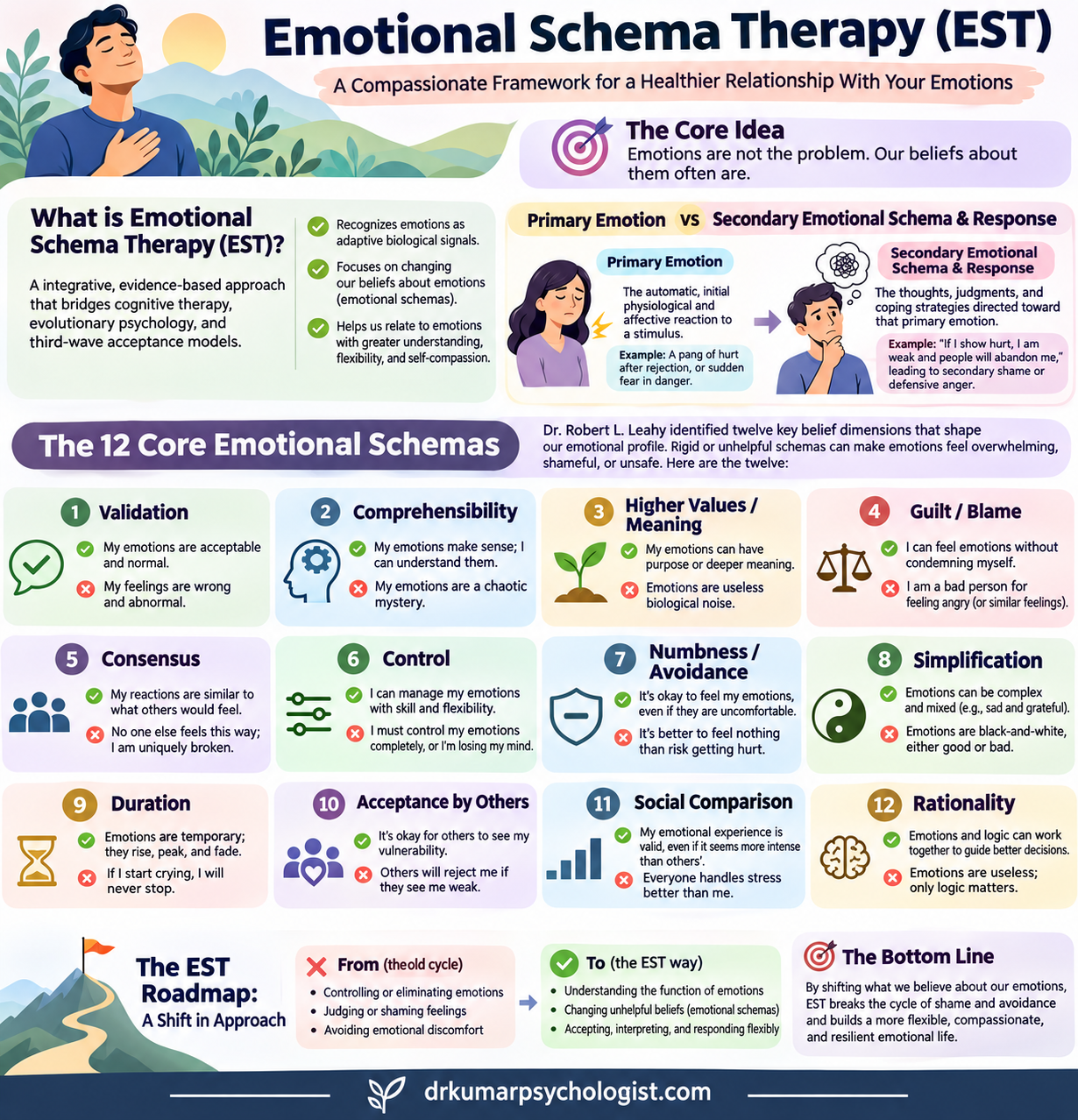
Emotional Schema Therapy, developed by psychologist Dr. Robert L. Leahy, shifts the question from what you feel to what you believe about what you feel.
Ever had thoughts like these? Explore below to see how they work, and how they can change.
What is an emotional schema?
Traditional CBT showed that thoughts shape feelings. EST adds that people often get stuck because of their theories about emotion itself. An emotional schema is a filter, a “naive theory” about affect. Switch lenses to see how the same feeling is read.
EST draws on cognitive therapy, evolutionary psychology and acceptance-based models. Emotions are adaptive signals that mobilize us, communicate our needs and keep us safe. Rigid schemas turn them into sources of shame and avoidance.
Primary emotion, secondary suffering
The first wave of feeling is automatic. The story you tell about it decides what happens next. Pick a moment and compare the two paths.
The 12 core emotional schemas
Leahy identified twelve dimensions of your emotional profile. Select one to see both ends of it, and mark the ones that sound like you.
This is a reflection tool, not a test. A trained therapist can assess your profile with the Leahy Emotional Schema Scale (LESS).
Coping that keeps us stuck
Rigid schemas trigger strategies that feel protective but feed the distress. Open each to see how.
Experiential avoidance
Trying to suppress or escape inner experience. The relief is brief, and the feeling learns that it must be dangerous.
Rumination
Circular thinking about symptoms, driven by the belief that analyzing distress will give you control. It usually keeps the feeling going.
Emotional overinvolvement (fusion)
Being consumed by the feeling and treating it as fact: “I feel hopeless, therefore my life is hopeless.”
Acting out
Using impulsive behavior such as substance use, binge eating or aggression to discharge unbearable tension.
Emotions behave like waves
One EST experiment tests the prediction “If I start crying, I will never stop.” Drag the slider to compare what tends to happen when a feeling is fought and when it is allowed.
An illustration of the idea, not data from a study.
How EST works in practice
Befriending your inner experience
By changing what we believe about feelings, instead of trying to force them away, we break the cycle of shame and avoidance. Psychological flexibility isn’t about feeling happy all the time. It’s the freedom to feel the full range of emotions without being incapacitated by them.
This page is educational and does not replace professional care. If you are struggling, consider speaking with a qualified mental health professional.
- Leahy, R. L. (2002). A model of emotional schemas. Cognitive and Behavioral Practice, 9(3), 177-190.
- Leahy, R. L. (2015). Emotional Schema Therapy: Distinctive Features. Routledge.
- Leahy, R. L. (2018). The Emotional Schema Therapy Cookbook. Guilford Press.
- Leahy, R. L., Tirch, D., & Napolitano, L. A. (2011). Emotion Regulation in Psychotherapy: A Practitioner’s Guide. Guilford Press.