
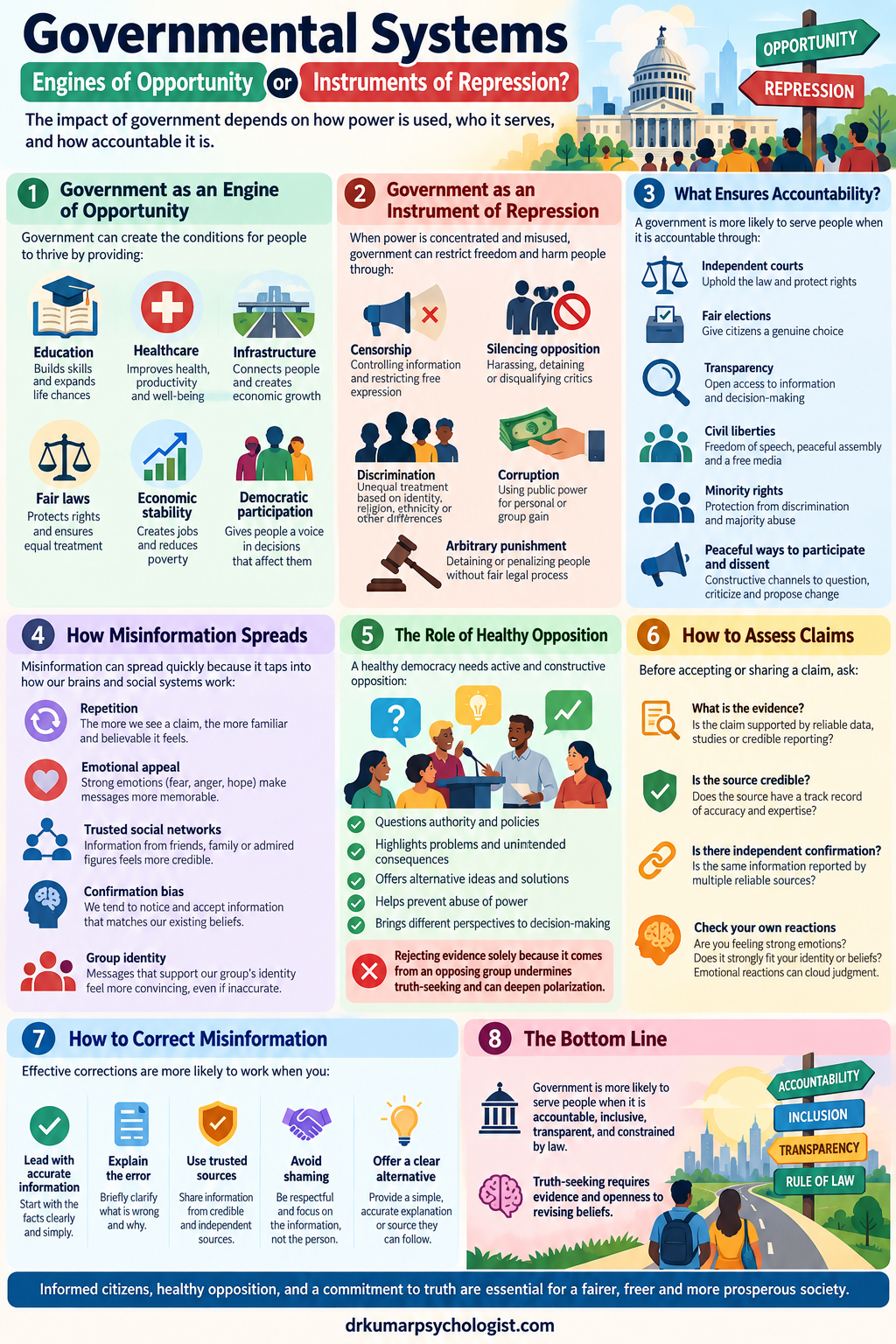
Governmental systems: engines of opportunity or instruments of repression?
How governments expand or restrict human freedom, why misinformation spreads, and how psychologists understand opposition, misunderstanding, and the search for truth.
Introduction
Governmental systems around the world have historically served as both engines of opportunity and instruments of repression. Governments can build schools, hospitals, roads, legal systems, and social protections. Yet the same power can also be used for censorship, discrimination, surveillance, political persecution, and control.
The central question is not simply whether government is “good” or “bad.” The more important question is: under what conditions does government expand human freedom and opportunity, and under what conditions does it become oppressive?
What are governmental systems?
A governmental system is the structure through which a society makes collective decisions, enforces laws, delivers public services, and regulates power. It includes legislatures, courts, police, civil services, schools, health systems, and local authorities.
Governments differ greatly in how they use power. Some protect rights, provide public goods, and let citizens take part in decisions. Others concentrate power among a small group, restrict dissent, and use public institutions to maintain control.
Two faces of state power
Governments become repressive when leaders use state power mainly to preserve control rather than serve the public. Repression may be obvious, but it can also be subtle and gradual.
How governments create opportunity
- Education and public services
- Public education, healthcare, sanitation, transport, and welfare give people access to knowledge, health, mobility, and economic participation, especially those who do not begin life with equal resources.
- Rule of law and rights
- When laws are applied fairly, citizens can work, trade, own property, express opinions, and seek justice with confidence. Independent courts protect people from arbitrary punishment.
- Economic growth and stability
- Effective institutions support investment, jobs, and poverty reduction. The World Bank notes that countries with strong institutions are often more resilient and better able to deliver key services.
- Democratic participation
- Elections, peaceful protest, free media, and public debate let people question authority, demand accountability, and influence policy.
How governments become repressive
- Censorship and control of information
- Restricting journalists, blocking websites, manipulating narratives, or punishing people who share inconvenient facts makes it harder for citizens to understand reality and challenge authority.
- Suppression of opposition
- Harassing opposition leaders, manipulating elections, or using force against peaceful protesters removes a key way of holding power accountable.
- Discrimination and exclusion
- Laws and services that look neutral may be applied differently to religious minorities, ethnic groups, women, migrants, dissidents, or marginalised communities.
- Corruption and arbitrary power
- Corruption weakens trust and diverts public resources. Without transparency or consequences, institutions begin to serve private or political interests.
The psychologist’s view: misinformation, opposition, and truth
Political conflict is not only about facts and policies. It is shaped by emotions, identity, fear, social belonging, and mental shortcuts. People rarely evaluate information as neutral observers; they interpret it through what they already believe, value, or wish to protect.
Why misinformation spreads
Misinformation is false or inaccurate information that people believe or share, often without intending to deceive. It spreads more easily when it is repeated, emotionally arousing, simple, and shared by trusted members of one’s own community. The American Psychological Association explains that people first focus on understanding new information and deciding what to do with it, rather than checking whether it is true, which makes everyone vulnerable.
Confirmation bias and identity
People prefer information that confirms existing beliefs. They seek out, notice, and remember what supports their political identity and dismiss evidence that challenges it. Motivated reasoning adds another layer: instead of asking “What is true?”, a person may unconsciously ask “What conclusion protects my identity, values, or group?” This does not mean people are unintelligent. Human thinking is social, emotional, and identity-driven.
When opposition is healthy
Healthy opposition protects democracy by questioning authority, exposing injustice, defending rights, and offering alternatives. The psychological question is whether opposition rests on evidence or mainly on group loyalty. Opposing a policy because of its likely consequences is reasonable; rejecting facts only because they come from an opposing group is not.
Why misunderstanding happens
People interpret information differently from its intended meaning because of unclear language, missing context, cultural differences, stress, fear, selective attention, or past experience. A complex government announcement shared online without context may be read in its most frightening form, especially if it triggers anxiety or confirms an existing belief.
Truth is not just a strong opinion
Truth is not set by how strongly a person feels, how many people agree, or how often a claim is repeated. A more reliable approach uses evidence, credible sources, transparency, logical reasoning, and willingness to revise one’s beliefs.
Six questions to ask of any claim
How to respond to misinformation
Correcting misinformation is difficult because false information can keep influencing thinking even after a person accepts it was wrong. This is called the continued influence effect. Corrections work better when they:
- Lead with the accurate explanation
- Explain why the false claim is wrong
- Avoid repeating the misinformation too often
- Use credible and trusted sources
- Avoid shaming or attacking the person
- Acknowledge emotions and identity concerns
- Offer a clear alternative explanation
The goal is not to “win” an argument. It is to create conditions in which people can think more accurately, regulate emotional reactions, and stay open to evidence.
What makes government healthy or harmful?
The difference between an opportunity-enhancing government and a repressive one is not simply its size. A large government may provide hospitals, schools, and welfare support; another may maintain a large security apparatus. The more important factors are:
- Independent courts and equal application of law
- Free and fair elections
- Protection for journalists, opposition parties, and civil society
- Transparency and anti-corruption mechanisms
- Respect for civil liberties and minority rights
- Limits on police and security-force power
- Peaceful avenues for public participation and dissent
Key takeaway
Governmental systems expand opportunity when they are accountable, law-bound, inclusive, and transparent. They become instruments of repression when power is concentrated, unaccountable, and used to control rather than protect people.
From a psychological perspective, misinformation, opposition, misunderstanding, and truth are deeply connected. People need more than access to facts; they also need critical thinking skills, emotional awareness, media literacy, and respectful dialogue.
Truth is approached through evidence, reflection, and willingness to correct ourselves, not through how strongly we feel, who agrees with us, or how often we hear a claim.
References
- Acemoglu, D., & Robinson, J. A. (2012). Why nations fail: The origins of power, prosperity, and poverty. Crown Publishers.
- American Psychological Association. (2023). What psychological factors make people susceptible to believe and act on misinformation? apa.org/topics/journalism-facts/misinformation-belief-action
- American Psychological Association. (2024). Using psychological science to understand and fight health misinformation: Consensus statement. apa.org/pubs/reports/misinformation-consensusstatement.pdf
- Ecker, U. K. H., Tay, L. Q., Roozenbeek, J., van der Linden, S., Cook, J., Oreskes, N., & Lewandowsky, S. (2024). Why misinformation must not be ignored. American Psychologist.
- Freedom House. (2025). Freedom in the world 2025: The uphill battle to safeguard rights. freedomhouse.org
- Lewandowsky, S., Cook, J., Ecker, U. K. H., et al. (2020). The debunking handbook 2020. George Mason University Center for Climate Change Communication.
- Lewandowsky, S., Ecker, U. K. H., Seifert, C. M., Schwarz, N., & Cook, J. (2012). Misinformation and its correction: Continued influence and successful debiasing. Psychological Science in the Public Interest, 13(3), 106–131.
- World Bank. (n.d.). Governance. worldbank.org/ext/en/topic/governance
- World Bank. (2025). The Worldwide Governance Indicators 2025 methodology revision.