
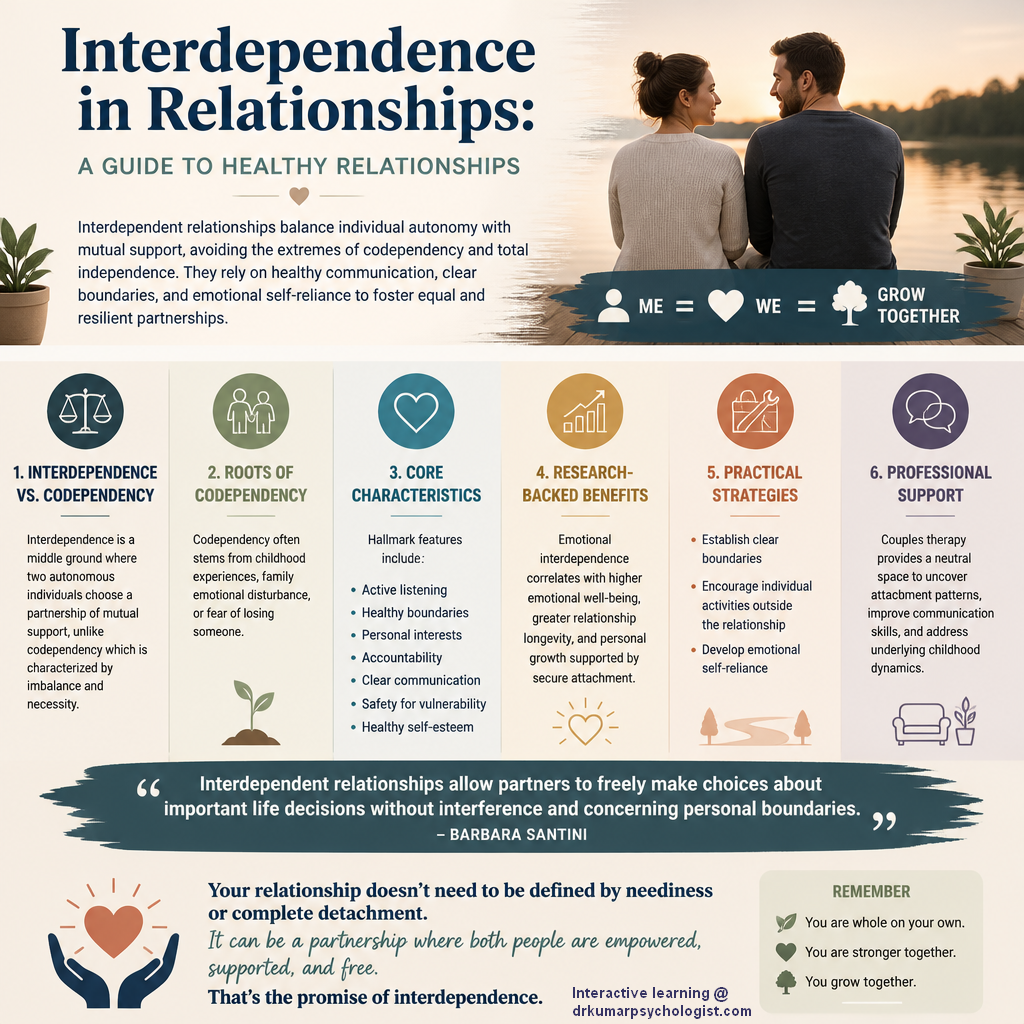
The Balance of Two
Understanding interdependence in healthy relationships. A strong relationship is not two halves trying to become one. It is two whole people choosing to support one another without losing themselves.
“I am whole. You are whole. We choose to grow together.”
Interdependence is the healthy middle ground between emotional isolation and losing yourself in another person. Both partners can rely on each other while retaining their own identity, voice, interests and responsibility.
Independence
“I can stand on my own.” Autonomy matters, but too much distance can leave partners disconnected or unsupported.
Interdependence
“I can stand on my own, and I can lean on you.” Mutual care and personal autonomy coexist.
Codependent patterns
“I cannot be okay unless you are okay.” Self-worth, choices or emotional stability may become overly tied to the other person.
Codependence vs. interdependence
These are patterns, not labels to apply to a person after one disagreement. Every relationship can show different patterns at different times.
Codependent dynamic
Fear, over-responsibility or approval-seeking can make it difficult to express needs, tolerate distance or make independent choices.
Interdependent dynamic
Care is mutual. Each person can ask for support, set limits, take responsibility and pursue meaningful interests.
| Dimension | Codependent pattern | Interdependent pattern |
|---|---|---|
| Communication | Indirect, fearful or avoidant | Open, direct and respectful |
| Needs | One person’s needs repeatedly disappear | Both people’s needs are considered |
| Emotional support | One person feels responsible for fixing the other | Partners support each other while taking responsibility for their own regulation |
| Time apart | Distance may trigger intense fear or guilt | Separate interests and time are respected |
| Responsibility | Fixed rescuer–receiver roles may develop | Responsibility is shared and negotiated |
| Identity | Identity may become absorbed in the relationship | Individual identity is maintained within the partnership |
| Decisions | Choices may be driven by fear, pressure or approval | Choices are discussed with respect for autonomy |
Important nuance: needing one another is not automatically codependency. Mutual reliance is a normal and valuable part of close relationships.
Why can codependent patterns develop?
There is no single cause. Early family experiences, inconsistent care, fear of abandonment, low self-esteem, difficult past relationships and learned beliefs about love may all contribute. These influences can shape expectations—but they do not determine a person’s future.
Learned roles
Growing up feeling responsible for another person’s emotions can make over-functioning seem normal.
Fear of loss
Past rejection or instability may make disagreement, boundaries or time apart feel threatening.
Fragile self-worth
When approval becomes the main source of value, saying no or expressing a different view can feel unsafe.
Seven qualities of interdependence
These behaviours create a relationship in which both people can feel connected, respected and free to grow.
Active listening
Listen to understand. Reflect feelings before offering advice or solutions.
Healthy boundaries
Make room for emotional space, privacy, personal time and individual decisions.
Individual interests
Encourage friendships, hobbies and goals outside the relationship.
Accountability
Own your actions, apologise when needed and avoid making your partner responsible for everything you feel.
Clear communication
Express needs directly and respectfully, without guilt, threats or mind-reading.
Safety for vulnerability
Make it possible to share fears and hopes without ridicule, punishment or contempt.
Healthy self-worth
Value yourself independently while remaining open to care, reassurance and affection.
When two people support each other well
Emotional well-being
Feeling understood and supported can strengthen belonging and help partners navigate stress together.
Resilience over time
Shared responsibility can reduce the strain of one person carrying the entire emotional load.
Individual growth
Security makes room for difference, learning, new interests and personal goals.
These are potential benefits, not guarantees. Relationship quality also depends on safety, respect, context and how partners respond to conflict.
Three ways to practise interdependence
Establish clear boundaries
Identify what helps you feel respected and safe. Communicate it calmly, and make space for your partner’s limits too.
Try: “I care about this conversation. I need 20 minutes to settle down, and then I’d like us to continue.”
Encourage individual activities
Name the interests, friendships and goals that help each of you feel like yourselves. Make room for them without treating independence as rejection.
Try: “I hope you enjoy your class tonight. Let’s catch up afterwards.”
Build emotional self-reliance
Notice and name your feelings. Use grounding, journaling, movement or a trusted support network—while still asking your partner for reasonable support.
Try: “I’m feeling anxious. I’ll take a moment to understand it, and then I’ll tell you what would help.”
What would an interdependent response look like?
Choose the response that best balances connection with individuality. Read the feedback, then consider how you might respond in real life.
Your partner wants to spend Saturday with friends. You feel disappointed because you hoped to spend the day together.
Your partner is upset after a difficult day. You are also tired and emotionally stretched.
You and your partner disagree about an important decision.
Your reflection score: 0 of 3 scenarios explored.
Where does your relationship balance feel today?
This is a reflection prompt, not a psychological test or diagnosis. Move the sliders to describe your current experience.
Choose one area that feels less supported and start with a small, respectful conversation or action.
Your two-person growth plan
Complete these prompts for yourself. Your answers stay in this page and are not sent to a server.
Your entries remain in this browser page only. Refreshing the page may clear them. Use the print option to keep a copy.
Notice the small shifts
These are conversation starters, not a pass/fail checklist. Change takes practice from both people.
You do not have to change difficult patterns alone
A qualified mental health professional or couples therapist can help explore attachment patterns, communication habits, boundaries and the influence of earlier experiences. Seek individual support if your partner is unwilling to participate. If a relationship involves coercion, intimidation, violence or fear for your safety, prioritise confidential, individual support and safety planning rather than assuming joint therapy is appropriate.
Interdependence is the art of being connected without being consumed: relying on one another without surrendering individuality, and growing together without demanding that either person become someone else.
Further reading & source notes
Verify the full bibliographic details and quotations against the original publications before academic or clinical citation.
- Sels et al. (2019), cited in the source article in relation to mutual emotional respect and support.
- Sels et al. (2016), cited in the source article in relation to emotional interdependence and individual lives within romantic relationships.
- Frontiers in Psychology (2016), “Emotional Interdependence and Well-Being in Close Relationships”.
- Santini (2024), statements on codependency, boundaries and family experiences.
- Roberts-Meese (2024), statements on secure attachment, autonomy and tolerating difference.
- Relationship Smart (2025), comparison of codependent and interdependent relationship patterns .
- Psych Central, comments on changing unhealthy relationship dynamics.
Educational resource only; it is not a substitute for personalised mental health care.