
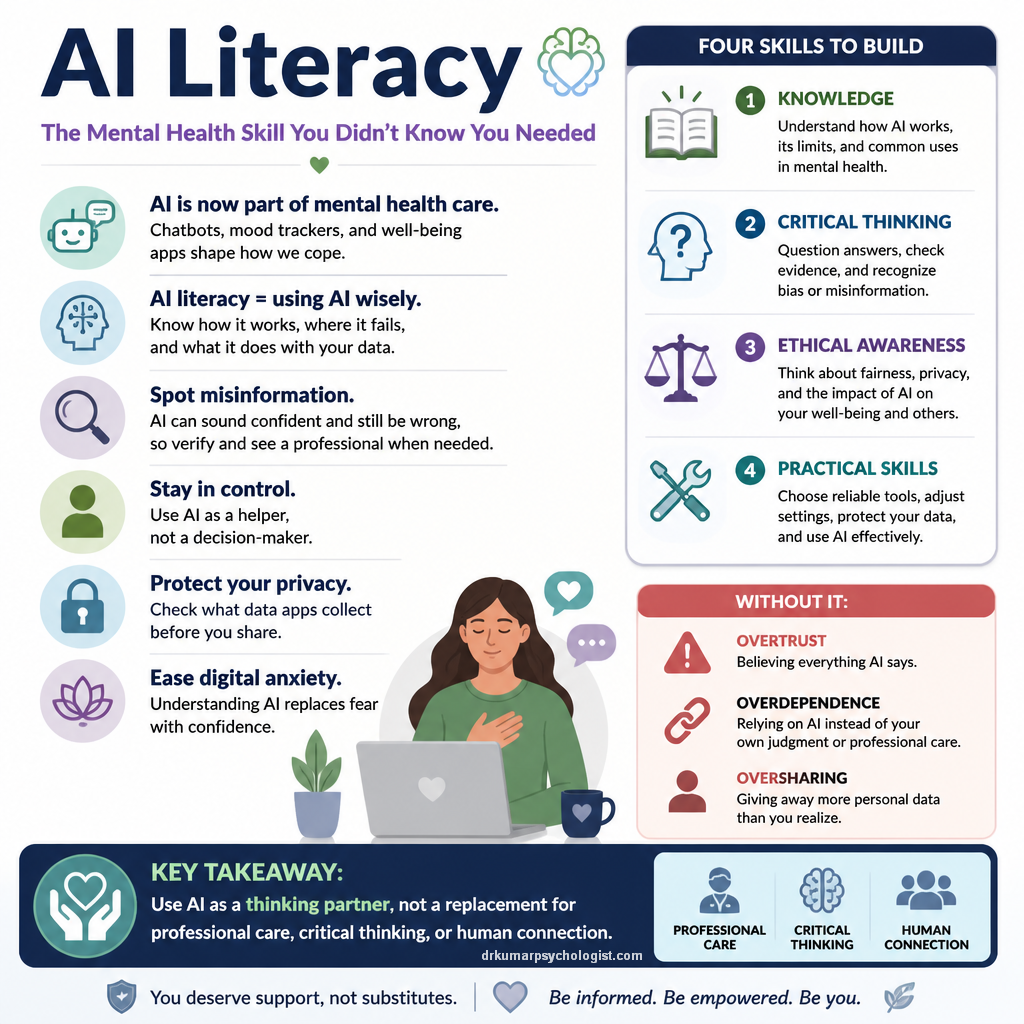
AI Literacy: The Mental Health Skill You Didn’t Know You Needed
AI is already part of daily life. It shapes what we search, what we watch, and increasingly how we look after our mental health—through chatbots, mood trackers, and well-being apps. Understanding AI is becoming a mental health skill, not just a tech skill.
What Is AI Literacy?
AI literacy means knowing enough about AI to use it wisely.
Understand the basics
Know what AI is and roughly how it generates answers.
Know its limits
Understand what AI does well—and where it falls short.
Check reliability
Assess whether the information it gives you is accurate.
Protect yourself
Be aware of privacy, bias, and responsible use.
Why It Matters for Your Mental Health
Millions of people now use AI for emotional support, stress relief, and learning about psychology. That can be genuinely helpful—but only if you know what you’re dealing with. Tap each benefit to learn more.
Four Skills to Build
Select a skill to see what it involves.
Knowledge
Learn the basics of how AI generates answers, and the difference between AI assistance and human expertise.
Critical thinking
Question AI advice, verify it with reliable sources, and watch for bias.
Ethical awareness
Pay attention to privacy, fairness, and responsible use.
Practical skills
Learn to write good prompts and fit AI into healthy self-care habits.
Practical Ways to Use AI Well
Self-reflection
Ask for journaling prompts to deepen self-awareness.
Learning
Have psychological concepts explained in plain language.
For professionals
Draft educational materials, generate discussion questions, and create psychoeducational content—always backed by your own professional judgment.
Your AI Wellbeing Checklist
Tick each habit as you practise it. Your progress is shown below.
0 of 6 completed
Quick Knowledge Check
Choose the best answer for each question.
1. An AI chatbot gives a confident but incorrect answer about anxiety treatment. This is best described as:
2. What is the healthiest way to use AI for mental wellbeing?
3. Before using a mental health app with AI features, you should:
The Bottom Line
AI literacy is more than a technical skill—it’s a mental health skill. When you understand how AI works, question what it tells you, protect your data, and keep your own judgment, you can use it for learning, reflection, and well-being without falling into the traps.
Key takeaway: Use AI as a supportive thinking partner, not a replacement for professional mental health care, critical thinking, or human connection.
American Psychological Association. (2025). Health advisory: Use of generative AI chatbots and wellness applications for mental health. Retrieved from https://www.apa.org/topics/artificial-intelligence-machine-learning/health-advisory-chatbots-wellness-apps [apa.org]
Miao, F., Shiohira, K., & Lao, N. (2024). AI Competency Framework for Students. UNESCO. Retrieved from https://www.unesco.org/en/articles/ai-competency-framework-students [unesco.org]
Miao, F., & Cukurova, M. (2024). AI Competency Framework for Teachers. UNESCO. Retrieved from https://www.unesco.org/en/articles/ai-competency-framework-teachers [unesco.org]
Organisation for Economic Co-operation and Development (OECD). (2025/2026). Empowering Learners for the Age of AI: An AI Literacy Framework for Primary and Secondary Education. OECD & European Commission. [oecd.org], [digital-sk….europa.eu]
World Health Organization. (2021). Ethics and Governance of Artificial Intelligence for Health: WHO Guidance. Geneva: WHO. [who.int], [who.int]
World Health Organization. (2024). Ethics and Governance of Artificial Intelligence for Health: Guidance on Large Multi-Modal Models. Geneva: WHO. [iris.who.int]
Ali, M., Ali, S., Abbas, Q., Abbas, Z., & Lee, S. W. (2025). Artificial intelligence for mental health: A narrative review of applications, challenges, and future directions in digital health. Digital Health, 11. [pmc.ncbi.nlm.nih.gov]
Yoon, S. C., An, J. H., Choi, J. S., Chang, J. H., Jang, Y. J., & Jeon, H. J. (2025). Digital Psychiatry with Chatbot: Recent Advances and Limitations. Clinical Psychopharmacology and Neuroscience, 23(4), 542-550. [pmc.ncbi.nlm.nih.gov]
Explore Our New Interactive Learning Page