
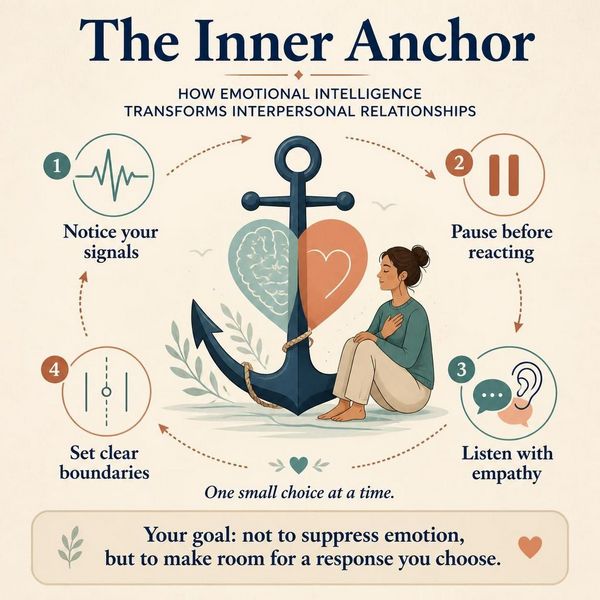
The Inner Anchor
How emotional intelligence transforms interpersonal relationships. Practise noticing your signals, pausing before reacting, listening with empathy, and setting clear boundaries—one small choice at a time.
Your goal: not to suppress emotion, but to make room for a response you choose.
Start the experience ↓EQ is a set of learnable skills
Emotional intelligence includes noticing emotions, understanding what they may be telling you, regulating your response, and navigating relationships thoughtfully. It is not about being calm all the time or always agreeing.
Notice
What is happening in me right now?
Understand
What might be underneath this feeling?
Choose
What response serves my values and the situation?
Connect
How can I be clear while respecting the other person?
Find your early-warning signal
Imagine someone says, “This work isn’t good enough. You need to redo it.” Before you decide what to say, notice what your body or mind tends to do first.
Which signal do you notice most often when you feel challenged?
Practise the inner-anchor pause
When you notice activation, you do not need to solve the whole disagreement instantly. Try this brief reset: place both feet on the floor, release your shoulders, and let one comfortable exhale be a little longer than your inhale. Never force or hold your breath.
Press start. Breathe normally and gently; stop if you feel uncomfortable.
Choose the response that builds connection
A friend says: “I’ve had a terrible week. Nothing I do seems to be enough.” What is the most helpful first response?
Empathy vs. sympathy: quick distinction
Empathy tries to understand and validate the person’s experience. Sympathy expresses concern for someone. Both can be kind; active listening adds attention, curiosity, and checking that you understood correctly.
Build a clean boundary
A colleague asks you to take on an urgent task, but your schedule is already full. A useful boundary has three parts: acknowledge the need, state your limit, and offer a feasible next step.
“I understand this is important for tomorrow.”
“I can’t complete a thorough review tonight alongside my current deadlines.”
“I can review it first thing tomorrow, or we can agree which current task should move.”
Can you spot the high-EQ move?
Choose one answer for each question, then check your learning. The aim is practice, not perfection.
Your one-week inner-anchor experiment
Choose one small action to try in a real conversation. Small, repeatable practice is more useful than expecting yourself to respond perfectly every time.
This learning activity is educational, not a diagnostic tool or a substitute for individual mental health care. Attachment patterns and emotional responses can change; avoid labelling yourself or others based on one interaction.
Kakarla, U. (2025). Emotional Intelligence in Interpersonal Communication. International Journal of Innovative Scientific Research, 3(1), 111–121.
Maheshwari, A. (2024). ATTACHMENT STYLE AND ITS INFLUENCE ON EMOTIONAL INTELLIGENCE AMONG YOUNG ADULTS. ShodhKosh: Journal of Visual and Performing Arts, 5(6), 3453–3459.
Professional Leadership Series (2026). The Inner Anchor: Facilitator Master Guide (90-Min Workshop). Inner Anchor Workshop Suite[14].
Paech, S. J. (2023). EQ-Bench: An Emotional Intelligence Benchmark for Large Language Models. arXiv preprint arXiv:2312.06281[41].
Segal, J. (2026). How to Be Emotionally Intelligent in Romantic Relationships. HelpGuide.org[49].