
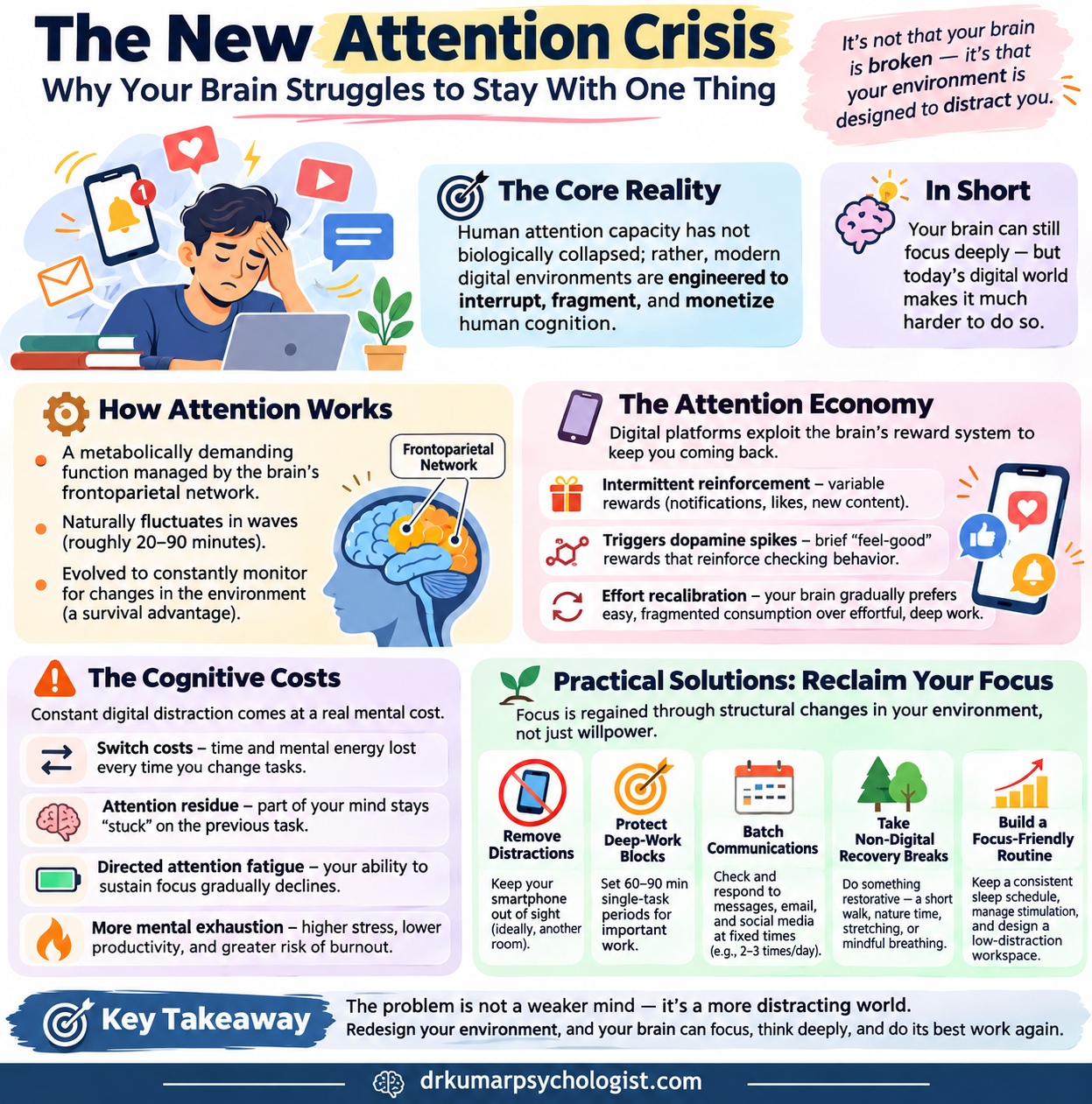
The attention crisis reflects a mismatch between stable human neurobiology and digital environments designed for constant interruption. Task switching, notifications, variable rewards, and smartphone presence create measurable cognitive costs without proving biological attention decline. Focus can be restored through environmental redesign: remove devices, single-task, batch communication, take analog breaks, and practice mindful refocusing.
The New Attention Crisis: Why Your Brain Struggles to Stay With One Thing
Popular narratives warn that modern technology has permanently broken our brains. The scientific evidence reveals a more nuanced truth: our ancient neural architecture is mismatched with an economy engineered to interrupt, fragment, and monetize human cognition.
Experience “Attention Residue” While Reading
Toggle simulated digital pings below to feel how intermittent interruptions tax your working memory as you read the opening paragraphs.
Many people feel that staying focused has become harder than it used to be. Whether trying to read a long book, write an analytical report, or hold an uninterrupted conversation, our minds seem pulled toward the nearest glowing screen or open browser tab. While popular narratives often warn that our brains are permanently “broken” or biologically shrinking in capacity, the scientific evidence points to a far more nuanced reality.
The modern attention crisis represents a complex intersection of neurobiological constraints, digital platform architecture, and socio-economic forces. Rather than a simple degradation of individual willpower or innate biological capacity, the inability to sustain focus is largely a systemic outcome of an environment engineered to interrupt, fragment, and monetize human cognition.
The Neurobiology of Attention: Capacity vs. Environment
Attention is not a single “mental muscle,” nor is it designed for unbroken, laser-like focus. Instead, it is a metabolically demanding function orchestrated by the brain’s frontoparietal network, involving complex interactions between arousal systems, executive control, working memory, and distraction filtering.
Natural Rhythms and Fluctuations: Sustained attention is inherently difficult because the human brain evolved to monitor the environment for change. Research on attention networks reveals rhythmic shifts between task-focused control systems (the Task-Positive Network) and internally oriented “default mode” activity (DMN), explaining why concentration naturally comes in waves rather than a flat, static line.
Rhythmic Focus vs. Fragmented Context Switching
Natural Wave Mode: The brain alternates smoothly between deep frontoparietal engagement and brief Default Mode Network recovery phases, allowing memory consolidation and sustained comprehension.
A 2024 meta-analysis across 32 countries found no biological decline in children’s performance on standard attention tests—and even noted a slight improvement among adults.
Workplace digital-tracking studies by Gloria Mark reveal that average time spent on a single screen task fell from roughly 2.5 minutes in the early 2000s to about 47 seconds today.
Evidence Matrix: What the Data Actually Supports
People switch tasks far more often
Observational workplace studies consistently find significantly shorter periods on a single screen task and markedly higher context-switching frequency.
Switching measurably hurts performance
Task switching reliably adds quantifiable costs in completion speed, elevated error rates, and working-memory depletion.
Biological attention capacity has collapsed
Large-scale longitudinal testing across 32 countries shows baseline human biological attention capacity has not deteriorated.
Reducing digital interruption restores focus
Controlled field experiments demonstrate that blocking mobile internet access for just two weeks measurably improves objectively tested sustained attention.
The Architecture of the Attention Economy
To understand why distractions feel irresistible, we must examine the socio-economic structures behind modern technology. In the digital age, human attention has become a scarce commodity extracted and assetized by platforms to drive engagement and market valuation—a structural externality scholars refer to as “cognitive decomposition.”
Effort Recalibration (“Brain Rot”): Platforms engineered for minimal friction and immediate reward bias the brain’s internal cost-benefit computations. Over time, this effort recalibration makes low-effort, fragmented digital consumption feel subjectively more rewarding than cognitively demanding deep work, driving the phenomenon colloquially termed “brain rot.”
Why Infinite Feeds Hijack Reward Circuits
Our brains evolved where rewards were scarce. Platforms deliver unpredictable, variable rewards—notifications, likes, and algorithmic novelty—triggering dopamine prediction spikes via the exact mechanism used in slot machines.
Click “Pull Feed” to simulate variable-ratio reward reinforcement.
The Pain of an Unstimulated Mind
Constant external stimulation conditions the brain to experience quiet, internal thought as aversive. When participants were asked to sit alone in a room with their thoughts for just 15 minutes without phones or distractions, many chose physical pain over boredom:
The Cognitive Costs of Fragmentation
Every time your focus shifts from a primary task to a message, alert, or open browser tab, your brain pays a steep metabolic and cognitive price. Even brief glances carry lingering neural overhead.
Switch Costs & Attention Residue
Shifting contexts forces the brain to disengage from one rule-set, load another, and re-engage. This consumes working memory and leaves behind “attention residue” from the prior task, degrading performance and impairing selective-attention filtering.
Smartphone “Brain Drain”
Resisting distractions requires active inhibitory control. Research shows that even the mere presence of your smartphone on a desk—silent and face-down—reduces available working memory and fluid intelligence, as your brain expends energy inhibiting the urge to check it.
Vigilance Decrement & Overload
High perceptual load from constant pings destabilizes cortical excitation and inhibition, accelerating the vigilance decrement. In school and work, chronic information overload impairs learning and mediates emotional exhaustion, anxiety, and burnout.
Daily Context-Switch & Residue Calculator
Reclaiming Focus: Structural and Practical Solutions
Because the attention crisis is driven primarily by environmental design rather than personal moral failure, relying solely on willpower is rarely effective. Reclaiming sustained attention requires reshaping physical and digital environments alongside biological recovery.
Build Your Cognitive Shield
Single-Task & Analog Rest Timer
Define one explicit next action, place your phone out of reach, and commit to a protected 25-minute block followed by 5 minutes of screen-free rest.
“Ultimately, your brain is not broken—it is adapting to a world of engineered novelty. Rebuilding the capacity for sustained, meaningful focus begins with deliberately designing environments that protect human cognition from constant fragmentation.”