
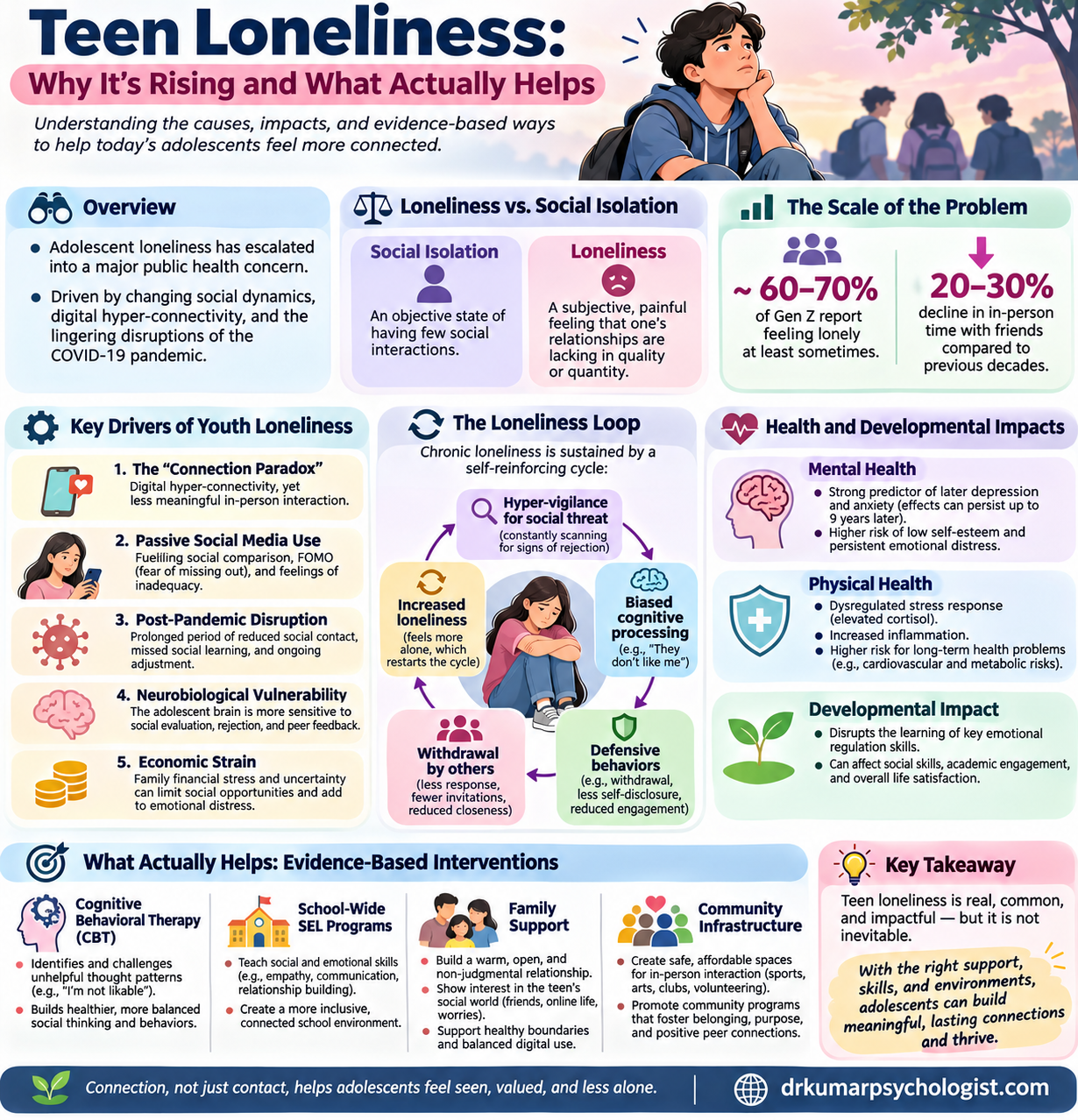
Teen Loneliness: Why It’s Rising and What Actually Helps
Adolescent loneliness is rising worldwide. Learn what causes it, how it affects long-term mental health, and which evidence-based strategies actually help teens connect.
A teenager can sit in a classroom of thirty people and still feel completely alone. That gap between being around people and feeling connected is at the heart of one of the biggest mental health concerns facing young people today.
In this post, we look at what recent research says about youth loneliness: why it is increasing, how it affects health later in life, and what really helps.
The Classroom Paradox: 30 Peers, Zero Resonance
Drag the slider below to shift from high physical proximity without emotional safety to meaningful relational resonance inside a 30-student classroom.
Loneliness vs. Social Isolation: What’s the Difference?
These two terms are often used as if they mean the same thing, but researchers separate them:
Social Isolation
Social isolation is objective. It means having few people around and few social interactions.
Loneliness
Loneliness is subjective. It is the painful feeling that your relationships are not enough, either in number or in quality.
Interactive Explorer: The 4 States of Social Experience
Click any quadrant to exploreAn Evolutionary Survival Alarm
From an evolutionary view, loneliness works like hunger or thirst. It is an alarm that tells us to repair our social bonds, because humans have always depended on each other to survive.
How Big Is the Problem?
The numbers are hard to ignore:
Research Note: Some of these figures come from commercial surveys and news reports, so treat them as strong signals rather than exact measurements. The overall direction, though, is consistent across many sources.
Why Is Youth Loneliness Rising?
No single cause explains it. Researchers point to several factors working together.
The Connection Paradox
85% say Gen Z spends too much time onlineGen Z is the most digitally connected generation in history, yet has fewer meaningful in-person relationships. Many young people say they are tired of endless feeds: 85% of Gen Z say their own generation spends too much time online.
It is not only about screen time. How teens use technology matters. Passive scrolling through other people’s highlights can fuel comparison, while real conversations with friends can support connection.
Why Loneliness Gets Stuck
Hawkley and Cacioppo describe a cycle that explains why loneliness can last. Click each step in the loop below to explore how it operates—and how to break it:
1. Feeling unsafe socially makes the brain scan for signs of rejection.
When loneliness activates the brain’s threat-detection system, a neutral look from a classmate or a delayed text reply immediately registers as proof of exclusion.
Key Clinical Takeaway: The result is a self-fulfilling loop. This is also why simply putting a lonely teen in a group is often not enough. The thinking pattern behind the loneliness needs attention too.
Why It Matters for Long-Term Health
Chronic loneliness is not just a sad phase. Research links it to five critical areas of development and health:
What Actually Helps?
An Honest Look at the Evidence
Here the research is honest and a little humbling. A 2026 meta-analysis of 18 studies with children and teens aged 4 to 18 found only small, non-significant reductions in loneliness overall. Intervention science has not caught up with the scale of the problem. Still, some approaches look promising:
Social and Emotional Learning (SEL) Programs
Strongest Evidence (2021 & 2026 Meta-Analyses)These were the most effective approach in the 2026 analysis. An earlier 2021 meta-analysis (Eccles & Qualter) also found that programs teaching emotion management and social skills work best.
Cognitive Behavioral Therapy (CBT)
CBT targets the biased thinking at the center of the loneliness cycle and helps teens re-engage with peers.
Healthier School Climates
Good teacher-student relationships, peer cooperation, and a lack of discrimination all matter.
Family Support
Warm, open communication at home acts as a protective buffer against peer stress and isolation.
Community Spaces
Parks, libraries, and public transport help young people meet in person, a point the CDC also emphasizes.
What Parents and Educators Can Do Now
A Signal Worth Listening To
Adolescent loneliness is not a rite of passage to be waited out. It is a signal worth listening to. The research shows the problem is real, widespread, and linked to later mental health difficulties, even if our best solutions are still being developed.
The most promising path combines skill-building for young people with supportive families, schools, and communities.
If this topic matters to you, share this post with a parent, teacher, or friend who could use it.
References
- Eccles, A. M., & Qualter, P. (2021). Alleviating loneliness in young people: A meta-analysis of intervention studies. Child and Adolescent Mental Health.
- Frontiers in Psychiatry (2025). Loneliness in adolescence: Prevalence, developmental contexts, and interventions.
- Hards, E., et al. (2022). Loneliness and mental health in children and adolescents with pre-existing mental health difficulties. British Journal of Clinical Psychology.
- Hawkley, L. C., & Cacioppo, J. T. (2010). Loneliness matters: A theoretical and empirical review of consequences and mechanisms. Annals of Behavioral Medicine, 40(2), 218-227.
- Kim, E. S., et al. (2025). Loneliness during adolescence and subsequent health and well-being outcomes. Journal of Adolescent Health.
- Mental Health Foundation (UK). Loneliness in young people: Research briefing.
- Interventions to reduce loneliness in children and adolescents (4-18 years): A systematic review and meta-analysis (2026). Journal of Affective Disorders.
- CDC. Health effects of social isolation and loneliness.
- Survey sources: GWI (2025) as reported by GRASS (March 2026); Talker Research/Life Time as reported by Vice (October 2026); Understanding Society (October 2026); York University Trauma & Mental Health Report (May 2026).