
How Micro-Commitments Can Transform Your Habits and Life
A micro-commitment is a tiny, low-friction action requiring minimal time, energy, or mental effort. By making the barrier to entry practically non-existent, you make it almost impossible for your brain to say “no.”
Rooted in psychology and behavioral economics, this concept taps into the classic Foot-in-the-Door technique. Once you say “yes” to a minuscule request, your brain subtly shifts its identity:
“I am someone who takes action!”
This minor shift in self-perception makes taking the subsequent steps dramatically easier.
The Micro-
Commitment
Leverage
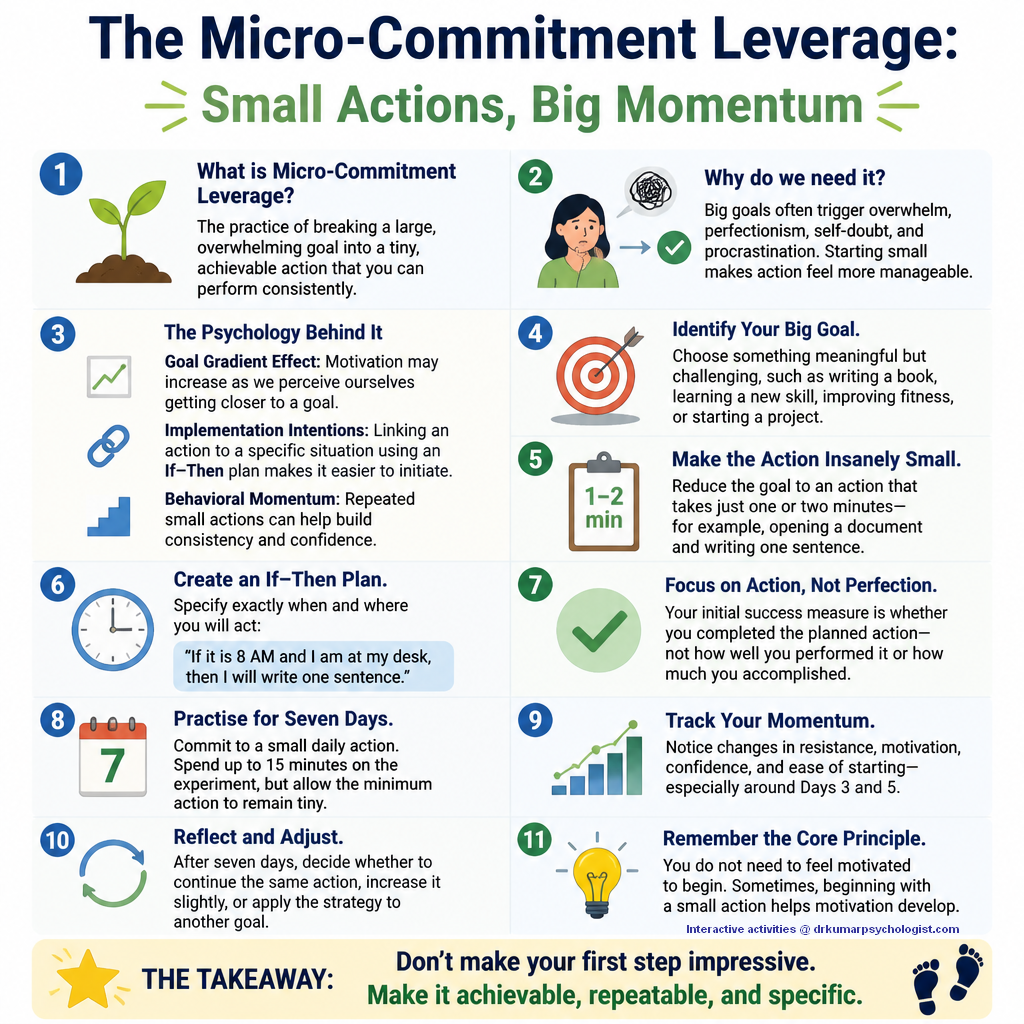
When a goal feels too big, your first step may be too big too. Turn an intimidating ambition into one tiny, specific action—and practise showing up without judging the result.
Your challenge: spend up to 15 minutes a day for one week. The micro-action itself can take less than a minute.
Why tiny commitments can help
Make the starting line easier to cross—not the long-term goal less meaningful.
Implementation intentions
An “If–then” plan links a specific cue to a response: “If it is 8 AM at my desk, then I will write one sentence.”
Goal-gradient effect
Progress can make a goal feel closer and encourage further effort. Small visible wins may help you build momentum.
Less starting friction
A tiny action feels more manageable than a vague, demanding task. You practise beginning before motivation is perfect.
These ideas can support action, but they do not guarantee automatic habits or eliminate every form of procrastination.
The 5-step experiment
Keep the action small enough that you can do it on an ordinary, imperfect day.
Name the big, scary goal
What larger outcome matters to you?
Shrink the first action
Choose one concrete action that takes 2 minutes or less.
Make an If–Then plan
Choose a clear time, place, or event that will cue the action.
Measure doing, not quality
No editing, rating, or judging during the micro-action. Completion is the win.
Notice your momentum
Track completion and reflect on resistance, especially on Days 3 and 5.
Build your Micro-Commitment Plan
Fill in your own version. Your entries stay in this page while it is open; they are not sent to a server.
Make it real, even if it feels intimidating.
What is the smallest useful first move?
Choose a reliable time, place, or event.
Connect the action to a value, not just pressure.
Your 7-Day Momentum Tracker
Check a day only after you complete the micro-action. A missed day is information, not a verdict.
Compared with Day 1, how does starting feel today?
Reflect without judging yourself
Use these prompts after Day 7—or sooner if you notice something useful.
Quick check: what is the real win?
Choose the answer that best fits the experiment.
You planned to write one sentence, but it feels awkward and imperfect. What counts as success today?
What next?
Use your observations to choose a realistic next step.
Want to Dive Deeper? Key Research & Studies
For those who love looking at the data, here are foundational and modern studies backing up compliance, habit formation, and behavioral science:
Foundational Compliance & Behavioral Science
- Freedman, J. L., & Fraser, S. C. (1966). Compliance without pressure: The foot-in-the-door technique. Journal of Personality and Social Psychology, 4(2), 195–202. (Established how a small initial request drastically increases compliance with subsequent larger requests).
- Cialdini, R. B. (2007). Influence: The Psychology of Persuasion. Harper Business. (Outlines consistency and commitment as primary drivers of human action).
Recent Field Experiments & Empirical Studies
- Bryan, G., Karlan, D., & Nelson, S. (2021). Microcommitments: The Effect of Small Commitments on Student Success. AEA Papers and Proceedings, 111, 92–96.
- Falk, E., Scholz, C., Cooper, N., & Gomes, V. (2025). Behavior change and social influence. In The Handbook of Social Psychology (6th ed.). Situational Press.
Habit Formation & Implementation Intentions
- Webb, T. L., & Sheeran, P. (2006). Does changing behavioral intentions engender behavior change? Psychological Bulletin, 132(2), 249–268.
- Milkman, K. L., Minson, J. A., & Volpp, K. G. (2014). Holding the bag to change behavior: A review on the role of commitment devices in personal and public health. Journal of Economic Perspectives.