
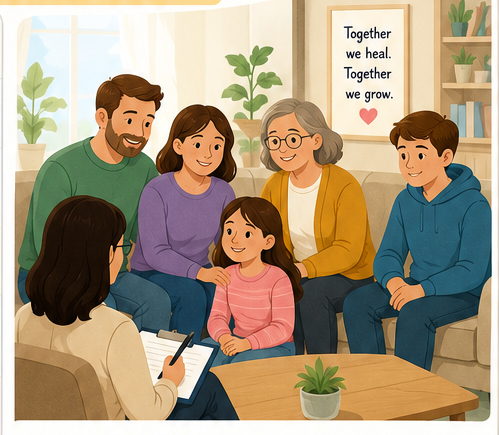
When people think of therapy, they usually picture one person on a couch, working through their own thoughts and feelings. But some of the deepest psychological wounds don’t belong to one person at all — they belong to a system. A parent and a teenager locked in the same argument for years. Siblings who stopped speaking after a death in the family. A marriage strained by an addiction that no one names out loud. These are not individual problems. They are family problems, and they call for a different kind of healing.
That’s where family therapy comes in.
What Family Therapy Actually Is
Family therapy is a branch of psychotherapy grounded in family systems theory — the idea that a family functions like an emotional unit, not a collection of separate individuals. A change in one member’s behavior inevitably ripples through the rest of the group. A licensed family therapist works with two or more family members together, treating the relationship patterns as the client, rather than isolating one “identified patient” as the source of dysfunction.
This distinction matters enormously. A child’s anxiety, a teenager’s defiance, or a parent’s short temper is often a symptom of a larger relational pattern — not a standalone flaw to be corrected in isolation.

Why It Matters: The Case for Treating the System
1. It Interrupts Cycles That Individual Therapy Can’t Reach
An individual can spend years in therapy processing their own reactions to a parent’s criticism, but if the underlying family dynamic never changes, that person returns to the same triggering environment every time they walk through the front door. Family therapy works upstream — addressing the communication loop itself, not just one person’s response to it.
2. It Builds Psychological Safety at the Source
Support and vulnerability can only exist where safety exists first. Families that default to blame, stonewalling, or lecture-mode teach their members — explicitly or not — that honesty is risky. A therapist creates a structured, moderated space where each person can speak without the conversation collapsing into defensiveness, which is often the first time some families have ever had a truly safe exchange.
3. It Replaces Blame with Shared Responsibility
One of the most consistent findings in family therapy research is the shift from an individual-blame model (“What’s wrong with you?”) to a systemic one (“What’s happening between us?”). This reframe alone reduces shame and increases the odds that everyone stays engaged in the repair process, rather than one person being cast as the “problem.”
4. It Strengthens Resilience for the Long Term
Family resilience isn’t a fixed trait — it’s a set of learned processes: clear communication, flexible roles, and a shared narrative of having overcome hardship together. Therapy accelerates the development of these processes by giving families language and tools they can reuse long after sessions end, whether the presenting issue is grief, divorce, chronic illness, addiction, or simply a household that has drifted into disconnection.
5. It Catches Problems Before They Calcify
Many families wait until a crisis — a suicide attempt, an affair, a teenager’s expulsion — before seeking help. But family therapy is equally valuable as a preventive measure. Just as physical checkups catch problems before they become emergencies, periodic family therapy can surface friction points (a blended-family boundary issue, a caregiving imbalance, an unspoken resentment) while they’re still manageable.
What Family Therapy Can Help With
- Communication breakdowns — chronic misunderstandings, stonewalling, or explosive conflict
- Life transitions — divorce, remarriage, relocation, a new diagnosis, a death in the family
- Parent-child conflict — power struggles, boundary issues, adolescent independence
- Addiction and mental illness — helping the whole family understand their role in recovery, not just the individual
- Blended and multigenerational families — navigating new roles, loyalties, and boundaries
- Chronic illness or caregiving strain — redistributing emotional and logistical load fairly
What Happens in a Session
Contrary to the assumption that family therapy means “airing grievances,” most approaches are highly structured. A therapist might:
- Map out communication patterns using tools like genograms (multigenerational family maps)
- Teach specific scripts for de-escalating conflict, such as replacing accusatory “you” statements with “I” statements
- Assign small, concrete “homework” — a weekly ritual, a scheduled check-in, a boundary experiment
- Help the family construct a shared narrative around a hardship, rather than letting it remain a source of silent shame or blame
The goal isn’t to relive every past wound in the room. It’s to change the pattern going forward.

The Bigger Picture
A family that has never learned to repair conflict well doesn’t just struggle in moments of crisis — that struggle becomes the water everyone in the house swims in daily. Children raised in these patterns often carry them into their own adult relationships, repeating the cycle without realizing where it came from.
Family therapy offers something rare: a chance to consciously rewrite the emotional operating system of a household, rather than passing it down unexamined. It is not a sign that a family has failed. It’s a sign that a family has decided to do the work of becoming resilient — together, deliberately, and with the right support in the room.
American Psychological Association (APA). (2018). Family Therapy. APA Dictionary of Psychology. Describes family therapy as a form of psychotherapy focused on improving relationships and behavioral patterns within the family system.
Doherty, W. J., & McDaniel, S. H. (2009). Family Therapy. Washington, DC: American Psychological Association. Emphasizes systems theory and the role of family relationships in understanding and treating individual problems.
Nichols, M. P., & Davis, S. D. (2020). Family Therapy: Concepts and Methods (12th ed.). Pearson. A comprehensive text covering the history, theories, techniques, and contemporary practice of family therapy.
Goldenberg, H., Goldenberg, I., & Stanton, M. (2016). Family Therapy: An Overview (9th ed.). Cengage Learning. Discusses major family therapy models, concepts, intervention strategies, and clinical applications.
Minuchin, S. (1974). Families and Family Therapy. Harvard University Press. A foundational work introducing Structural Family Therapy and family systems concepts.
Bowen, M. (1978). Family Therapy in Clinical Practice. Jason Aronson. Presents Bowen Family Systems Theory and concepts such as differentiation of self and emotional systems.
Cleveland Clinic. (2022). Family Therapy: What It Is, Techniques & Types. Explains the purpose, methods, benefits, and types of family therapy in clinical practice