
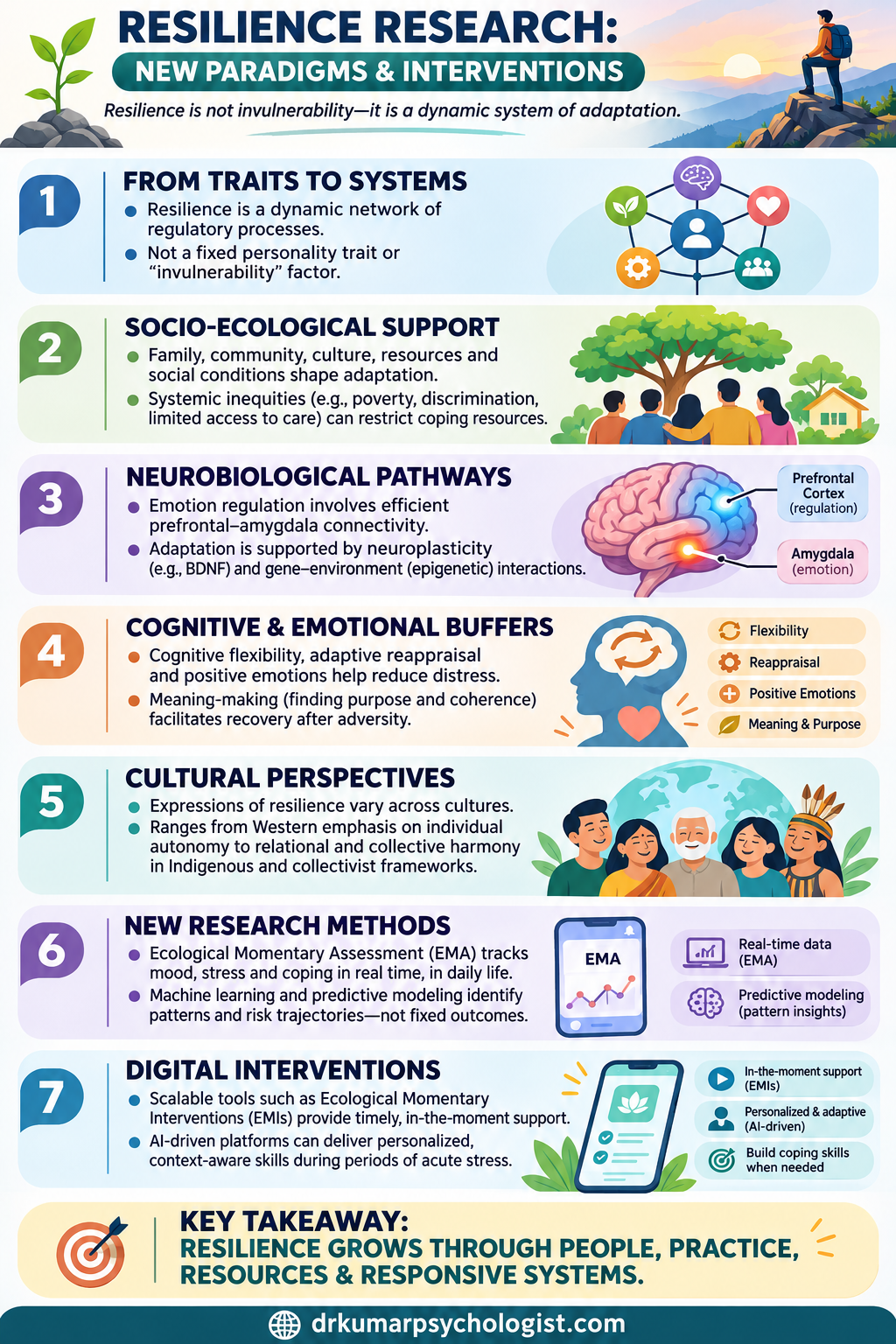
Everything You Thought You Knew About Resilience Is Wrong
For decades, self-help told us to “be tough, grit our teeth, and bounce back alone.” Modern neuroscience and genetics prove that’s a myth. Explore 5 counter-intuitive breakthroughs through interactive simulations.
Outdated Myth vs. Modern Reality
Resilience Isn’t a Solo Muscle—It’s Your Support Ecosystem
In Simple Terms
You don’t “bounce back” purely through willpower. Think of yourself as the center of a web connected to sleep, friends, healthcare, and financial safety. When life hits hard, a dense web absorbs the shock and pulls you back to normal fast. An isolated person—no matter how “mentally tough”—gets overwhelmed.
Interactive Ecosystem Simulator
Toggle support nodes on/off, then hit “Trigger Life Stressor” to test recovery speed.
Toggle Environmental Scaffolds
“Vulnerability” Genes Are Actually Environmental Superpowers
In Simple Terms
Scientists used to think sensitive people had “weak” genes. Now we know those are amplifier genes. Like delicate Orchids, sensitive people struggle in harsh environments—but in warm, supportive environments, they bloom brighter and outperform hardy “Dandelion” types who stay steady no matter what.
The “Dandelion” Profile
Lower Environmental Plasticity
Steady and consistent. Can grow almost anywhere, though less dramatically boosted by extra encouragement.
The “Orchid” Profile
High Plasticity (“Superpower” Genes)
Deeply responsive to surroundings. Slide toward Enriched to see how sensitivity turns into extraordinary thriving!
In a Sudden Crisis, Taking Small Action Beats “Venting”
In Simple Terms
When panic hits, “venting” your fear over and over actually keeps your brain’s alarm bell ringing. Instead, making one tiny, structured decision switches your brain’s calm “Control Center” back on and turns down the panic alarm.
Test Your Brain’s Response
Your alarm system is blaring. Choose how to respond on the right.
Option B: Use the 3-Step ART Model (Click in order)
Resilience Is Built in Tiny Micro-Moments, Not Heroic Leaps
In Simple Terms
Forget retrospective personality quizzes. Real resilience happens hour by hour. When a bad email or traffic jam spikes your stress, taking a 2-minute reset right then prevents stress from snowballing all day.
24-Hour Stress & Recovery Curve
Toggle “Just-In-Time Micro-Habits” after each daily bump to see how the stress curve changes.
Add 2-min slow exhale reset (+20% recovery)
Add 60-sec cognitive reframe (+25% recovery)
Add 5-min walk & friend text (+30% recovery)
The Dark Side of “Grit”: When Resilience Is Weaponized
In Simple Terms
Sometimes organizations hand out mindfulness apps instead of fixing impossible workloads or unfair conditions. True resilience doesn’t mean endlessly tolerating broken systems—it means fixing the weight of the load itself.
Systemic Load vs. Individual Grit Balance
Try cranking up “Individual Grit” under an unfair systemic load—then see what happens when you fix the system.
Even if you max out individual grit to 100%, an 85% toxic systemic load still causes exhaustion. Lowering the unfair systemic load is what actually unlocks sustainable well-being.
Stop asking: “How do I force myself to be tougher?”
Instead, build your personal ecosystem. Pick 1 Environmental Scaffold, 1 Social Connection, and 1 Micro-Habit below to generate your shareable Resilience 3.0 Blueprint.
1. Environmental Scaffold
2. Social Connection
3. Regulated Micro-Habit
My Personalized Resilience 3.0 Blueprint
🏗️ Scaffold: Select an option above…
🤝 Connection:
⚡ Micro-Habit: Select an option above…
- Belsky, J., & Pluess, M. (2009). Beyond diathesis stress: Differential susceptibility to environmental influences. Psychological Bulletin, 135(6), 885–908.
- Coutu, D. L., et al. (2023). Network analysis of psychological resilience and psychopathology: A dynamic systems approach. Clinical Psychology Review, 99, 102234.
- Feder, A., et al. (2019). Mechanisms of resilience and vulnerability to stress. Dialogues in Clinical Neuroscience, 21(3), 259–269.
- Joseph, M. (2016). The Secret Life of Resilience: How Bounce Back Culture Harms Us. NYU Press.
- Kashdan, T. B., & Rottenberg, J. (2010). Psychological flexibility as a fundamental aspect of health. Clinical Psychology Review, 30(7), 865–878.
- Kirmayer, L. J., et al. (2011). Community resilience: Models, metaphors and measures. Pimatisiwin, 9(1), 62–117.
- Masten, A. S. (2001). Ordinary magic: Resilience processes in development. American Psychologist, 56(3), 227–238.
- Szyf, M. (2021). Environmental programming of health and disease through epigenetics. Epigenetics, 16(4), 353–370.
- Ungar, M. (2021). Multisystemic resilience: Adaptation and transformation in contexts of change. Oxford University Press.