
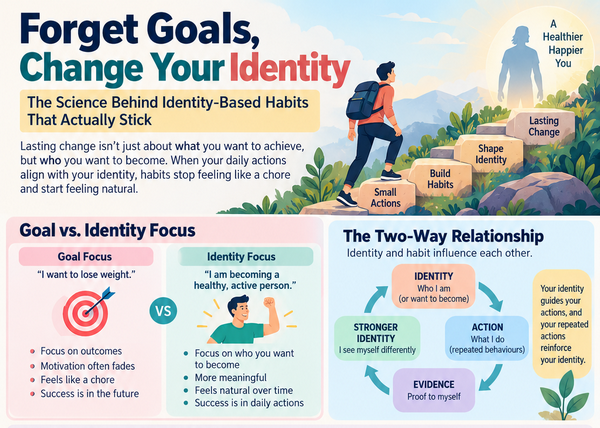
Stop Chasing Goals. Start Becoming the Person Who Achieves Them

The content emphasizes shifting from goal-oriented thinking to identity-based habits by practicing behaviors aligned with one’s desired identity. It highlights that goals can lead to postponed satisfaction, while daily actions contribute to self-perception and consistency. The focus is on small actions tied to meaningful values for sustainable change.
Welcome to the science of identity-based habits.
1. The Hidden Problem With Goal-First Living
Goals are useful. They provide direction, clarify priorities, and help us measure progress.
But goals have a limitation: they often place satisfaction in the future.
- “I’ll feel successful when I finish the book.”
- “I’ll feel healthy when I lose the weight.”
- “I’ll feel disciplined when I finally become consistent.”
This creates a psychological trap: your desired identity becomes something you postpone until you achieve a result.
Identity-based habits offer another perspective. Instead of waiting for success to define you, you begin practising the behaviours associated with the person you want to become.
The shift: From “What do I want to achieve?” to “What kind of person am I practising being?”
2. Your Identity Is Not Just a Label. It’s a Feedback Loop.
Think of identity and behaviour as two sides of a moving system.
Your self-image influences your actions. Your repeated actions provide evidence that can reshape your self-image.
Consider this cycle:
IDENTITY → ACTION → EVIDENCE → IDENTITY
- Identity: “I want to become a reader.”
- Action: You read two pages before bed.
- Evidence: You kept a small promise to yourself.
- Identity: “I’m becoming someone who reads regularly.”
One evening won’t transform your identity. But repeated actions can gradually strengthen a self-perception that supports further action.
This is a useful psychological model, not a rigid law. Identity and habits influence each other, and the relationship depends on context, motivation, opportunity, and experience.
3. The Three Psychological Forces Behind Lasting Habits
Force 1: Self-Consistency
People often prefer actions that feel consistent with how they see themselves.
If you see yourself as someone who values learning, reading for ten minutes may feel meaningful beyond the information you gain.
Practical insight: Connect a behaviour to a personally meaningful value rather than relying exclusively on external rewards.
Force 2: Automaticity
A habit becomes easier to repeat when it is practised consistently in a stable context.
Your brain gradually learns the connection between a situation and a response.
For example:
After I make my morning coffee, I will read one page.
The identity provides meaning. The cue provides an opportunity to act. Repetition helps the behaviour become more automatic.
Practical insight: Don’t depend on remembering or feeling motivated. Give your habit a reliable place in your day.
Force 3: Self-Perception Through Action
We learn about ourselves partly by observing what we repeatedly do.
You may not initially feel like a disciplined person. But when you repeatedly complete small, realistic commitments, you acquire experiences that can support a more confident self-view.
Practical insight: Instead of demanding that you believe in a new identity immediately, create opportunities to experience the behaviour.
Stop Chasing Goals. Start Becoming.
Identity-based habits: how to change who you become. Goals give direction. Small, meaningful actions give you opportunities to practise the person you want to become—without demanding perfection.
Your mission: choose one value, design one tiny action, and make it easier to repeat.
Start the experience ↓Keep the goal. Change your daily question.
Goals help you choose a direction. Identity-based habits add a different question: What small action would express the value I care about today? You don’t have to wait until you achieve a result to practise a meaningful behaviour.
Outcome-first
“I’ll feel successful when I finish the whole book.”
Satisfaction may feel distant; a missed day can seem like failure.
Identity-in-practice
“I’m becoming someone who makes room for learning.”
A small reading session can count as practice today.
Important nuance
Identity and behaviour influence each other, but not in a rigid or guaranteed way. Habits also depend on opportunity, health, resources, context, and support. Missing a habit is information—not a verdict on your character.
Turn a distant goal into a practice identity
You want to write a book, but the project feels overwhelming. Which response helps you practise the value today?
Identity → Action → Evidence → Identity
Imagine: “I’m becoming someone who keeps learning.” You review one concept after lunch and notice you followed through. What is the best next step?
Three forces that can support habits
Self-consistency: behaviour can feel meaningful when it aligns with your values. Automaticity: repeating a behaviour in a stable context can make it easier to start. Self-perception: you may learn about yourself by noticing what you repeatedly do. None of these requires perfection.
Build a habit you can actually start
Choose a meaningful value, then turn it into a small action you can begin on an ordinary day.
Plan for the day you miss
A rigid identity can turn a lapse into shame. A flexible identity helps you resume without pretending setbacks never happen.
Identity-based habits: quick check
Choose one answer for each question.
Your 7-day identity experiment
Keep your goal for direction. Use this small experiment to practise a behaviour that expresses a value you care about.
This is an educational activity, not a guarantee of behaviour change or a substitute for individual professional support. Adapt habits to your health, capacity, resources, and circumstances. Rest and flexibility are part of sustainable change.
drkumarpsychologist.com
Small actions · Meaningful values · Flexible growth
- Bem, D. J. (1972). Self-Perception Theory. In L. Berkowitz (Ed.), *Advances in Experimental Social Psychology* (Vol. 6, pp. 1–62). Academic Press.
- Doidge, N. (2007). *The Brain That Changes Itself: Stories of Personal Triumph from the Frontiers of Brain Science*. Viking.
- Festinger, L. (1957). *A Theory of Cognitive Dissonance*. Stanford University Press.
- Schultz, W., Dayan, P., & Montague, P. R. (1997). A neural substrate of prediction and reward. *Science*, 275(5306), 1593–1599.
- Patrick, V. M., & Hagtvedt, H. (2012).** “I Don’t” versus “I Can’t”: When Empowered Refusal Motivates Goal-Directed Behavior. *Journal of Consumer Research*, 39(2), 371–381.
- Clear, J. (2018). *Atomic Habits: An Easy & Proven Way to Build Good Habits & Break Bad Ones*. Avery.
- Lewin, K. (1951). *Field Theory in Social Science*. Harper & Row.
Creative activity suggestions are illustrative, not clinical advice.