
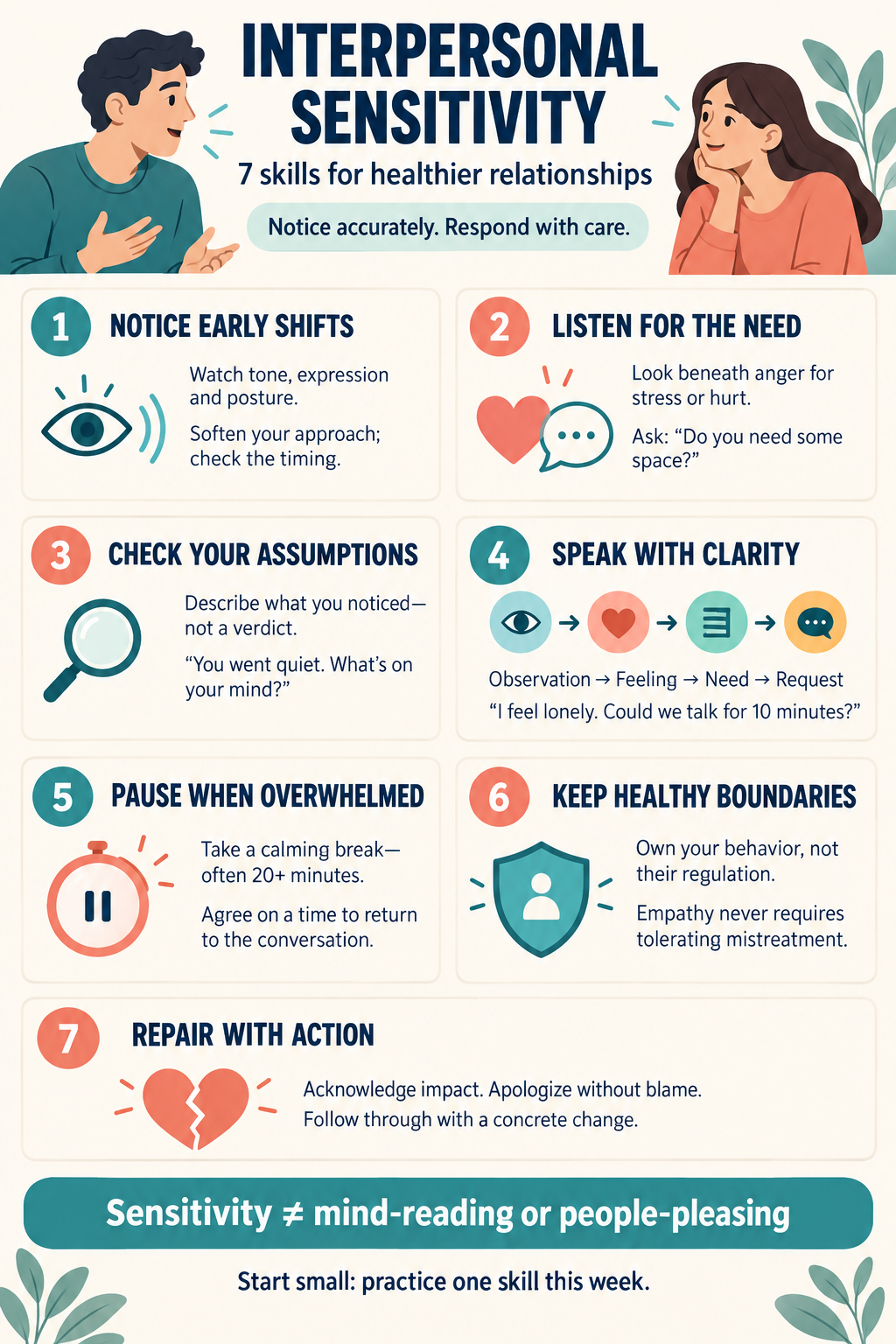

Read the room.
Keep yourself.
Interpersonal sensitivity is not mind-reading or keeping everyone happy. It is the practice of noticing accurately, responding thoughtfully, communicating clearly and keeping healthy boundaries.
Seven skills. One calmer conversation.
Choose a skill to preview it. Then move through the short practice stations below. The goal is not perfection; it is a more grounded next response.
Catch the pre-trigger micro-shift
Notice a clipped answer, flatter voice, shorter sentences or a change in posture before tension becomes obvious. Then adjust your timing and tone.
Try: Before raising a sensitive topic, scan face, voice and posture for two seconds. Treat cues as information—not proof.
Notice before you react
Read the cue without pretending you know its meaning.
Your partner answers “Fine” in a flat voice, looks away and starts tidying the kitchen.
What is the most accurate first move?
Three channels to scan
A cue is a clue, not a conclusion. Context and direct checking matter.
Listen beneath the surface
Try a gentle reflective guess. It invites correction rather than demanding an explanation.
Choose a response that makes room for the feeling.
Empathy blockers: spot the trap
“Just talk to your boss.”
Jumps to fixing.“It’s not a big deal.”
Invalidates the feeling.“Everything will be fine.”
Closes the conversation early.“Are you feeling stretched thin?”
Invites clarification.Observation or evaluation?
Hypervigilance often turns a small cue into a confident story. Practise separating what happened from what you concluded.
“You’re sulking.”
“You don’t care.”
“You’re trying to punish me.”
“I noticed you went quiet after I mentioned the weekend.”
“You haven’t replied to my last two messages.”
“I may be reading this wrong—is something on your mind?”
Your turn: rewrite the mind-reading statement
Statement: “You’re ignoring me because you don’t care.”
Build a clear OFNR message
Replace blame with a specific observation, a feeling, the need underneath it and a doable request.
Tip: “I feel that you don’t care” is an interpretation. Try naming the feeling directly: lonely, worried, disappointed, overwhelmed.
Know when to pause
When you are physiologically flooded, solving the issue may have to wait. A pause works best when it includes a clear return time.
Check your own activation
Which signs are showing up for you right now?
The 20-minute somatic reset
“I’m getting flooded. I want to do this well. Can we pause and come back at 7:30?”
Try slow breathing, a walk or cold water. Do not spend the break rehearsing your argument.
A pause with a return time is a repair move. Disappearing without explanation can become stonewalling.
Empathy without over-functioning
You can care about someone’s feelings without taking responsibility for managing their emotional regulation.
Sort responsibility fairly
My words, actions, honesty, accountability and the boundaries I set.
Their interpretations, choices, unmet needs and how they regulate their reactions.
Your behaviour may be a stimulus for another person’s feelings; it does not make you the owner of every reaction.
Which boundary is clear and protective?
Important distinction: a trigger is not a safety violation
Sensitivity can help avoid unnecessary triggers. It never requires tolerating repeated disrespect, manipulation or aggression. If there is abuse or immediate danger, prioritize safety and seek appropriate support rather than relying on communication techniques alone.
Repair with sincerity and change
An apology is not just a sentence. It names the impact and is followed by a credible behavioural shift.
Repair: the three essentials
Avoid “I’m sorry, but you…”
Show that you understand what your action did.
Describe what you will do differently next time.
Choose your next move
Use the seven skills in a realistic moment. There may be more than one kind response, but choose the one that best fits the information available.
A difficult evening
Your partner arrives home, gives short answers and says, “I can’t deal with another thing today.” You had planned to discuss a household issue. You feel disappointed and notice your own body becoming tense.
1. What is the most grounded first move?
Your 7-day sensitivity experiment
Choose one small behaviour to practise. Repetition matters more than trying to master all seven skills at once.
Quick recall
Your plan stays in this page while it is open. Use Print / save as PDF to keep a copy.
- Softened Startup: (Gottman & Silver, 2015)
- OFNR & Needs-Based Communication: (Rosenberg, 2015)
- Shame vs. Guilt Dynamics: (Brown, 2006)
- Autonomic Regulation & Prosody: (Porges, 2011)
- Anger Management & Physiological Reset: (American Psychological Association, 2012)
- Substance Relapse & Trigger Management: (National Institute on Drug Abuse, 2020; Smith & Meyers, 2004)