
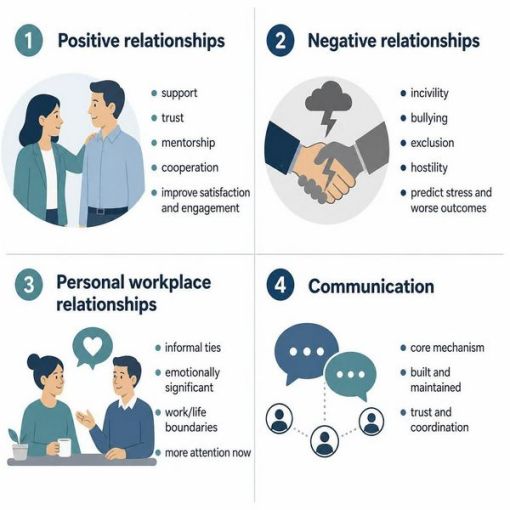
“People don’t just leave jobs—they often leave relationships.”
When organizations discuss employee performance, the conversation usually revolves around salaries, benefits, technology, productivity tools, and performance metrics. While these factors undoubtedly matter, decades of organizational psychology research suggest that one of the strongest predictors of employee well-being and organizational success is something far more human: the quality of workplace relationships.
Every day at work, people interact with supervisors, colleagues, mentors, clients, and team members. These interactions influence how employees think, feel, collaborate, and perform. Increasingly, research shows that healthy workplace relationships are not simply a pleasant workplace feature—they are fundamental to psychological well-being, employee engagement, resilience, innovation, and long-term organizational effectiveness.
In today’s knowledge-driven workplaces, organizations thrive not only because they employ talented individuals but because those individuals are connected through relationships built on trust, respect, and effective communication.

What Are Workplace Relationships?
Workplace relationships refer to the professional and interpersonal connections employees develop throughout their organization. These relationships may involve:
- Supervisors and managers
- Coworkers and teammates
- Mentors and coaches
- Direct reports
- Cross-functional colleagues
- Professional support networks
Earlier organizational research primarily viewed workplace relationships as either sources of support or conflict. Modern organizational psychology offers a much broader perspective. Researchers now recognize that workplace relationships are dynamic—they evolve over time, vary in quality, and shape individual well-being, team functioning, leadership effectiveness, and organizational culture.
Rather than simply asking whether employees get along, researchers increasingly explore questions such as:
- How much trust exists within teams?
- How do relationships develop and change over time?
- How are disagreements repaired after conflict?
- Do employees experience psychological safety?
- How do relationships influence teamwork, innovation, and organizational change?
These questions better reflect the complexity of today’s workplaces, where collaboration has become a critical driver of success.
Why Positive Workplace Relationships Matter
Supportive workplace relationships serve as valuable psychological resources that help employees navigate stress, uncertainty, and change.
When people feel respected, trusted, and valued, they are better equipped to solve problems, regulate emotions, and maintain motivation during challenging periods.
Research consistently links positive workplace relationships with numerous benefits.
Higher Job Satisfaction
Employees are more likely to enjoy their work when they experience kindness, appreciation, fairness, and mutual respect from colleagues and leaders.
Greater Organizational Commitment
People become emotionally invested in organizations where they feel connected, included, and supported. Strong relationships foster loyalty that extends beyond financial rewards.
Better Performance
High-trust teams communicate more effectively, coordinate work efficiently, share knowledge openly, and solve problems more creatively.
Lower Burnout
Supportive coworkers and supervisors help buffer the effects of workplace stress, reducing emotional exhaustion and improving resilience during demanding periods.
Reduced Turnover
Employees who experience belonging and meaningful workplace relationships are significantly less likely to search for employment elsewhere.
Increased Learning and Development
Mentors, experienced colleagues, and psychologically safe teams encourage continuous learning through guidance, constructive feedback, and shared expertise.
Sometimes, simply knowing that someone “has your back” at work can make a remarkable difference in how employees respond to daily challenges.
The Hidden Cost of Negative Workplace Relationships
Unfortunately, not every workplace provides an environment of trust and psychological safety.
Research increasingly highlights the damaging effects of unhealthy workplace relationships, including:
- Workplace incivility
- Bullying
- Social exclusion
- Hostile supervision
- Chronic interpersonal conflict
- Passive-aggressive communication
These behaviors often appear subtle when viewed individually, yet their cumulative psychological impact can be profound.
Examples include:
- Ignoring someone’s ideas during meetings
- Public criticism or humiliation
- Sarcastic remarks
- Excluding colleagues from important conversations
- Withholding essential information
- Dismissing concerns without listening
Although these behaviors may seem relatively minor, repeated exposure creates chronic relational stress.
Employees experiencing unhealthy workplace relationships commonly report:
- Emotional exhaustion
- Increased stress and anxiety
- Reduced motivation
- Lower morale
- Presenteeism (being physically present but mentally disengaged)
- Higher intentions to leave the organization
Importantly, relational harm rarely affects only one individual. Negative behaviors often spread through teams, eroding trust, reducing collaboration, increasing conflict, and weakening the overall organizational climate.
Personal Workplace Relationships Matter Too
Organizations are increasingly recognizing that workplaces are also social environments where meaningful human relationships naturally develop.
Many employees form:
- Close workplace friendships
- Trusted peer relationships
- Long-term mentoring partnerships
- Emotional support networks
These relationships frequently extend beyond work responsibilities. Colleagues celebrate achievements together, provide encouragement during difficult periods, and support one another through personal challenges.
Such connections contribute to:
- Greater psychological well-being
- Stronger workplace identity
- Increased resilience
- Higher engagement
- Long-term organizational attachment
While close workplace relationships can be deeply beneficial, maintaining appropriate professional boundaries remains essential. Healthy boundaries help balance emotional support with fairness, confidentiality, professionalism, and role clarity.
Communication Is the Foundation of Healthy Workplace Relationships
Every workplace relationship is built through communication.
Modern organizational psychology views communication not merely as exchanging information but as the primary process through which relationships are created, strengthened, repaired, or damaged.
Healthy communication includes:
- Active listening
- Respectful feedback
- Clear expectations
- Honest conversations
- Timely responses
- Recognition and appreciation
- Constructive conflict resolution
Conversely, poor communication often leads to:
- Misunderstandings
- Distrust
- Rumors
- Defensive behaviors
- Emotional withdrawal
- Reduced cooperation
Employees who genuinely feel heard are far more likely to feel respected, valued, and psychologically safe.
Why Supervisors Have the Greatest Influence
Although positive coworker relationships are valuable, research consistently demonstrates that relationships with supervisors have one of the strongest influences on employee outcomes.
Managers shape employees’ daily experiences by influencing:
- Recognition
- Feedback
- Workload
- Autonomy
- Fairness
- Psychological safety
- Professional development
Supportive supervisors encourage learning, provide emotional support during stressful periods, recognize achievements, and create environments where employees feel comfortable asking questions or admitting mistakes.
By contrast, inconsistent or hostile leadership is associated with lower job satisfaction, reduced trust, increased emotional exhaustion, and higher turnover intentions.
Employees may eventually forget the details of difficult projects, but they rarely forget how their manager made them feel.
Building Healthier Workplace Relationships
Healthy workplace relationships require intentional effort from both organizations and individual employees.
What Organizations Can Do
- Promote a culture of respect and inclusion.
- Train leaders in emotional intelligence and effective communication.
- Address bullying, incivility, and interpersonal conflicts promptly.
- Establish mentoring and peer-support programs.
- Recognize collaboration—not only individual achievement.
- Foster psychological safety so employees feel comfortable speaking openly.
What Employees Can Do
- Practice active listening.
- Show appreciation regularly.
- Offer help when colleagues need support.
- Address conflicts early and respectfully.
- Maintain healthy professional boundaries.
- Communicate honestly and clearly.
- Treat everyone with dignity and respect, regardless of role or status.
Meaningful workplace cultures are rarely built through occasional team-building activities alone. Instead, they emerge from countless everyday interactions characterized by kindness, trust, respect, and collaboration.
Final Thoughts
Workplace relationships influence far more than whether employees enjoy coming to work. They shape mental health, motivation, engagement, innovation, teamwork, organizational resilience, and long-term success.
Positive relationships cultivate trust, belonging, cooperation, and psychological safety. Negative relationships create stress, disengagement, conflict, and employee turnover.
As organizational psychology continues to evolve, one message has become increasingly clear: organizations succeed not only because they employ talented people, but because of the quality of the relationships connecting those people.
Investing in respectful communication, supportive leadership, and healthy workplace relationships is not simply an employee well-being initiative—it is a strategic investment in organizational performance, resilience, and sustainable success.
Key Takeaways
- Workplace relationships are among the strongest predictors of employee well-being and organizational performance.
- Trust, respect, and psychological safety improve motivation, resilience, teamwork, and job satisfaction.
- Chronic incivility, bullying, and poor communication contribute to stress, burnout, disengagement, and turnover.
- Supportive supervisors play a pivotal role in shaping employees’ daily experiences and long-term commitment.
- Small, respectful interactions practiced consistently have a lasting impact on workplace culture.
- Investing in healthy workplace relationships benefits employees and organizations alike.
References
- Annual Review of Organizational Psychology and Organizational Behavior (2025). Workplace Relationships: Current Perspectives and Future Directions.
- Recent empirical research (2025) examining workplace incivility, prosocial behavior, supervisor–employee relationships, job satisfaction, organizational commitment, psychological safety, cynicism toward organizational change, and turnover intentions.