
Intoduction
Step 3 Master the Cognition-Emotion-Behavior Triad
- The Performance Triad: Intentional performance requires mastering three interconnected gears: cognition (internal strategy), emotion (biological signals), and behavior (visible execution), which default to a reactive loop if left unchecked.
- The Feedback Loop: Cognition, emotion, and behavior function as a continuous loop where thoughts trigger physical feelings that drive external actions; recognizing this interplay allows you to intervene and reshape your responses.
- The Fact-Check Protocol: Intercepting negative narratives requires isolating a limiting thought, labeling the emotion, auditing objective evidence, and reframing the narrative to engage the analytical prefrontal cortex over the reactive amygdala.
- Cognitive Reappraisal: Instead of fighting anxiety, reinterpreting physical stress symptoms (like a racing heart) as excitement shifts the brain’s state from perceiving a threat to welcoming an opportunity.
- Self-Distancing for Regulation: Using third-person self-talk (referring to yourself by your name rather than “I”) during stressful moments creates psychological distance, activating the prefrontal cortex to prevent impulsive behavioral reactions.
- The Action Rule: Overthinking causes behavioral paralysis and creates non-existent problems; taking immediate action based on limited information lowers anxiety more effectively than endless analysis, building confidence after the fact.
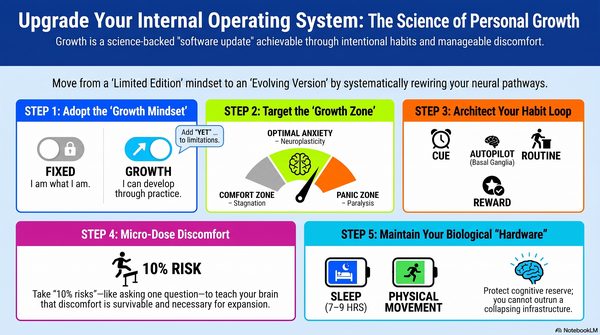
- Implementation Intentions: Creating automated “If/Then” plans for emotional triggers offloads the cognitive cost of decision-making from the prefrontal cortex to the basal ganglia, turning high-performance responses into effortless, automatic neural habits.
- Systematic Self-Mastery: Combining fact-checking, anxiety reappraisal, self-distancing, decisive action, and automated planning forms an integrated workflow that transforms reactive living into sustainable, intentional performance.