
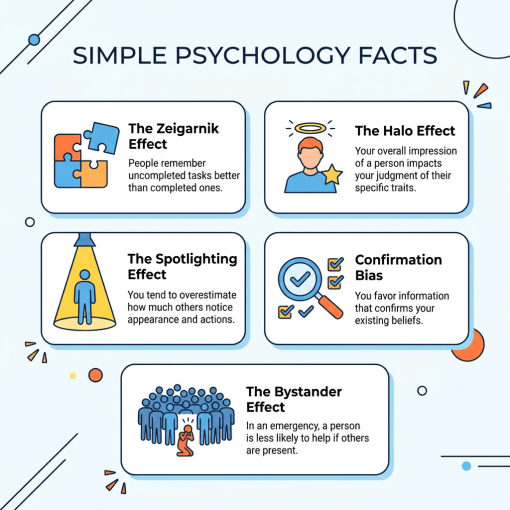
Human behavior is full of fascinating paradoxes. We often believe we are rational, objective, and in control of our memories and perceptions, but psychological science repeatedly shows that our brains take shortcuts, succumb to social pressures, and rewrite our past. Below are six compelling psychology facts, grounded in classic and contemporary research, that explore the hidden mechanics of the human mind.

- The Brain Shuts Down Reasoning: Political Confirmation Bias
When faced with information that contradicts deeply held political beliefs, the human brain does not calmly evaluate the evidence—it often halts logical reasoning entirely.
The Science: Neuroimaging studies by Westen, Blagov, Harenski, Kilts, and Hamann (2006), alongside observations by Shermer (2006), demonstrate that reasoning circuits in the brain virtually shut down when individuals are exposed to political hypocrisy or dissonant information. Meanwhile, the neural circuits associated with emotional relief and reward light up once a biased conclusion is reached, allowing people to comfortably dismiss facts that threaten their worldview.
- Fabricated and Reconstructive Memories
We tend to think of memory like a video recorder that stores exact snapshots of the past. In reality, memory is entirely reconstructive, meaning we build and rebuild our recollections every time we recall them—leaving wide room for fabrication.
The Science: Seminal work by Elizabeth Loftus (2003a) and researchers Wade, Garry, Read, and Lindsay (2002) proved that external cues, leading questions, and imagination inflation can easily plant entirely false autobiographical events into a person’s mind. People can vividly “remember” details of events that never actually occurred.
- Expectancy Bias in Performance
What we expect to see can fundamentally alter how we observe data, and even influence how subjects perform—a phenomenon where observer expectations become a self-fulfilling prophecy.
The Science: Early methodological studies by Rosenthal and Lawson (1964), as well as the landmark classroom experiments by Rosenthal and Jacobson (1968a, b), showed that when experimenters or teachers expect certain outcomes (such as rats being “maze-bright” or students being “intellectual bloomers”), they unintentionally treat the subjects in ways that bring about the expected results.
- Time Pressure and Altruism: The Good Samaritan Experiment
Are good people always helpful, or does the situation dictate morality? One of social psychology’s most striking findings is that simple time constraints can completely override a person’s moral inclinations.
The Science: In the classic Good Samaritan study by Darley and Batson (1973), seminary students were asked to prepare a short talk on the parable of the Good Samaritan and walk to another building. Some were told they were running late, while others had ample time. Along the way, they encountered a distressed person slumped in an alleyway. The results were staggering: theology students who were pressed for time routinely stepped right over the victim to make their appointment, regardless of the sacred topic they were about to present.
- Culture Shapes Visual Reality: The Müller–Lyer Illusion
Even our basic sensory perceptions are not purely objective; they are heavily influenced by the cultural environments and physical architecture we grow up around.
The Science: Cross-cultural studies by Segall, Dasen, Berry, and Poortinga (1999), building on perceptual frameworks by Gregory (1977), revealed that individuals raised in “carpenter-built” environments—filled with straight lines, square rooms, and right angles—are far more susceptible to the Müller–Lyer optical illusion than people from cultures living in circular, non-carpentered dwellings. Our brains interpret visual angles based on the geometric patterns of our everyday surroundings.
- Dehumanizing Labels Altering Aggression and Shock Levels
It is remarkably easy for human beings to inflict harm when language strips away the humanity of the target. Dehumanization serves as a psychological barrier that turns off natural inhibitions against cruelty.
The Science: Groundbreaking experimental research by Bandura, Underwood, and Fromson (1975), alongside insights from Zimbardo’s (2007) work, demonstrated that when people are referred to using dehumanizing or animalistic labels, they experience increased levels of aggression and administer higher levels of simulated shock to others. Linguistic distancing makes cruelty feel justifiable or emotionally detached.
- Brain Shutting Down Reasoning (Political Confirmation Bias)
Academic References: Westen, Blagov, Harenski, Kilts, & Hamann (2006); Shermer (2006).
Textbook Location: Psychology: Core Concepts (6th Edition), Chapter 1 (“Mind, Behavior, and Psychological Science”), under Critical Thinking Question 4: Could Bias Contaminate the Conclusion?. - Fabricated & Reconstructive Memories
Academic References: Loftus (2003a); Wade, Garry, Read, & Lindsay (2002).
Textbook Location: Psychology: Core Concepts (6th Edition), Chapter 4 (“Memory”), under Suggestibility: External Cues Distort or Create Memories and Fabricated Memories. - Expectancy Bias in Rat Maze Performance
Academic References: Rosenthal & Lawson (1964); Rosenthal & Jacobson (1968a,b).
Textbook Location: Psychology: Core Concepts (6th Edition), Chapter 1 (“Mind, Behavior, and Psychological Science”) under Expectancy Bias, and Chapter 5 (“Thinking and Intelligence”). - Good Samaritan Seminary Experiment (Time Pressure)
Academic Reference: Darley & Batson (1973) Good Samaritan Study.
Textbook Location: Psychology: Core Concepts (6th Edition), Chapter 11 (“Social Psychology”), under Do It Yourself! What Makes a Samaritan Good or Bad?. - Müller–Lyer Illusion in Circular vs. Carpentered Cultures
Academic References: Gregory (1977); Segall, Dasen, Berry, & Poortinga (1999).
Textbook Location: Psychology: Core Concepts (6th Edition), Chapter 7 (“Sensation and Perception”), under Illusions in the Context of Culture. - Dehumanizing Labels Altering Aggression & Shock Levels
Academic References: Bandura, Underwood, & Fromson (1975); Zimbardo (2007).
Textbook Location: Psychology: Core Concepts (6th Edition), Chapter 11 (“Social Psychology”), under Dehumanization.