
Assertiveness is not just a communication “trick”; it is a key change in how a person thinks and acts that helps them regain control. In human interactions, assertiveness is the middle ground between being too passive and being overly aggressive. By finding this balance, people shift from merely reacting to actively influencing their work and personal lives.
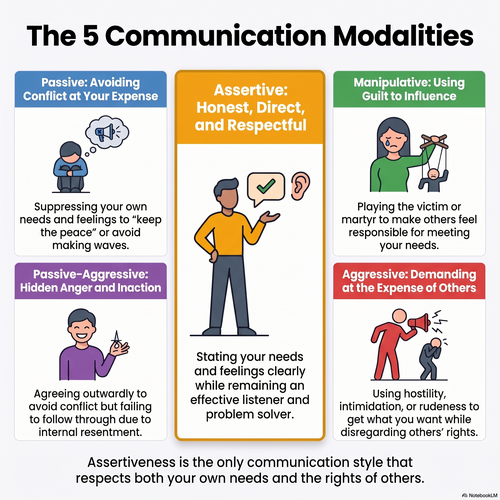
The Five Communication Modalities
To cultivate social self-efficacy, we must first categorize the communication modalities that hinder healthy expression:
- Passive: Characterized by the suppression of needs and the avoidance of “making waves,” this style discounts one’s own value to prioritize immediate (though superficial) relational harmony.
- Aggressive: This modality pursues personal objectives through hostility, intimidation, or the violation of others’ rights, disregarding the reciprocal nature of healthy interaction.
- Passive-Aggressive: A covertly hostile style where conflict is avoided directly but expressed through non-compliance, resulting in interpersonal frustration and confusion.
- Manipulative: This involves utilizing guilt, victimhood, or martyrdom to coerce others into assuming responsibility for the individual’s needs.
- Assertive: The healthy ideal. It involves stating thoughts, feelings, and boundaries directly and honestly, maintaining an unwavering respect for both the self and the recipient.

Comparative Analysis: The Spectrum of Behavior
| Communication Style | Internal Motivation | Interpersonal Impact |
| Passive | Fear of conflict; anxiety relief. | Suppressed needs; others are forced to guess intentions. |
| Aggressive | Desire for dominance or immediate compliance. | Disrespect; high conflict; erosion of trust. |
| Passive-Aggressive | Expression of covert anger; avoidance of direct risk. | Confusion, resentment, and relational instability. |
| Manipulative | Shifting responsibility through guilt/victimhood. | Others feel coerced and burdened; loss of authentic connection. |
| Assertive | Self-respect; clarity; mutual dignity. | Healthy boundaries; reduced stress; sustainable respect. |
The Strategic Necessity of Error Reduction
Assertiveness is a tool for strategic error reduction. Research indicates that when we fail to communicate our internal states, others are forced to operate on assumptions which carry a 50% error rate. This means that without assertive clarity, there is only a coin-flip’s chance of being understood. Assertiveness, therefore, is the practice of providing others with the data they need to interact with us accurately, effectively cutting the rate of interpersonal misunderstanding in half.
The Anatomy of Resistance: Why Assertiveness is Psychologically Taxing
Assertiveness is a complex behavioral challenge because it requires the prefrontal cortex—the seat of rational thought—to override the primitive threat responses of the limbic system. It is not a lack of willpower that makes speaking up difficult, but a sophisticated internal defense system designed to prioritize safety over self-expression.
Evolutionary and Social Inhibitors
From an evolutionary perspective, human survival was historically contingent upon group belonging. Consequently, the brain’s amygdala-driven threat response often treats the prospect of disagreement as a survival risk. We fear social exclusion because, at a biological level, being “disliked” was once equivalent to being cast out of the protective tribe.
Attachment Theory and the Weight of Conditioning
Our ability to assert ourselves is deeply influenced by our internal working models of relationships, often categorized through attachment theory:
- Anxious-Preoccupied Attachment: Individuals with this style may suppress their needs out of a profound fear that assertion will lead to abandonment.
- Avoidant Attachment: These individuals may equate direct communication and vulnerability with a loss of independence, leading them to withdraw rather than state their needs.
These styles are often reinforced by Learned Childhood Patterns. Environments where disagreement was punished, emotions were dismissed, or obedience was the sole metric of worth create neural pathways that associate self-expression with danger.
Cognitive and Systemic Barriers
Furthermore, we navigate the “Selfish Misconception,” a cognitive distortion where setting a boundary is incorrectly viewed as an act of aggression. Systemically, the “Double Bind” theory highlights that the cost of assertiveness is not distributed equally. Due to hierarchy, race, and gender norms, certain individuals face a higher “emotional labor” burden, where assertive behavior is unfairly penalized as “bossy” or “aggressive.”
The Anxiety-Avoidance Cycle
This resistance is maintained by a psychological loop: avoiding a difficult conversation provides immediate anxiety relief. This negative reinforcement strengthens the avoidance habit, making future assertive situations feel increasingly threatening.
Impact on Personal and Professional Well-being
Assertiveness functions as a catalyst for systemic well-being, moving beyond mere social “politeness” to establish genuine psychological stability.
Validated Outcomes
Longitudinal meta-analyses and systematic reviews confirm that a commitment to assertiveness results in significant, measurable benefits:
- Reduced cortisol and stress levels.
- Improved workplace performance through clearer role boundaries.
- Greater relationship satisfaction via the elimination of resentment.
- Enhanced psychological well-being and communication efficacy.
The Reciprocal Nature of Self-Esteem
Data suggests a “mutually reinforcing cycle” between self-worth and social interaction. While high self-esteem facilitates healthy communication, the act of behaving assertively actually builds self-esteem over time. Confidence is rarely the prerequisite for assertiveness; it is the behavioral consequence of consistently acting in alignment with one’s values.
The Assertiveness Checklist for High-Pressure Moments
To ensure your communication remains clear and boundaried under pressure, evaluate your interactions against this checklist:
- Directness: Did I state my need honestly without hinting?
- Respect: Was my tone firm but respectful?
- Brevity: Did I avoid over-explaining or apologizing for my boundary?
- Emotional Regulation: Did I manage my internal state rather than reacting impulsively?
- Acting While Anxious: Did I speak up despite the presence of anxiety, rather than waiting for the fear to disappear?
Assertiveness as the Ultimate Manifestation of Self-Respect
Assertiveness is the refined balance of honesty, confidence, and respect. It is a lifelong practice that signals to the world—and more importantly, to yourself—that your thoughts and needs have intrinsic value.
Contrary to common fears, assertive behavior does not damage healthy relationships; it strengthens them by establishing a foundation of mutual dignity and clarity. By moving away from the 50% error rate of assumptions and toward direct communication, you foster authentic, high-integrity connections.