
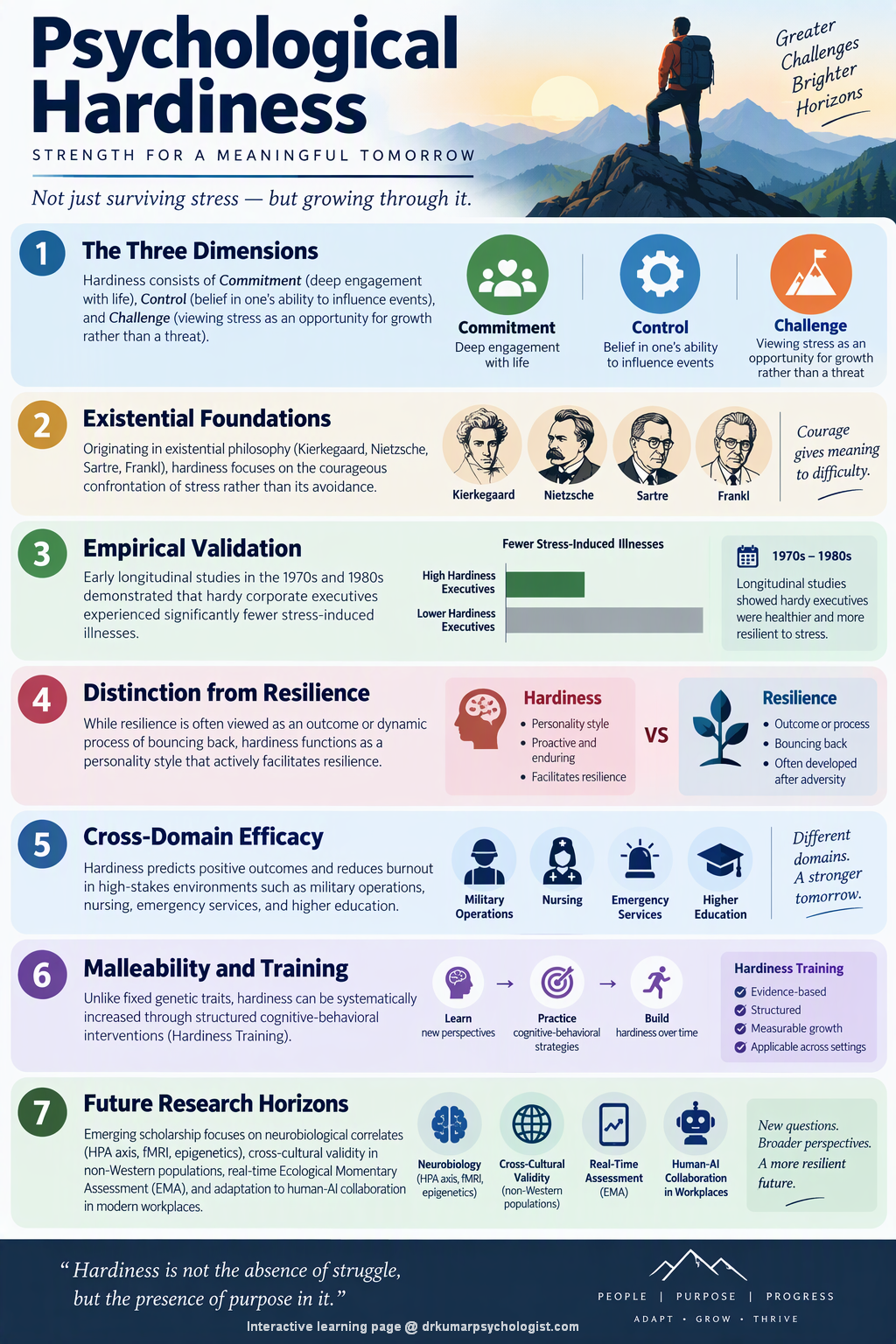
Build a more engaged, agentic and growth-oriented response to stress through the Three Cs: Commitment, Control and Challenge.
LearnPractiseGet feedbackReflectApplyWhat is psychological hardiness?
A personality style that can help people interpret and respond to stressful experiences in ways that support adaptation.
Where did the idea come from?
Developed by Suzanne C. Kobasa and Salvatore R. Maddi, hardiness draws on existential psychology and the idea of meeting uncertainty with courage, choice and responsibility.
Hardiness and resilience
In this framework, hardiness is a personality style or resource that can facilitate resilience—often described as a process or outcome of adapting to adversity.
Learning note: hardiness is a resource, not a promise that stress will disappear or that every outcome can be controlled.
The Three Cs of hardiness
Explore each dimension, then try translating it into a practical response.
1. Commitment
Stay involved rather than withdrawing or becoming detached from life, work and relationships.
Ask yourself:“What matters here, and how can I stay meaningfully engaged?”
2. Control
Recognise the actions and choices through which you may influence events, rather than surrendering to powerlessness.
Ask yourself:“What part of this situation can I influence?”
3. Challenge
View change as a normal part of life and stressors as potential opportunities for learning and growth.
Ask yourself:“What might this experience teach me?”
Turn the Three Cs into action
Work through the scenarios. There is no need to choose a perfect answer—focus on the reasoning behind your response.
You receive difficult feedback at work or during training.
Your first reaction is disappointment. You are tempted to avoid the person and disengage from the task.
Which response best demonstrates all three Cs?
Separate what you can influence from what you cannot.
Imagine you have an important examination or project deadline.
Change the question you ask.
Choose a stressful change you are facing, or use the example of adapting to a new role.
Reconnect with what matters.
When stress rises, people may disengage from meaningful roles and relationships. Use these prompts to identify one small act of re-engagement.
Knowledge check
Test your understanding of the model and its applications.
My Three-Cs action plan
Choose one real situation and create a small, observable action for each dimension.
Your entries stay in this page while it is open. They are not sent to a server or saved to an account.
Where is hardiness research heading?
The source identifies several emerging research directions.
🧠 Neurobiology
Research questions include stress physiology (HPA axis and autonomic reactivity), fMRI studies of threat and challenge appraisal, and possible epigenetic correlates.
🌍 Cross-cultural validity
Researchers are examining whether the Three Cs translate across cultures, including contexts where communal coping and relational harmony are important.
📱 Real-time assessment
Ecological Momentary Assessment (EMA) and mobile health tools may track daily stress appraisals and coping in real-world settings.
🤖 Future workplaces
Hardiness may inform adaptation to automation, AI collaboration, job disruption and continuous upskilling.
🏥 High-stakes settings
Applications discussed include military operations, nursing, emergency services, education and organizational life.
📈 Training and development
Hardiness training explores structured approaches such as situational reconstruction, focusing and compensatory self-care.
A 30-second hardiness pause
Key message: Hardiness does not require you to like adversity. It offers a way to meet it with engagement, purposeful action and openness to learning.
- Bartone, P. T. (1999). Hardiness protects against war-related stress in Army National Guard soldiers. Journal of Consulting and Clinical Psychology, 67(1), 72–82.
- Bartone, P. T. (2006). Resilience under military operational stress: Can leaders influence hardiness? Military Psychology, 18(Suppl.), S131–S148.
- Bartone, P. T., Ursano, R. J., Wright, K. M., & Ingraham, L. H. (1989). The impact of a military air disaster on the health of assistance workers: A prospective study. Journal of Nervous and Mental Disease, 177(6), 317–328.
- Benishek, L. A., Bieschke, K. J., Park, J., & Slomp, M. (2005). Academic hardiness and college-level retention. Journal of College Student Retention: Research, Theory & Practice, 6(3), 295–310.
- Escolas, S. M., Mason, K. A., & Merrill, J. E. (2013). Hardiness and job satisfaction in the military: The mediating role of occupational stress. Journal of Psychology, 147(4), 373–386.
- Funk, S. C. (1992). Hardiness: A review of theory and research. Health Psychology, 11(6), 335–345.
- Kobasa, S. C. (1979). Stressful life events, personality, and health: An inquiry into hardiness. Journal of Personality and Social Psychology, 37(1), 1–11.
- Kobasa, S. C., Maddi, S. R., & Kahn, S. (1982). Hardiness and health: A prospective study. Journal of Personality and Social Psychology, 42(1), 168–177.
- Maddi, S. R. (2002). The story of hardiness: Twenty years of theorizing, research, and practice. Consulting Psychology Journal: Practice and Research, 54(3), 175–185.
- Maddi, S. R. (2006). Relentlessness: The key to resilience in the face of stress. Journal of Occupational Health Psychology, 11(4), 386–398.
- Maddi, S. R., & Kobasa, S. C. (1984). The Development of Personal Views Survey.wyd. Insight.