

solution-oriented thinking – Explained
Ever notice how some people, faced with a setback, immediately start asking “whose fault is this?” — while others jump straight to “okay, what do we do now?”
Both instincts are natural. But only one of them tends to move things forward. Psychologists call it solution-oriented thinking (SOT) — and understanding how it works can change the way you handle everything from a stalled project at work to a rough patch in a relationship.
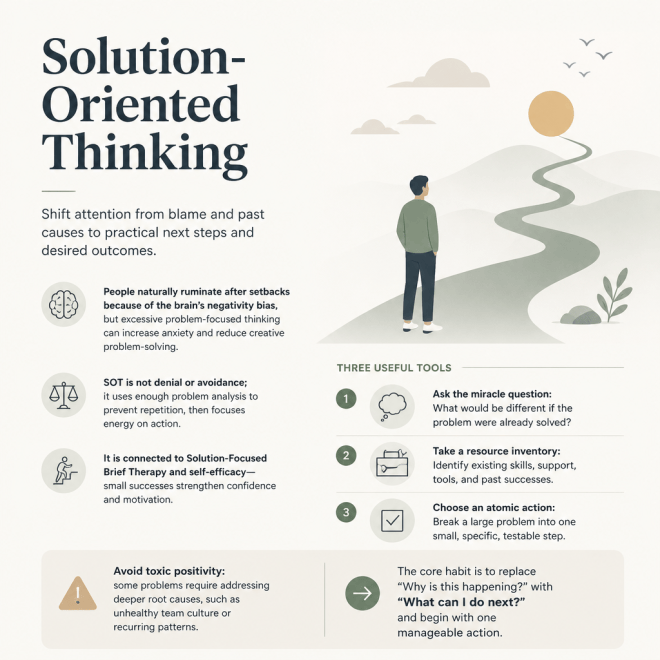
Why Your Brain Loves to Dwell on Problems
Humans are wired with a negativity bias — an old survival mechanism that makes us hyper-alert to threats and causes of failure. Thousands of years ago, obsessively analyzing “why did that predator get my friend?” kept you alive.
Today, that same wiring shows up as rumination: replaying what went wrong, hunting for blame, circling the same thoughts without landing anywhere. It feels productive because it feels like thinking hard. But it often isn’t going anywhere.
What Solution-Oriented Thinking Actually Does
SOT isn’t about ignoring problems or pretending everything’s fine. It’s a deliberate mental shift — from analyzing the past to designing the future.
| Problem-Focused Thinking | Solution-Oriented Thinking |
| “Why did this happen?” | “What can we do about it?” |
| Looks backward, at causes | Looks forward, at outcomes |
| Often triggers anxiety or defensiveness | Builds a sense of agency and momentum |
| Ends in diagnosis | Ends in action |
This idea has real roots in clinical psychology — it draws on Solution-Focused Brief Therapy, developed by de Shazer and Berg, which found that people can often move toward change without first excavating the full history of a problem. It also connects to Bandura’s concept of self-efficacy: the more we experience ourselves successfully solving small pieces of a problem, the more we believe we’re capable of solving the next one.
Three Practical Tools You Can Use This Week
1. Ask the “miracle question.” Instead of “what’s wrong here,” ask: if this problem were already solved, what would be different? Picturing the resolved state — vividly — helps your brain reverse-engineer the steps to get there. Try it the next time you’re stuck: describe the finish line before you plan the route.
2. Do a resource inventory, not a deficiency audit. When something’s not working, our default is to list everything that’s missing or broken. Try flipping it: what do I already have — skills, people, past wins, tools — that I could put to use right now? You’ll usually find more than you expect.
3. Break it into “atomic” actions. Big problems are paralyzing because they’re abstract. Instead of “fix the team’s communication,” try “send one clarifying message today.” Small, testable actions lower the psychological barrier to starting — and each small win builds confidence for the next step.
A Word of Caution: Don’t Let It Become Toxic Positivity
SOT has a real limitation worth naming: if you only ever ask “how do we move forward” and never ask “why does this keep happening,” you risk papering over a genuine root cause. A team with a toxic culture doesn’t need a better to-do list — it needs the culture addressed.
The healthiest approach uses problem analysis to inform the plan, without letting it anchor the whole process. Understand the “why” enough to avoid repeating it — then spend most of your energy on the “how.”
The Takeaway
Your brain’s default setting after a setback is to look backward. Solution-oriented thinking is the practiced skill of catching that impulse and redirecting it — toward what’s next, not just what went wrong. It won’t replace honest diagnosis when a real root cause needs fixing, but for most everyday obstacles, it’s the faster, more empowering path from stuck to moving again.
Next time you catch yourself asking “why is this happening,” try pausing and asking “what’s one small thing I can do about it right now?” That single shift in framing is where solution-oriented thinking begins.
- Bandura, A. (1997). Self-efficacy: The exercise of control. W.H. Freeman.
- de Shazer, S. (1985). Keys to Solution in Brief Therapy. W.W. Norton & Company.
- Fredrickson, B. L. (2001). The role of positive emotions in positive psychology. American Psychologist.
- Grant, A. M. (2012). An examination of solution-focused coaching. International Journal of Evidence-Based Coaching and Mentoring.

How to Shift from Problems to Solutions
The content explores the concept of solution-oriented thinking (SOT), contrasting it with problem-focused thinking, which often hinders progress. It highlights…


Podcast Episode: Hope, Self-Talk, And Time
This week podcaste discusses the importance of positive self-talk in overcoming inner criticism and building resilience. The piece emphasizes accurate…

The Practical Framework for Serenity – A Complete Guide
This guide redefines inner peace as a process of subtraction rather than acquisition, emphasizing that our innate serenity can be…

Understanding Grief: From Rigid Stages to a Dynamic, Meaning-Driven Process
The classic five stages of grief, as proposed by Elisabeth Kübler-Ross, oversimplify the complex nature of mourning. Modern psychology shows…

The Art of Giving Effective Feedback
Effective feedback is crucial for learning and personal growth. It should be intended to help, specific, descriptive, useful, timely, clear,…

Unlocking Your Mind’s Remote Control: How “Anchoring” Works in Therapy
Anchoring is a psychological technique rooted in classical conditioning, allowing individuals to connect specific sensory stimuli with desired emotional states,…
Discover more from Dr.kumar psychologist
Subscribe to get the latest posts sent to your email.
